Observing, Wed 3 Jan 2007

The CSC was partially correct for the evening. I met up with Jackie already at the alternate site on Tyneside. The cirrus clouds were just dissipating, though there was still some high level ice crystals which magnified the glow around the moon. But the humidity stayed reasonable until about 11pm and the heavy winds that were forecast were never more than a light breeze. So considering the weather we’ve been having over the past few months, it was a reasonable observing night.

I set up while Jackie was observing with her new binos. Once I was polar-aligned, I focused on Orion and its glorious nebula. At that time, a friend who’s interested in joining a local astronomy group joined us. Jackie did her usual enthusiastic job of promoting our wonderful HAA club while we both tried to show him some of the constellations and interesting objects that can be seen with binos and scopes.

I also got a new digital camera for Christmas which I set up on a camera tripod. I took a couple of 15 sec exposures of Orion, the moon and Pleiades. Only the Orion shots were passable and even at 15 sec, star trails were evident. I guess the next present will be a camera attachment for my tracking mount – thank goodness my birthday is this month {grin}.

After finding some old standby’s to look at and trying a couple of other objects that I’ve only occassionally seen, frost started to form on the outside of the dewshield around 11:15. So before it started to collect on the scope and ourselves, we packed it in.

It was a joy to get out observing after the long drought. Even better was to have some people to share it with. HAA is a great club.

As a footnote, I went back outside briefly at around 2am and noticed a huge halo around the moon from the ice crystals in the upper atmosphere. It appeared to cover an area of about 30 degrees (if I had been more experienced and thought about it while I was outside, I would have made an accurate measurement instead of guessing after the fact). Not good conditions for astronomical viewing, but an interesting object just the same.

Sunspots II

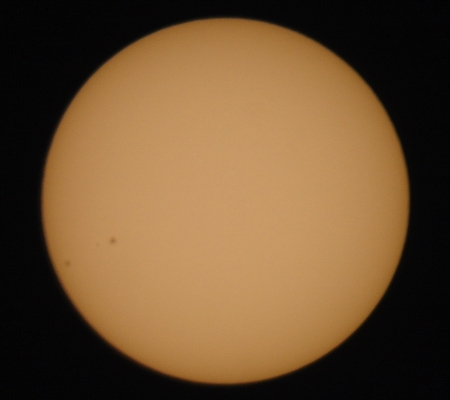
This is a continuation of my previous blog of Jan 1. Jan 2 was another fine morning for imaging sunspots and sorting out the problems encountered mentioned in my previous blog. Good news and bad news about the RA motor drive on my Orion German Equatorial mount. The good news is that it now works, sort of. The bad news is that it only works when I slew to the east. It won’t slew to the west which means it won’t track a celestial objects. Back to plan B used yestereday, ie setting a 10-sec delay, manually pre-positioning the frame, then clicking the remote shutter and pray that when the picture is taken 10 seconds later, the spots of interest will be centred.

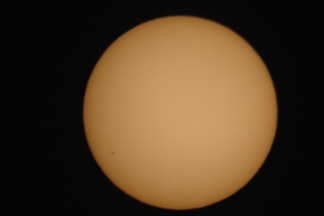
First picture is of entire sun using my V1. Sunspots 830 and 834 are clearly visible, whereas 833 is almost invisible. I increased the camera optical zoom to its maximum, 4X, and took another picture where all spots are easily discernible, as well as a faint fourth. However, that image is in my Gallery at HAA.

V1 image details: ISO 200, F3.5, 1/1000 sec at 9:59 am EST.

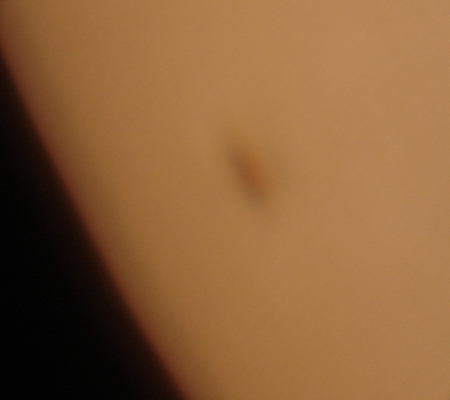
Second picture is a closeup of sunspot 330, the furthest west of the cluster. I chose it because of the difficulty of focusing the others. Now if I had used a reliable motorized mount, the issue would be moot. OK, I’m getting ahead of myself. The forecast for Jan 3 is for clear skies in the morning. I hope to use my tried and true Sphinx mount and see if the pictures turn out better. Stay tuned. Oh, by the way, did you notice that I set the colour setting on my H5 to “Natural” and obtained a more colourful effect?

H5 image details: ISO 200, F3.7, 1/15 sec at 10:39 am.

Sunspot 330 2007 Jan 2,

Sunspots 2007 Jan 1

I had been waiting for a day with clear skies and when sun spots were to reappear. Finally, I got a chance to use some of my Christmas “presents”. One was a 14mm Scopetronix Wide Angle eyepiece with built-in 28mm threads for a Nikon camera. Unfortunately my cameras, a SONY DSC-V1 accepts 52mm threads via a 45.5 mm converter tube (obtained from Scopetronix) and a SONY DSC-H5 which accepts 58mm threads via a SONY-supplied 56mm converter tube. To use the Scopetronix threaded 14mm eyepice, I used more of my presents, two step-down rings which I ordered and received prior to Christmas. A 37-28mm ring and a 52-37 ring allowed me to take images of the sun today with my Orion 100mm ED suitably equipped with an Orion sun filter. Unfortunately, I hadn’t used this equipment for about two years. I polar-aligned as best I could. However, I couldn’t get my RA motorized drive to work after plugging into AC via a 6v DC converter with correct plug. When the clouds arrived I solved the problem during the disassembly. It helps if you push in the “phone” connector to the motor drive all the way in and hear it click.

My first image was of the entire sun using a Scopetronix Maxview 40mm as practice. Difficult to focus using an LCD in daylight. I then replaced the 40mm with the 14mm eyepiece and took a host of images with the 5 MP SONY DSC-V1. Then I replaced the V1 with my 7 MP DSC-H5 with 3″ LCD hoping for easier focusing. Alas, it too was still too bright despite blocking as much of the sun via a bath towel wrapped over my head. However, I took many images using a 2 sec timer delay which made timing of the sun’s image into the centre of the display much easier than the 10 sec delay of the V1. When the clouds came it was time to disassemble and watch the Rose Bowl parade. During commercials I excitedly examined each image. The images using the 14mm revealed four major spots and over 40 others in incredible detail. Curious that although the images of the major spots were in different locations of various image frames, the location of the 40 others didn’t change. What a major disappointment when I realized I had focused on something – dust ? or blemishes ? – on the eyepiece or perhaps on the objective lens or on the sun filter. Oh well, I’ll try again tomorrow. In the meantime you can see my feeble efforts of today and judge for yourself.

V1 image details: ISO 200, F3.5, 1/800 sec at 10:15 am EST.

V1 Sun

I “accidently” experimented with the light source setting on the H5. My previous photo-shoot using the H5 was indoors using incandescent light source setting. I’ll fix that next time too. H5 image details: ISO 200 F3.5, 1/200 sec at 10:36 am EST

H5 Sun

Dynamic Duo!

When I read, yesterday (Dec. 19th), that the Shuttle would undock from the ISS at 5:09pm EDT I wondered if we?d be lucky enough to see them, together. A quick check of www.heavens-above.com revealed they?d be right overhead at 6pm.

Sure enough, as Gail and I scanned the sky from our deck, a light as bright as Venus but with a yellow tint came out of the cloud bank over Lake Erie and headed toward us.

As it closed, we could see there were two lights, one close behind the other. 10×50 binoculars showed the separation to be about 10 arc minutes. I?d be interested to know the actual distance in metres (or kilometers?), at that time, between the two.

Another thing we noticed was how much larger and brighter the ISS appeared compared to our last sighting in the Spring. Also, the impression of speed was enhanced by seeing the two objects chase across the sky, as opposed to a single light. And, knowing there were nine people up there made it all the more impressive. Safe landing STS-116!

SUNSPOTS!

Finally! The sun has some activity. Readers of this website will know from Mike Spicer’s post about a flare that the sun spit out toward the Earth. Today was the first chance that I had to get my PST solar telescope out to have a look at the sun. I was pleased to see that there was something more interesting to see than a clear disk in Hydrogen alpha light.
Just outside of the centre of the sun’s disk is a large sunspot. It is certainly not the biggest spot that I have seen, but it was respectable, considering that there has been no activity there for weeks. In hydrogen alpha light, you can see the spot as a dark blotch surrounded by a very large irregularly shaped lighter area. Interestingly, I could tease out more details if I slightly de-tuned the filter. This brought out detail in the bright area around the sunspot.
The edge of the solar disk was not idle either. There were several very large flares that I could see that expanded out into space. In the past few weeks, there might have been only one or at most two flares. Now I could see lots! I wonder if this is the beginning of the sun starting its active cycle as it heads toward a maximum in the next 5 years or so.
The more that I use the PST, the better I get at seeing fine detail on the surface of the sun.Next, I have to consider imaging through the PST, however, the biggest problem is that I need my computer to capture and process the image. Unfortunately, it is difficult to see the screen of the telescope in bright sunlight. Talk about an ironic situation for an astronomer!
The PST is a great little telescope and it can be set up in seconds. It is the ultimate ‘grab-and-go’ telescope! I am glad I bought it.

Observers’ Notebook

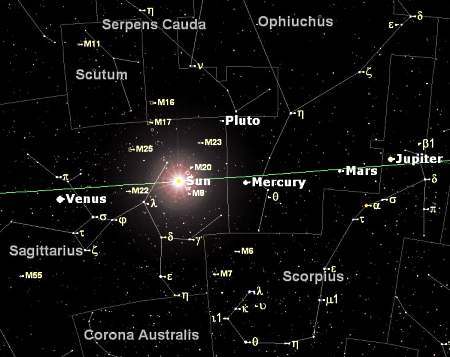
WONDERING WHERE THE PLANETS ARE?

Alas, the chart below shows the positions of most of the planets very close to the Sun in December. Console yourself with evening views of Uranus and Neptune (if you can find them) and early morning views of glorious Saturn:

They are hiding close to the Sun this month

A lesson in humidity

While Binbrook was fogged out, November 24th, Grimsby did not suffer the same fate. Interestingly, I recently acquired a set of three gauges that give my observatory readings on temperature, barometric pressure, and humidity.

When I started observing at 7pm that evening, the humidity was just over 70% and the limiting magnitude was about 4.5. By 9:30pm, the humidity was nearly 80% and only stars brighter than mag. 3 (and higher than 50 degrees) were visible to the naked eye. Between those two readings, however, I did manage to do some useful viewing.

I spent a little while pushing my 6″ reflector through Pegasus and Andromeda, but after checking my log realized I had no entries for Lacerta. Although Lacerta was barely visible to the naked eye, the area bordering Cepheus was easy to locate and the following objects were new finds for me:

IC 1434 – a fairly circular open cluster of about 3 dozen 10-12 mag. stars with about the same amount showing dimly among them. Near the centre of this cluster is a tiny binary that I only noticed with a barlow at 114X. Increasing the magnification to 171X allowed a clean but narrow separation.

IC 1442 – just over a degree NE of IC 1434, this open cluster of about 40 stars has an interesting rectangular shape to it. It also features a bright “waistband” of 3 stars reminiscent of Orion’s Belt.

NGC 7245 – with a 21mm eyepiece, this open cluster almost fits in the same 1 degree FOV with IC 1442. More compact, and richer with stars than 1442.

NGC 7235 – I crossed the border into Cepheus for this one. An elongated open cluster spanning at least 2 degrees, it features a tiny but very appealing carbon star in the middle of the “stream”. There is a whiter star that may catch your eye but tight focus will bring out the beauty in the carbon one.

HD213306 – AKA Delta Cephei. If you’re into pretty double stars then you should have this attractive yellow and blue pair on your list.

LATER THAT NIGHT: Finding myself awake at 5am I toyed with the idea of going out again for, after all, the Clear Sky Clock was reading near perfect conditions – Wrong. The fog had made it to Grimsby.

Clear Skies (Finally)

Clear skies and an opportunity to go to Binbrook for observing – but of course it couldn’t be that easy. Yes, the sky was quite clear, but down closer to the ground we had a slight fog/haze and the half dozen or so of us observing were overcome by dew in just over an hour – despite a wind that was somewhat stronger than forecast and making stars jump around at any higher power. I managed to get about 20 minutes of imaging in before my telephoto camera lens dewed over – and even my Tuthill heated dew shield on my main scope couldn’t keep the dew away. But the sky was clear.

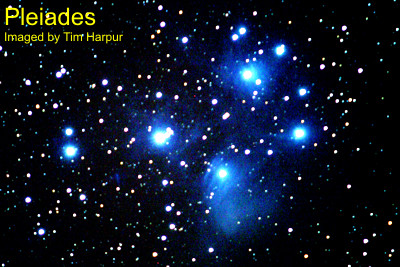
The following (drastically reduced) image of the Pleiades (M45) was taken with a Canon Digital Rebel XTi using an f/5.6 400mm apo telephoto lens piggy-backed on my main scope. A combination of 2x2min, 2x4min, and 2x6min at ISO800.

Clear Skies for a Change! by Tim Philp

Today was a great day of astronomy for me. I started the day with my Coronado PST with some sun watching early this morning. As has been the case for the last while, the sun is a very dull place with no sunspots, however, there was a great solar flare on the edge of the sun’s disk. After spending about a half an hour gazing at the sun in Hydrogen Alpha light, I put things away and waited for dark.
According to the weather reports, there will be several days of clear sky at night! As you all know, that has been very rare recently. I am sure someone must have gotten a new telescope as it is well known that the purchase of a new scope will cause weeks of cloudy skies. OK, fess up, who bought a new scope?
Well, tonight, I hauled out the LXD-750 mount for a night of stargazing in my backyard. Jackie Fulton came over to join me with her little 80 mm Nexstar scope. She even had a charged battery in her car to make sure she did not run out of juice. She was well-prepared for every eventuality… except, she forgot her telescope on the balcony in Hamilton.
Since she had let me use her scope in the past, I decided that fair was fair and I shared mine. Of course, I only had my 6 inch refractor for her to use, not her usual scope.
After a quick alignment, we started seeing objects in the cold clear skies. Mike Spicer’s Skychart in the Event Horizon came in very handy to pick objects for our tour of the night sky. Very quickly we found M42, M45, M35, M37, M36, M31, M103, and M38.
I was especially impressed with the clear view of M42. The Trapezium was clear and the nebulosity was very evident in the views we got. I have left the mount set up for my observing sessions tomorrow night and I plan to do some imaging with both my ToCam Pro and my DSI. I might even try my hand at getting my autoguider to work so I can take some long exposures.
What a great night. I can’t wait for tomorrow evening’s session. I hope to get started early enough to get some good views of Uranus and Neptune.

Events for November