
Wednesday 7th of March 2007 | Bob Christmas
Our own Anthony Tekatch graces the article of today’s Sky & Telescope lead web story – check it out!
http://skytonight.com/news/home/Star_Counters_Wanted_.html
Our own Anthony Tekatch graces the article of today’s Sky & Telescope lead web story – check it out!
http://skytonight.com/news/home/Star_Counters_Wanted_.html
Sorry it took so long – I had a severe system crash and spent yesterday re-installing and restoring backed up files. I just finished data recovery on the memory card and now have some of the (cloudy) images of the last 15 minutes of the eclipse.
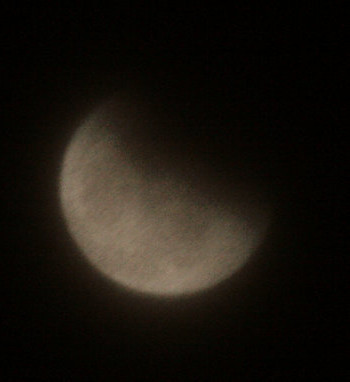
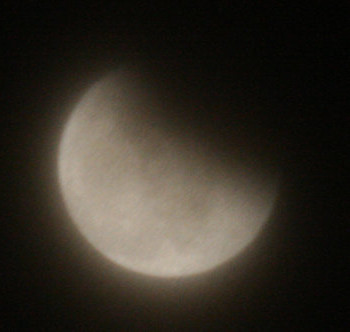
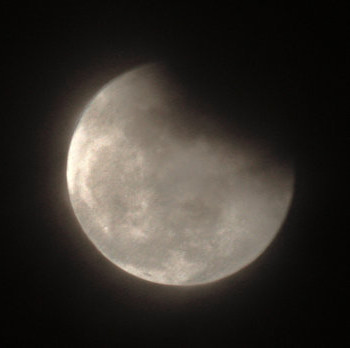

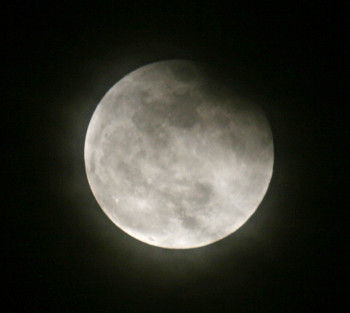
The people of Hamilton ARE interested in our activities. When over 50 guests show up for an event that is so obviously clouded out, you know that our efforts are not in vain. One couple had even come from Toronto!
I received many positive comments on all aspects of the Eclipse Night (as described below), and will just add my thanks to Darla, Brian, Steve and Mary Ellen of the PCDC, and to the many HAA members who each contributed in their own way to make the night another success – you guys are great!
From Mike Jefferson:
“GOES 11,12 reported an energetic spike last night @ ~ 11.00 EST. It may mean long-distance radio problems and satellite communications ————- and, it may mean an aurora!!!”
LUNAR OCCULTATION OF THE PLEIADES, 23 FEB 07
Such a sunny, bright afternoon with the crescent Moon almost overhead…and could you see any of the Pleiades near that Moon, against the bright blue sky? I certainly did not see any stars through the eyepiece of my telescopes (and I tried a few). Here’s an image, reduced to a 450 pixel wide b/w in JPG format:

UPDATE: A GREAT OBSERVING NIGHT FRIDAY 23 FEB
It was cold with a brisk wind from time to time, but the sky was beautifully transparent – great for observing. Some friends were stopping by to observe with me so I set up an extra scope with a binoviewer (no waiting). I did some imaging while waiting for them to arrive.
The air was unsteady at first, so the images of Saturn I obtained were not better than those of last November. There are very few nights of excellent seeing and you never know, the air could settle down like it did tonight.
I tried out a pair of TeleVue 19mm wide field eyepieces, comparing them with a pair of 19mm Panoptics in the Denkmeier – the view was exactly the same, I could even use one of each in the binoviewer! So I have two excellent eyepieces for sale!
From the comments of all my visitors tonight, it’s obvious that aperture determines the best views. No one looked through the 6″ Mak for long when the 11″ SCT showed a much brighter Saturn with so many moons. Tim said he could see Enceladus – a surprise, since it was so close to the planet.
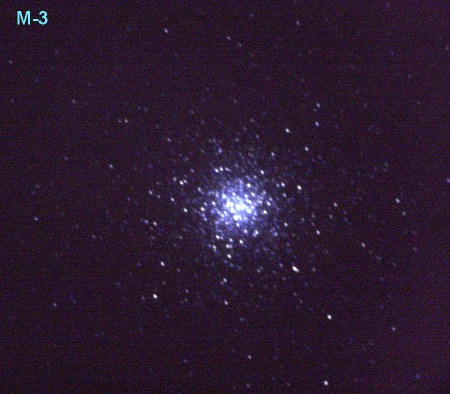
The patio is convenient – easy to come in from the cold. I don’t think we would have lasted long at Binbrook in the wind! I stayed out until 3 a.m. imaging a variety of objects. I wasn’t happy with the M-3 images from a few nights ago so I tried again tonight after imaging some galaxies. Here is a reduced-size/quality shot of a much brighter M-3 without any vignetting:
SMUDGED, YET SPOTLESS, SUN 21 FEB 2007
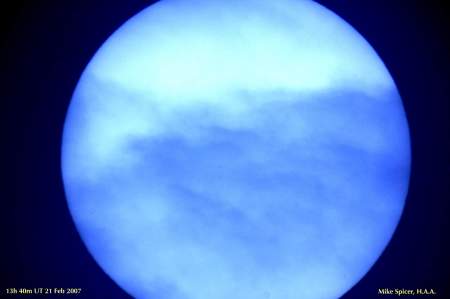
Here’s the sun from a few minutes ago, in much-reduced size and JPG format to fit here. That Clear Sky Clock keeps saying it’s very clear, but aren’t those clouds in front of ol’ Sol’s disk?
IMAGING VARIABLE STARS (“PHOTOMETRY”), 21 FEB 2007
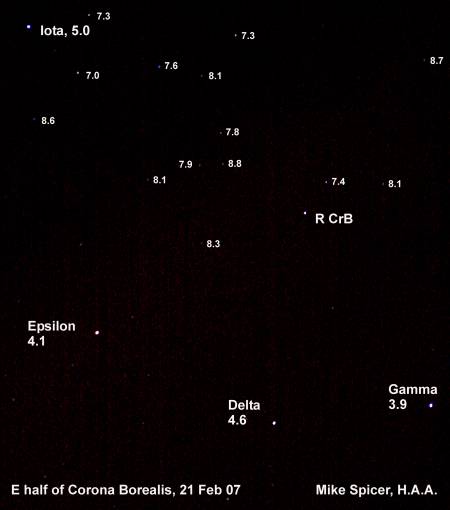
R Corona Borealis is my favourite variable star. After all, it’s easy to locate in the bright constellation of the Northern Crown, and it’s almost always about magnitude 6 – ie: at maximum brightness!
You estimate the brightness of variable stars by gauging them against nearby stars of known brightness. The AAVSO has charts for each variable, noting the most suitable comparison stars. Estimating brightness of stars is therefore part art, part science. It’s one of the more important contributions amateurs make to modern astronomy, well worth trying!
If you have a small telescope, an imaging camera and a V filter (a greenish colour) you can collect images of the variable stars and use the results to more accurately measure the changing brightness of variable stars. This is “photometry” and there is free software that will analyse the images to provide accurate readings. Telescopes and cameras are not just for taking “pretty pictures”.
Here’s an image of my favourite variable star, taken this morning with a V filter. R CrB is magnitude 5.9, or can’t you tell?
DON’T TRUST THAT CLEAR SKY CLOCK
It’s not Mr. Danko’s fault the CSC is misleading half the time… weather is hard to predict. Tuesday night the CSC predicted clear skies and good seeing from 8 pm on… alas, it didn’t work that way. I left a dinner engagement in time to be home at 8 pm… cloudy. Had to pass on observing with Steve K…. cloudy. The sky finally cleared at 2 a.m.
Transparency was excellent! I checked on a few variable stars with big binoculars… R Leonis stood out naked eye bright like a cherry in the sky. Saturn had passed the meridian and was out of reach for my 11″, but I set up a little GT80 refractor with the Rebel piggy-back to take some images of the sky. I tried a 135mm telephoto and then switched to imaging through the scope (using a barlow lens and diagonal). Clouds badgered my efforts. The seeing was poor but I managed a few images, and here is one of M-3, a globular near Arcturus:
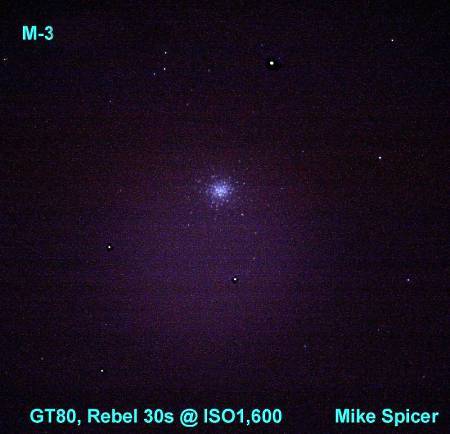
Now, you may wonder why the centre of the image is so bright. That’s what happens when you obtain focus in a small telescope using a 1.25″ barlow lens in a 1.25″ diagonal! Lesson: use a 2″ setup on reflector so you can see the camera screen when shooting. That, and once achieving good focus, take a large number of shots for stacking purposes, to eliminate noise.
Up Before the Sun, 16 February
Scanning the very dark sky before twilight, Jupiter dominates the viw at magnitude -2, just 10 above the SE horizon. At the moment it sits between two ninth magnitude globular clusters, NGC 6235 and NGC 6287, moving closer to the latter with each passing day.
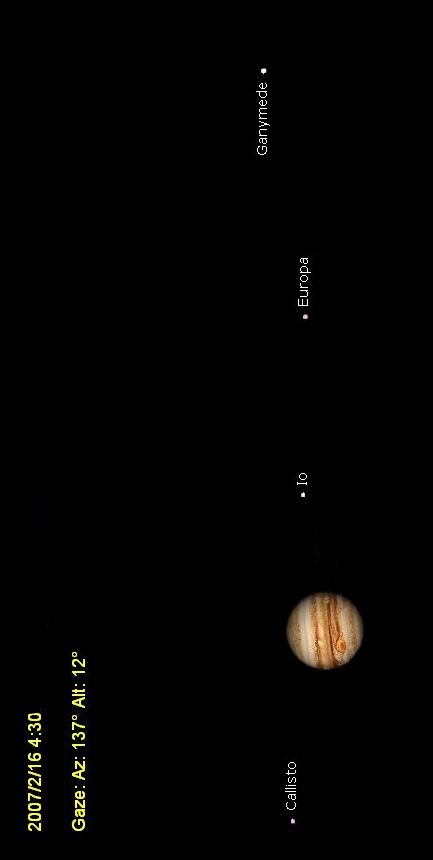
In a 6″ Maksutov with a zoom eyepiece (they’re very good) it is possible to make out a lot of detail even at the lower powers. The moons string out in a line with faint Callisto on the E side and Io, Europa and bright Ganymede in ascending distance from the planet on the W. The Great Red Spot is prominently separated from the SEB with a bright white boundary between them. GRS approaches the planet’s Central meridian and will be on it in less than an hour (5:30 a.m. in fact).
Here’s the scene:
BREEZING THROUGH THE SKIES, 10 February 07
With all the complaints of bad seeing lately, I was pleasantly surprised with the skies over Hamilton Saturday night, 10 February. It was a night of good transparency with long periods of great seeing after 11 pm.
As you’d know if you attended the Feb monthly meeting, Saturn’s about to eclipse the moon Iapetus in a few days. The 10th magnitude moon is half black, half white. Its orbit is inclined 7 degrees to the ring plane, so while we can still see the rings, at the moment Iapetus transits Saturn (or is eclipsed) as it orbits with a 90 day period.
I had a 5″ apo refractor set up before 7 pm and invited members to come over after preparing for a cold (-13C) and windy (20 km/hr) observing night. Jackie took up the challenge. She brought the smallest digital camera I have ever seen, a recent purchase.
Saturn was up in the East before 8 pm and I was delighted to see Iapetus just 51″ N of Titan (easy to find). It was Jackie’s first time seeing Iapetus and she said she couldn’t tell which half was black and which was white. There were a number of other moons in sight: Rhea was on the E side of the planet and when we took some 15s exposures with the Digital Rebel, Enceladus, Tethys and Dione were also visible. Jackie preferred the 3.5mm Nagler to a 4mm Radian (“I like the spacious view”) but I think the best views were in a 10mm SpearsWALER recently purchased from Khanscope. After 10 pm the seeing improved and for the first time this year I was able to see the Airy disk of various stars.
Gamma Leonis turned out to be an precious view. The two components were separated by a blackness that highlighted their golden colours. I tried to get Jackie to play the “guess the magnitude game”, but she was already across the sky, looking elsewhere in her 50mm binoculars. I think our Club 2007 observing project should be a double star booklet, double stars are such fun to see.
Jackie took some shots with her tiny digital camera, too. Then we put the ToUcam on the scope to capture some AVI files for stacking – they turned out ok despite the sometimes shakey seeing. Things got more difficult when we tried magnifying the imaging using 2x and 4x powermates. The ToUcam was now brushing patio stones and I had the darndest time getting a good focus without scraping my knuckles.
Meanwhile, our attention had turned to 5.9 magnitude U Orionis high overhead, like a small red LED at the tip of Orion’s err… club. Jackie looked at the Trapesium awhile; the nebula was extensive in 15 x 70 binoculars but only three dancing stars could be distinguished.
It was cold. Every hour we’d come in to warm up, then go back at it. As Saturn climbed to the meridian, the refractor’s eyepiece got lower and lower until my butt was on the patio stones and it was a cramped observing position to say the least. The TAL eq mount worked flawlessly; being Russian, it seemed to like the cold.
By 1 a.m. we had pictures galore, a couple of movies, frozen digits and a lot of wires all over the patio. All the equipment was brought inside to thaw (“here’s a counterweight… watch your fingers don’t freeze to it”). Then with Arcturus rising high in the East it was time to see R CrB, my favourite variable star (“almost always at maximum”) in binoculars. End of show.
Winter nights can be glorious for observing.