
Friday 30th of March 2007 | Bob Christmas
A new image of the side-by-side open clusters M46 and M47 has been posted in my HAA Gallery.
A new image of the side-by-side open clusters M46 and M47 has been posted in my HAA Gallery.
Click here to see a new digital image with the Crab Nebula (M1) in it, taken by Bob Christmas on Tuesday, March 20, 2007 from Mountsberg, ON.
Not having the energy for a trip to the Planetarium, Gail and I invited Kerry over to check out our observatory. Kerry is just a short drive from us and arrived at dusk.
Since we haven?t had many observing opportunities, lately, I?d pulled out all the toys and, while we waited for stars to emerge, we started the evening with a look at the 5 day Moon with the binocular box . At an altitude of ~60°, the Moon was well up in the sky and Kerry was impressed with how comfortable the mirror design of the binocular box was to use on objects approaching the zenith.
While Venus was favourably positioned I put a green filter on a Pentax 21mm ep and after looking at the planet ?boil? in the atmosphere for a minute, we pushed our 6? reflector up to the Moon. Seeing was quite steady and the green filter was a nice change to the mundane gray of a regular ?Moon filter?. We upped the power, and spent a moment examining a low dark ridge bordering the terminator on the edge of Mare Nectaris.
The stars were out by then so I removed the filter and let Kerry practice aiming the dob using the bulls-eye sight of the Rigel Quikfinder. In Quikfinder succession we looked at Mintaka and Alnitak in Orion?s Belt, and multiple system Sigma Orionis just below it.
After the obligatory stop at M42 we went in search of some clusters.
The Pleiades were an obvious choice and provided a chance to compare views between our 6? f8 scope and the Starblast which is a 4.5? f4. The smaller, faster ratio scope enabled us to get the entire star field in view, and I showed Kerry how to see the warhorse asterism in M45. We then compared views of M44, the Beehive Cluster, and decided that small scopes with wide field of views are ideal for these kind of targets.
While hunting open clusters, we bagged M35 and its small companion NGC 2158, M67, and the popular NGC 457 or ET cluster. By then, Saturn had cleared the walnut tree and we had nice views of its attractions including 3 of the larger moons.
Disregarding the moonglow, we decided to hunt some galaxies and managed to pull in NGC 2903, M81 & 82, M108, and planetary nebula M97. Not bad!
We finished the night as we had begun, with the binocular box. A last, low-power, look at the Beehive Cluster then a final challenge of picking up M81 & 82. With the aid of my laser pointer Kerry brought them into view and added the laser pen to her must have list.
It was the best kind of informal astronomy night of which, I?m sure, there?ll be many more.
KerryAnn invited a few members of the HAA over to observe from her driveway – unfortunately for most they had prior obligations to attend an HAA council meeting and missed out on the opportunity 🙁
Although KerryAnn’s place is very close to the bright Grimsby city lights – it’s high up on the escarpment and well above the majority of the light pollution – it’s not Binbrook, but it is a very nice alternative site. The viewing wasn’t the best last night – with high humidity/haze and the occasional cloud floating over – but even so, we were able to make out some very faint objects – and Saturn presented excellent views in both Kerry’s 6″ SCT and my 80mm APO. When I setup my equipment I could see my breath and gave KerryAnn’s 6″ corrector about 45 minutes before dew would hit (she doesn’t have a dew shield yet) – I was wrong – it wasn’t until near the end of a 3 hour observing session that dew struck.
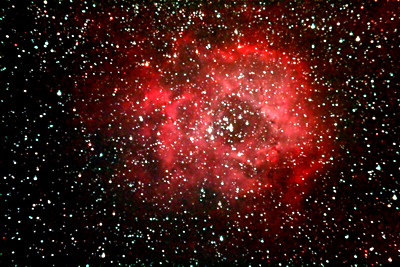
I had originally planned on imaging the Pleiades, but with the moon only a few degrees away I decided to go for the Rosetta (or Rosette) Nebula instead. KerryAnn tried her hand at imaging M1, the Crab Nebula, but due to lack of a guide scope she was limited to very short exposures.
After about 3 hours the temperature dropped and the clouds rolled in – so we decided to pack up.
The Rosetta Nebula (click on Title link for larger image)
imaged by Tim Harpur March 22, 2007
Canon Digital Rebel XTi mounted prime focus with UHC/LPR filter on
Celestron Onyx 80mm EDF refractor
manually guided
3 x 10 minutes @ ISO1600 stacked
Armed with certain knowledge of clear skies, and tentative clues that others would be there, i set out for the alternate site at about 8PM.
I was keen to test my binoculars under different conditions and see if they work better under ‘darker’ skies.
After driving by a few times, i noticed the turnoff and approached with headlights off. Turns out the dome light in my car wants to turn on when the key gets turned off. I will get that right next time.
M45 was high in the sky above a thin crescent moon, which was setting.
I had already completed my MM for this year… Jim was there, with his scope set up. He was picking up Messiers with his 8 inch scope
that i could only drool over with binoculars.
It was very cold though. As Jim was busy doing a telescope-only object, i would jump ahead and try my new red flashlight and star charts on the binocular objects. It did not take him long to catch up. I would have to say that the sky at the alternate location was not much darker than at the farm, and the trees are certainly a lot more troublesome. I think a 2 hour drive up north is in the cards for next month.
There was a lot of play in my tripod. I need one that can rotate without releasing the tilt control. The wind was very light, which helped a lot. The hand warmers got good use. With my star charts i tried hopping to m81, instead of using the interpolation technique i had used before. It is still pretty hard to get there with the charts, although there’s enough detail on them to establish you are there when you get there. The binoculars just don’t show enough of the field of view to move in the charts from object to object. This calls for ‘zoom’ binoculars, i think. I am also considering attaching a smaller lower-magnification pair on the same axis as the big ones.
At about midnight, we established that all the remaining Messier objects were still below the horizon, and packed up. 43 Messiers for Jim. Not bad.
We warmed up at Tim Horton’s in Dundas and phoned Jackie to see what happened to her plans. Turned out she got sidetracked to a warmer observing location. (!)
By Kerry
I had a great short night out last night with the C6 SCT. I had a hard day at work and was really tired and not in the mood to set up…. but I am glad that I changed my mind. My observations will be old news to many of you more experienced types but I just wanted to share.
Last night my site conditions were mag 5.5 (LVM) with some thin cirrus towards the east and it was also a bit breezy. I was set up on my front/side porch with the lights of Grimsby seen below (I’m on the escarpment).
Anyway, I used Mike’s 32mm the most, then the 25mm that came with the scope.
M1- I was so surprised with how bright and big it appeared. For years
I couldn’t even find it in my 4.5 in newt. GOTO is awesome!
M42- so much detail. Almost like a photograph but without the colour.
the 4 stars in the trapezium were sharp and easily seen but a few times
appeared to have lost focus. Not sure what was up with that. Maybe it
is the SCT focuser???
M82- bright elongation with a dark patch/slant almost half way across
it’s length. The dark area was easily visible with slightly averted vision
M81- nice bright core with oval shaped fuzziness around it. I was
expecting that an increase in power (10mm sirius plossl) would cause
it to be very faded but it was still nice and bright.
M96 and M95 could see the shapes but could not make out any detail… Anyway, my toes were really freezing so I didn’t spend much more time trying.
My favorite open cluster for the night was M38. I could not get over the
number of stars that I could see in the 35mm EP. It just filled the
field and was very beautiful.
Saturn – I finally saw a hint of the Cassini Division with the shadow
from the rings. I could make out 2 bands on the planet… it was
pretty breezy so Saturn was not crisp most of the time. I used the
10mm plossl.
Anyway I guess that’s it. I have to say I’m not dissapointed in this 6in. I can’t wait to go to a darker site (Binbrook). I wonder how much more detail I’d be able to see in the galaxies. As for Astrophotography… well of course I can’t wait to get more into that. I’m still waiting for a piggy back bracket and I will need an illuminated Reticle to try my hand at manual guiding. Oh ya someone has to show me how to collimate.
Take care for now and clear skies to all,
KerryLH
I arranged with my buddy Dave to use his back field for the MM on march 17th. He turned off all the lights on the buildings, providing a pretty dark sky.
I could see lights on houses about 400m away but they were pretty easy to ignore. One advantage was that standing near the corner of a building allowed me to be out of the wind.
I have 15×70 binoculars, and planned to only search for the Messier objects designated as visible in binoculars. The binocular mount attached easily to my tripod and did a magnificent job, but it turned out I had neglected 2 important preparations… my pocket sky atlas was in another vehicle, and my red flashlight is still just a twinkle in my eye. As a result, my eyes never got properly dark adapted, and this might have been a factor at spotting some objects. I figured that limiting my efforts to the binocular objects would partly compensate.
However, I did have wall-socket power, and a back-up sky chart book, “Seasonal Star Charts” by The Nature Company (#420) – it has a star wheel on the front, and 8 charts inside… although it did not have a Messier index. I got it at a used book store several years ago, for $3.79 and its value greatly exceeded its price. Unfortunately, it lacked an index, but did list the Messier objects with descriptions and magnitudes, on a per constellation basis. I had to select a number, flip through the various tables and charts, identify the Messier Objects, and then check my list to see if I had a hope of finding them in binoculars. Later I tried selecting a constellation I could see, and looking in the book for what’s available. I re-found a few that way later in the evening, to my chagrin.
My MM got started well before 8pm, with M31 being the first target, as I was of the opinion that it would be setting first. I watched Orion emerge from the blue sky. There was still some sky-glow at northwest direction, and the charts did not offer enough reference to really zoom in for a while. M33 was beyond my ability… with the sky-glow and haze, I could not locate enough visual stars that were on my map to know I had the field right.
I eventually pinned M31 down, and learned a few techniques for star hopping, based on interpolation from Cassiopeia.
Carrying on, I proceeded down the list, more or less in the order they are listed, looking up each on the charts and then planning an approach that made sense. Without a flashlight, I had to figure out what to do, return to the binoculars, and operate from memory. My star charts fit the northern sky into 8 pages, and as a result many binocular stars were not on them.
That’s always the case with any chart, but I would have liked a few more illustrated stars in the binocular field, to help ensure I was on target.
Staying awake was no problem, and the cold did not bother me much either.
I had a chance to use my snow suit to good advantage. One important thing I learned, is that it’s best, when using binoculars, to seek the targets that are not at the zenith. I think a crafted list would recommend the best range of times to look for each.
I managed to fish up 46 Messier objects last night, out of a possible 59. I only found a few in the last 2 hours though, and eventually with the sun coming up the stars started to disappear at about 6:30 am. By then the cows were milked, and it was time to consider breakfast, but the local diner only opens at 8 am. Those that escaped my effort were M33, M79, M78, M94, M53, M64m M83, M49, M23, M55, M15, and M30. Some for lack of ability to find on the charts, some for lack of ability to see something when I was pretty sure I was in the right place. M48 was listed twice in my charts, implying that at least one other one was missing. I found one of the M48’s.
My star hopping skills are much better today than 24 hours ago. I can look in the sky and place the binoculars pretty close to the target. If constellations are reasonably high in the sky I can recognize them and also make sense of which stars are likely to be on the map. Making triangles is my specialty. At least my map had all the visual stars on it.
Next time I could probably fish up about 55 of them, especially with a more detailed star chart. Some of them, I am pretty sure I had the right field, but saw nothing. For others there were insufficient guide stars available to hop.
I thought about going to the alternate site, but I guess I did best to remain at the farm. It was sheltered from the wind where I set up, and that helped a lot. I guess I will try the alternate site at least once to compare the light pollution, and for access to the horizon. I would say the limiting unaided visual magnitude at the farm was about 3.8. It never got dark enough there that I could not see the ground or the tripod.
I can see from Mike’s post that the cause was haze in the sky. I am comforted by this, as it implies the farm is perhaps a better place than it appeared, when sky conditions are better. I would be interested to know how the sky looked elsewhere last night.
The ground was frozen enough to walk far afield, but I did not want to be in the wind, and in general I could fish up most objects by repositioning to avoid the barn if needed.
The binocular-holder gadget I bought from Mike worked very well. I could not have done without it. I think perhaps 10×70 binoculars would gather a bit more light than the 15×70 I have.
Before I read about the haze (see below), I thought it’s time to shop up some binoculars with skyglow filters designed into them. Also hoping a lower magnification would add some brightness to the dimmer stars and objects. For sure, I will continue to use them to see how well they do in better conditions.
I think the MM is a great way to learn star hopping and also to learn a lot of constellations. Fishing up the ones I found last night next time will be the true test of that learning, but more than that, just being able to recognize the constellations and gauge distances on charts is the best reward.
Last night (March 17; St. Patrick’s Day) I was up at my brother’s place near Mountsberg, Ontario, to try out my newest acquisition, a Tamron 300mm f/2.8 telephoto lens for my Canon Digital Rebel 300D.
It is a very difficult challenge trying to find a way to properly mount this thing on my Super-Polaris equatorial mount, but the way I did it last night was OK for then.
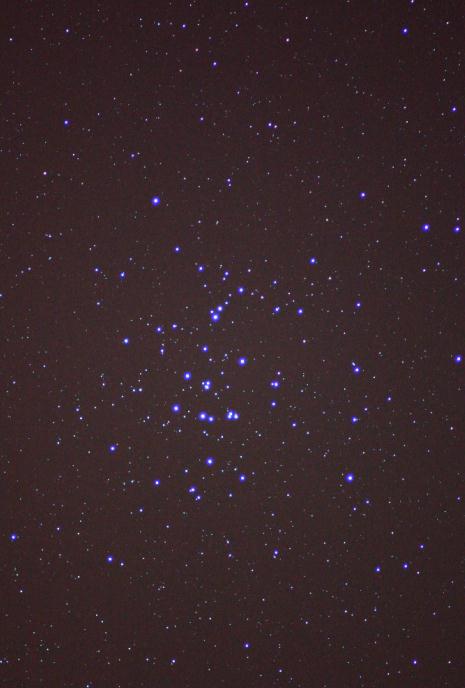
I took several 30-second and 1-minute exposures of M44 (the Beehive Cluster, pictured below) the Orion Nebula and the Pleiades.
I must say, I was quite surprised at how much stuff I was able to get, just from keeping the shutter open by one minute or less! Any more than one minute gets pretty close to the Hamilton-GTA area’s ‘light fog limit’. If it’s this good from anywhere around here, I can imagine what it could do 400 km up north…
The following M44 image is a gamma-corrected, colour-balanced and contrasted excerpt from a 1-minute exposure at f/2.8 at ISO 1600 setting.
Observing Notes, March 13 2007
The Clear Sky Clock called for good views from about 5pm to 9pm, and the temperature was above 10C. Who could ask for more. Well, it turns out that there’s a lot of mud at Binbrook now, and it never even occurred to me that they don’t plow the snow on those roads.
Now that I have signed up my first sponsor…
This evening I joined John Gauvreau’s night-school group and other members at Binbrook. My intention was to refine my skills as a star hopper, using my 15×70 binoculars as my visual aid, and my laser pointer in a pinch.
I arrived at about 7:10 and found everybody already there. The sun was setting. With care you could pick out Sirius in the blue sky. It was not long before the stars of Orion started to be visible to the unaided eye. Thin clouds were present over perhaps 25 percent of the sky, and constellations like Orion were drifting in and out of view. In my case, when looking for Orion’s belt, some help from Jackie with a laser pointer allowed me to see what I could not see a few seconds before. Its amazing how it helped… (or perhaps the clouds drifted away at the right time)
Tonight’s mission was to pick out a smattering of Messier objects, and employ the index, star charts, star hopping and averted vision to prepare for the MM. The emphasis was on being able to seek a designated target.
I tested my ability to align binoculars with something in the sky by seeking the Orion Nebula. I must say that this is the first time I got a full appreciation of the nebulosity without relying on photographs. That’s not bad considering the amount of cloud and haze which at times competed with the low surface brightness objects.
We decided to try to observe Mira… After several attempts, John provided star hopping advice… but it was to no avail. Unfortunately a bit too late to actually see it. It was down too low to the horizon, and the haze was pretty bad.
I continued my mission to observe the various Messier objects, primarily those considered binocular objects.
The Messier Marathon allows about 5 minutes per object. In some cases we were exceeding that.
Of course it was easy to pick out a few of the bigger Messiers, like M45. But some of them were such that I would not have considered it a positive identification. It takes a trained eye to distinguish nothing from something.
Using Orion and Gemini I tried to star hop to the Beehive Cluster (M44). I could see a hint of it in the sky but not align it in the binoculars. Even at 11 pm we could still see all around. (but not read the star charts without a flashlight).
There was a lot of sky glow from Hamilton reflected in the clouds.
I learned a few things…
I probably need a finderscope for my binoculars; a Nexstar scope is not all that easy to align, if it’s daytime or cloudy, and makes a lot of noise when slewing; what looks like a 150 degree angle on a flat star chart turns out more like 110 degrees in the sky. When the wind blows, my tripod shakes, and Sirius makes nice lissajous patterns; I need a gadget to elevate my binoculars higher than my tripod does. I will head for Home Depot tomorrow. I need more than a 4 inch scope, (or darker skies) to pick out the Messier objects considered dimmer than binocular objects, but my binoculars appear to be equal to the task for the 60 objects so designated. There are enough stars in the binocular field that star charts cannot show them all, so it’s not easy to star hop through binoculars. M40 seems to be somewhat of a hoax; I could see more stars than in the star charts, but nothing even remotely cometary. The constellations are actually pretty big;
2 inches on my star charts is 4 inches at arms length; My green laser is likely a 20 mw version; By the time I asked for advice on the Andromeda Galaxy, it had set; and the Beehive Cluster looks magnificent through my binoculars;
Some of the telescope Messier objects are a challenge even with a GoTo scope properly aligned. M56 and M66 gave me a lot of trouble; letting my glasses touch the rubber rings on the viewfinders was a disaster. The smudges on them made clear focusing dependent on exactly what part of my glasses were in the optical path. I will be bringing plenty of lens cleaners for my glasses next time. Also, reading glasses… (and a rocking chair, perhaps?)
I don’t think I can snatch the pebble yet.
The Rangers came at about 10pm and suggested that they might close the park later in the week because of possible damage to the grass.
Jim continued to serve up treats with his scope, calling us over as needed.
I saw a double star (cannot recall which) but the 2 were about a factor of 10 difference in brightness. It was a welcome change to have the scope already pointing in the right direction.
We packed up around 11 pm.
As Jackie observed, there’s a lot of walking around in an observing session. My apologies to the grass… we made quite a field of mud just walking on it.
With a little help from friends, our cars were pushed back onto the roadway.
A rather long drive to the ‘alternate’ observing location afterwards, with a view to possibly doing the MM there if Binbrook is muddied out.
I would recommend setting up on the pavement next time, and parking the cars further down the lane, but leaving one blocking the lane against unexpected vehicular arrivals.
Hi,
Travelling on the 403 at approx. 20:15 Sunday March 11, we saw a fireball. We were perhaps 1 km east of Garden Ave. We saw it over the course of 6-8 seconds. It burned brightly enough to light up the highway (brighter than a full moon). The flame was as green as a stoplight! Felt so close to us that we were frightened that it would land on the highway. It was travelling almost parallel to the ground. Anyone else spot it? I am no amateur astronomer (other than an astrophysics course at Western when I was majoring in Geophysics there). After today the whole family may be converted!!!
Leslie Josling,
Brantford, Ontario