An Astronomical Estate Sale

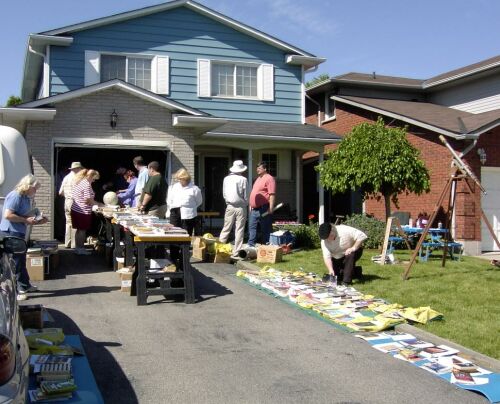
Those who set aside time to attend the Jim Winger astronomical estate sale were well-rewarded on June 9th. The brilliant morning sunshine cast a cheery light upon the rows and rows of books, magazines, and other paraphernalia collected over a lifetime by a man whose interest encompassed cosmology, physics, and electronics.
Ann, Bill, and Alex Tekatch had done a brilliant job of organizing everything into small groups and attaching a form for placing bids in the silent auction. When I arrived, about 10am, several HAA members were already perusing the items that had been neatly arrayed on the driveway and front lawn but, luckily, Ann had decided that the cut-off for bids would be 11am so I had time to check everything out and get busy with my pen.
There was so much quality stuff it was almost overwhelming. A few items though, were particularly ?hot? and prompted good-natured bidding wars with the participants cajoling their rivals to counter-bid.
When time was called, everyone gathered the items they had ?won? and began cashing out. Personally, I ended up with about two dozen books, some of them real gems, and three complete years of S&T ? one of which included the issue from the month that Gail was born which she got a real kick out of.
The usual HAA camaraderie was in abundance, and it was nice to see Charles Baetsen had the time to come down from Peterborough and pick up several nice items.
Even after everyone had gathered up their new treasures it seemed like there was still enough left for another auction. Hopefully, TES (Tekatch Estate Sales) will find new owners for some of those items at Starfest but, if not, they still managed to raise $540 for the HAA. Many thanks to them for all their time and effort; to Lucille Winger for the donation of Jim?s collection; and to the members who helped make the day such a success.
As a bonus, there was a tour of the gorgeous Tekatch observatory. Even at mid-day the Moon was conveniently placed and everyone got to look through a beautiful refractor. What a great way to finish off an extremely enjoyable morning.

A Stimulating June Meeting

Close to four dozen members arrived at the Spectator Auditorium on June 8th, for the last HAA monthly meeting before the Summer break. After picking up a door prize ticket and a super-sized Event Horizon (EH), most made a beeline for Jackie Fulton to reserve a spot on the bus trip to the David Dunlap Observatory. Ticket sales were brisk and Jackie later reported that there were only about a dozen seats left so if anyone wants to go they should contact her at publicity@amateurastronomy.org as soon as possible.
There had been a special request for contributions for the EH and the result was another newsletter full of excellent content masterfully compiled by Tim Philp. The centerfold skychart and accompanying article by Mike Spicer covers the next 2 months as did Mike?s precise ?Sky This Month? presentation.
Ann Tekatch, who with husband Bill and daughter Alex, had collected the astronomical estate of late Honorary Chair, Jim Winger, urged all members to attend the garage sale/auction at their home on the morning of June 9th. Interest for this was high and a good turnout expected.
Next was a report on the Club?s LOFAR II project by Mike Jefferson. Mike brought in the .9 metre antennae that he had painstakingly assembled and was close to operational state.
As a preview of the estate sale, Ann Tekatch had brought in a few books and a poster which were given away as the door prizes, then it was onto the final presentation of the night; a celestial trivia contest hosted by Glenn Muller. After assembling the group into seven teams Glenn teased everyone?s brains with sixty questions ranging from Messier object identification to observatory locations. It came as little surprise that the team with both Ray Badgerow and Bob Christmas on it claimed first place with an amazing 52/60.
As John Gauvreau put it ?Once Ray and Bob got on the same team, everyone else was just playing for second place!? But there was lots of laughter, and much discussion and comparing of scores afterwards when many of the attendees assembled at Kelsey?s on Main where refreshments were served by a courteous and efficient staff.

Hazy Gazing

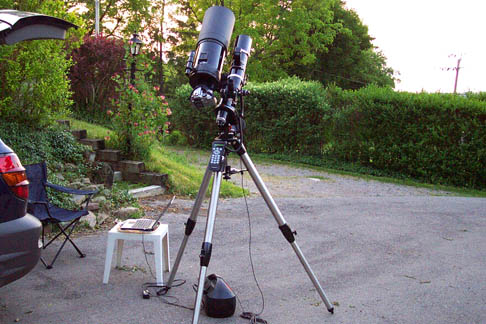
A combination of very thin high cloud, haze aloft and high upper winds made for less than ideal conditions last night. Even so it was nice to have set up the c6 and 80mm for some observing and a little bit of AP.

Targets: M101, M106, Owl Nebula M97, Ring Nebula M57, M81/82, M13, M51 etc.

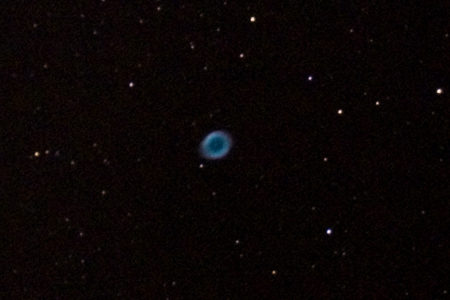
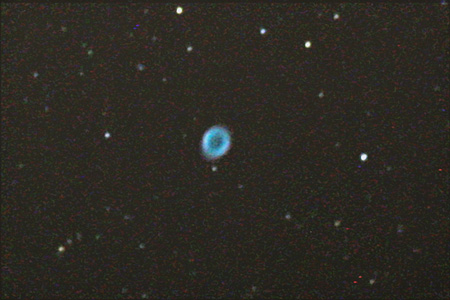
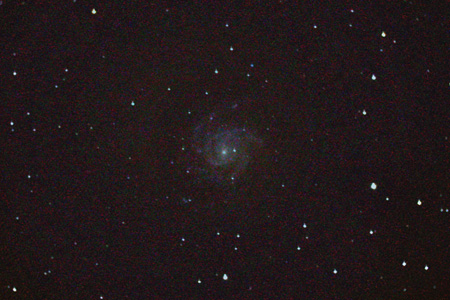
Because of the conditions, many of my favourite targets through the 6in SCT did not look as nice. It was tough seeing detail in M81/82. M101 was barely visible it looked like a large, very diffuse patch with averted vision. I tried some AP with even less luck no matter how long I exposed objects like M51 and M101 I couldn’t make out much detail. The sky conditions washed them out. I aimed my scope for M57 to see if I would have better luck with imaging since it is brighter… and wouldn’t you know there is was for the first time on my camera. A bit out of focus among other things but I’m not really complaining. I’ll give this image another try in the summer.

M57 Ring Nebula through the C6-SGT
By KerryLH

Another addition M101

Observatory Notes

UPGRADES AT THE GARDEN OBSERVATORY, 7 JUNE 2007

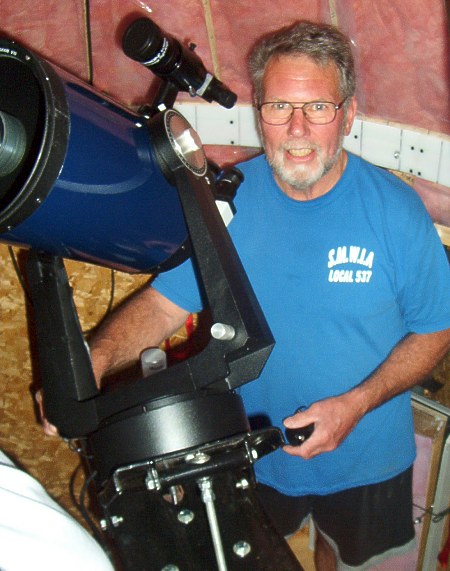
While members of a small local club were at the Steam Museum looking at a hastily set up older model glow-in-the-dark plastic POD, scratching their heads and wondering how their 6 foot 5 buddy could squeeze through its little doggy-door opening, I was observing at the Garden observatory.

Harvey Garden redesigned his observatory to hold a much larger Schmidt Cassegrain telescope on a permanent pier / wedge assembly in his back yard near Binbrook. We observed a number of objects tonight with a high-end binoviewer that he really liked. Of course, Harvey’s new telescope is an older “go-to” model… meaning he is getting very accurate using its setting circles to find objects. It’s great to have a permanently aligned telescope in a backyard observatory at a dark site, eh, Harvey?

So unlike a few others, I had beautiful views of Venus, Saturn and Jupiter tonight without having to squeeze my head through a small doggy-door into a humid glow-in-the-dark plastic POD at the Steam Museum.

Imaging Notes

RE-WORKING IMAGES AFTER TIM’S CLINIC

The software Tim suggested is challenging, but it certainly does help improve images, here’s a re-worked M42 from winter, diminished to 450 pixcels in jpg format:

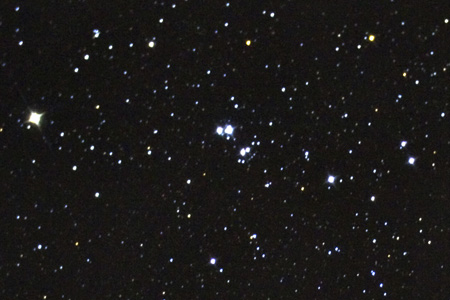
Images of M101 and M67 from Bob Christmas’ May 6, 2007 trip.

I’ve put a wider angle version of my M101 shot from Spectacle Lake that I took on May 6, 2007, in my HAA Gallery page, as well as an image of M67 I took the same night. They’re now the first two entries in my album.

If only every night were clear like this

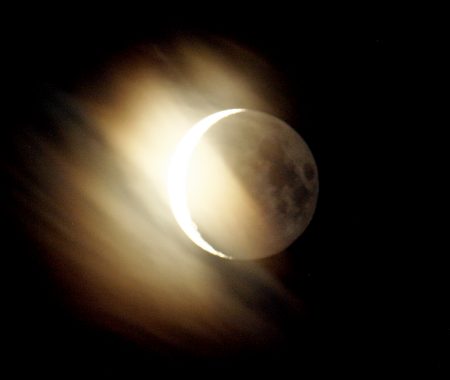
Another excellent night up in Tobermory. This time I started by imaging the setting moon and Venus while my dad and brother toured the sky with my GoTo.

Then I decided to do some visual observing for awhile too – such clear dark skies. Before packing up I shot 3 five minute and 1 ten minute exposure of a portion of the Virgo Galaxy Cluster. On the full sized original I can make out over 30 positive matches for galaxies and about a dozen or so maybe’s.

Virgo Galaxy Cluster (Widefield)

Virgo Galaxy Cluster (Widefield) – labelled – see my gallery for large format image.

New Scopes, New Members, Newcomers at Binbrook

Ideal conditions greeted the 8 observers who came out to Binbrook last night. After turning away some May 2-4 campers, we set up in the parking lot by the boat launch and used the dwindling daylight to check out everyone’s equipment.

Ron Kitchen had recently finished building his 12″ truss-dob and treated me to excellent views of M3 and M13. New members Gary and Cathy Krevenky didn’t take long to assemble their SCT but needed a little help with alignment stars.

Steve Germann was trying out one of Mike Spicer’s loaner scopes, and guest Dean Inglis brought an 8″ Meade LX90. Rounding out the optics were Don Pullen’s 7″ Maksutov, Gail’s Starblast, and my 6″ dobsonian which provided the first views of the night when I spotted Mercury sitting in the haze above Hamilton airport.

It would be a good night for planets as we would also turn our glass to Venus, Saturn, and eventually Jupiter. We caught Io just before it transited the planet and, apparently, Mike Spicer caught it just after it was done. Other targets such as galaxies M65/66, M63, M94, planetaries NGC 6543 & 6210, and globular clusters M92 and NGC 6229 were found and enjoyed.

Just before midnight, Dean reported his scope had dewed up and we decided that it was as good a time as any to call it a night. Several satellites had been spotted and a coyote chorus had intermittently serenaded us. The temperature remained comfortable, the seeing and transparency had been in the upper range of good, and there were no bugs – that’s about as good as it gets at Binbrook and I’m glad we could take advantage.

Oh yeah, we also discovered a brand new, and very civilized, porta-john located by the pavilion at viewing area “B”. Could you ask anything more of a great observing site 🙂

From Dean Inglis;

Hi Glenn,

Many thanks for inviting me to the HAA dark site: well worth the drive, which incidently is 35 min from home contrary to my reported underestimate! I greatly appreciated your hospitality as Chair of the HAA and as a fellow observer.
Having a GOTO is fun and quick, but I was really quite amazed at your detailed charts and pointing out that planetary neb to me with your scope! Last night held several firsts for me: Mercury,Cassini’s division, the Leo triplet +++

Best regards,
Dean

Yes Virginia, there are spots on the sun

Today was one of those rare occassions where I had a quiet day at work and the sky was clear. I decided to bring along my 100mm refractor, camera tripod and a solar filter. I had in mind to do a little solar viewing from the office parking lot.

Around 2:30pm I took a break from work and set up in the parking lot. I had seen some scattered clouds in the west and I didn’t want to wait until the sun set low enough to be affected by them. So with the sun still high, I set up the scope in the lot and took a look at the sun (thank goodness for the diagonal or my neck would be really sore).

The sky was pretty steady for mid-day which was nice and the breeze was light. I was very pleased to see a cluster of sunspots just off the equator. There were 2 medium spots and 3 or 4 smaller ones all grouped together. I started with my Skywatcher (Synta) 20mm LET eyepiece to give me a wide view. I then tried to zoom in on the spots with my 9mm LET, but I couldn’t get a good focus. I remembered I had borrowed a 12mm Xcel from Mike Spicer so I gave that a try. It did a great job of bringing up the spots in more detail. I could see some detail of the spot edges which was great considering the camera tripod isn’t the most steady mount I own.

I pulled out my camera to try and take some photos through the eyepiece by hand. Unfortunately I forgot to bring the transfer cable, so if the photos worked out, I’ll have to post them later. Maybe some other intrepid club member had the same idea and might have a few good photos to share.

Cluster of sunspots

A few curious people stopped by to take a look while I was observing. They were surprised that someone would look at the sun. And without exception, when they saw the sunspots, they asked if it was dirt on the lens. (I eventually got paranoid and had to double-check to make sure I wasn’t seeing things >just kidding.)

Eventually the work called me back to reality and I packed up. It was a nice afternoon break from work. I hope this evening at Binbrook will be just as rewarding.

Images from Tobermory

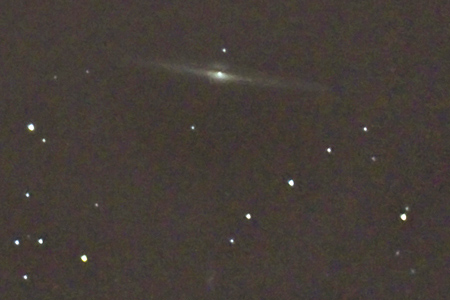
The sky was hazy and very unsteady when I set up last night – I thought the CSC may have been wrong again – but by the time I finished aligning things had settled down considerably and the haze was mostly moved to the distant horizon. I only imaged M101 (Spindle Galaxy) and M51 (Whirlpool Galaxy) – although actually both widefield images yielded about 6 or so positive’s for other small gallaxies. I then decided to snap of an image of the setting Venus – it was casting a bright beam across the water. The beam was actually about twice as bright earlier but my camera was busy on my main scope and I didn’t want to disturb it.

Spindle (Widefield) – 3 x 4min and 1 x 5min @ ISO1600 on 80mm APO

Spindle (Cropped)

Whirlpool (Widefield) – 3 x 5min @ ISO1600 on 80mm APO

Whirlpool (Cropped)