A Wonderful Day and Night at Binbrook

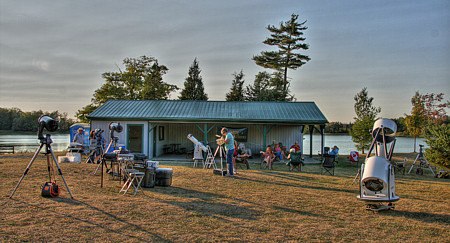
It is easy to conceive that Binbrook Conservation Area is an under-used resource when you only see it at night. That illusion was shattered, in a nice, way, when HAA members showed up on the Sunday afternoon of Labour Day Weekend for a picnic. The beautiful weather had brought families out in droves and it was fortunate that the HAA had the foresight to reserve a pavilion for the day.

Gail and I arrived about 2:30pm, left a Club cheque at the gatehouse to cover costs, then politely asked a family to vacate the afore-mentioned pavilion on which we hung the HAA banner. Turns out, though, that it was my white scope that members homed in on as they arrived shortly after.

By 4:30pm, just over a dozen of us were scanning the Sun for spots (two tiny ones) and flares (3 nice ones) after which we went on a Solar System hike. This consisted of hanging small placards, representing the Sun and planets, from tree limbs along a trail at intervals to scale with their actual distances. While the inner planets were all within 2 dozen paces Pluto was over half a mile away. It was a great way to explore areas of the park we had not previously seen. As we retraced our steps, we saw other strollers stopping to read the cards, their interest obviously piqued.

Everyone had brought a picnic supper, and some extra nibblies to share, and it was nice to see a couple from Brantford, who wished to join the Club, fit right in.

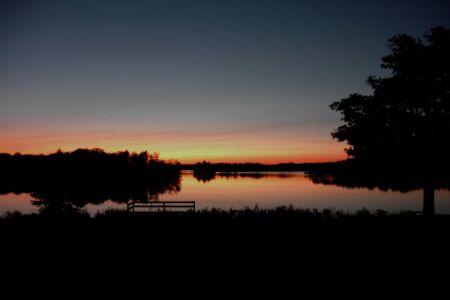
By 7pm, several more members showed up to take advantage of the exceptional conditions for observing and imaging until shortly after the Moon rose, about 11:30pm. While I only remembered my camera as the Sun set (see picture below), I hope that others will post their pictures of what was another memorable HAA event.
Update by Tim Harpur
We couldn’t have asked for a better day (and night) for the HAA picnic.
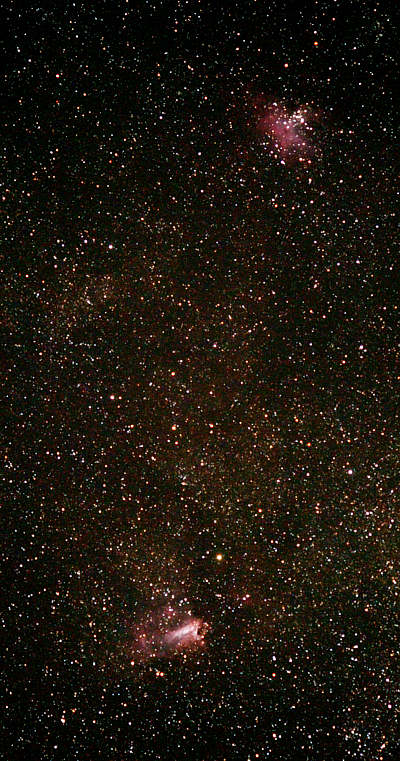
After taking a short walk through the solar system and eating – I set up for imaging through my 135-400mm telephoto APO lens. I mainly imaged wide field of the lagoon, trifid, eagle, and swan. The following image is the Eagle (top) and the Swan (lower) imaged at 168mm f/5.6 – 2 minute exposures stacked.

Friday night in Grimsby

I opted to join Glenn and Gail at their dobservatory since they are only a couple of minutes drive away, and there would only be a limited time for DSO observing before the moon rise. As always it was a very relaxing evening. I usually bring the bare bones with me in terms of gear since Glenn has a really good line up of interesting objects to view through their 6in scope. That evening, I was really impressed with the incredible sky conditions especially considering they live right in town. I was able to clearly make out the milky way through most of the evening, even as the moon was getting up to 20 deg above the horizon. We ended off the observing session with the moon, where we spent some time along the terminator.

Tonight should be another great night and since I will be going to Binbrook tomorrow, I may just opt out again tonight and set up from home on the driveway. Nothing like the comforts of home and crystal clear beautiful night skies.

Glenn’s Addendum:

Gail and I always enjoy Kerry’s company and enthusiasm for astronomy. Our sessions take the form of conversation as we “stroll” across the sky stopping occasionally to take in items of interest.
Last night we compared views of objects we had seen at Starfest noting, in particular, how light pollution can give them a different look.
One new object, that I hadn’t logged before, was open cluster NGC 6802 in Vulpecula. Not what you might call a showpiece, perhaps, but still worth a look and an item I will likely check out for comparison if the skies cooperate at Silent Lake next week.

The Lunar eclipse from Burlington

I awoke early and packed the car for the trip to Binbrook.

Then i decided to try to observe the eclipse from Burlington.
Starting at about 5 am, the moon was very bright and half obscured by
the Earth’s umbra. With my glasses on it was so bright i got double images
and a lot of glare.
As totality approached, it dimmed nicely until i could view it without
the glare. I forgot that due to the size of the earth, the umbra is large compared to the penumbra. Probably the earth’s penumbra is about as wide as the moon, considering the geometry of a solar eclipse.

I quickly constructed my tripod and put my finder-scope on it,
equipped with a zoom eyepiece. The moon was setting fast behind
the houses and trees.
I was able to view the eclipsing moon clearly as totality approached, and
even managed to snap a few time exposures with my pocket camera.
Alas it came too fast for my DSI so that’s going to have to get first light on another occasion.

I noticed Orion and the M45 overhead, and that the sky was starting to brighten for dawn.

The edge of the moon still illuminated was very bright and sharp,
but it also had a kind of shimmering nature to it, as if the
sharp edge of the moon against the sky was moving just a little,
like the surface of an ocean.
The time scale of the motions seemed to be 1-2 seconds, not the rapid
scintillation i am used to from stars.

The moon faded into low cloud just after totality, and i lost it,
but i did get a good impression of the rapid dimming towards the end.
I was surprised to note that even though it was all within the umbra, parts were still darker in the middle of the umbra. The moon lit by a circular
arc of sunsets from half the world made a nice sight.

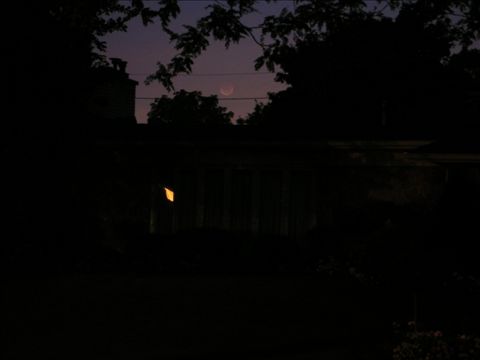
A photo of the moon across the street, above houses, power lines and trees.

I put my pocket camera on my tripod and made this 4 second exposure near the start of totality.

Eclipse views

One of the nice things about eclipses is that no two are alike. This morning’s lunar eclipse certainly had its own unique flavour.
I didn’t have transportation to the alternate site to join our fellow intrepid observers, so I observed from my neighbourhood here in Dundas. The partial phases were high enough in the sky to see from my home. I have always thought that a scope is the best way to photograph an eclipse, but binoculars often give a better view, so I used my 15×70 binos for some lovely views. As the moon got lower I was surprised to encounter my next door neighbour outside at 4 in the morning and let him look through the binos too.
As the moon got lower I set off on foot to view totality from a nearby cemetery that has a hill. I had hoped that the elevation would give me a good vantage point but I quickly abandoned it due to some very poorly placed trees (no, the spookiness of being alone at night in a cemetery was not a factor. That’s my story and I’m sticking to it!) I walked on to a park at the base of the hill (I love the leisurely pace of lunar eclipses that allow you to wander like this) and found a spot to view and take a few pictures from. The spot had already been found by another observer who was armed with Canon 15×30 image stabilized binoculars. We traded views through our binos and although I have always been impressed with the IS binos, the view of the dim eclipsed moon was greatly enhanced by the larger aperture of my good old 15×70 Oberwerks.
In the light of morning I had my third encounter of the day when walking home. A gentleman was out tending his garden and upon seeing me walking by with camera bag, binocular and tripod asked if I had observed the eclipse. We had a nice chat during which he explained that he had just bought a cheap department store telescope but had not assembled it yet. I offered tips, cautions and, of course, and invitation. He, along with the others that I met, was given info on the HAA and encouraged to come out to our very friendly club. Amateur astronomy and amateur astronomers are all around us. How nice to come upon some of them by chance.
I don’t have one of these new fangled digital cameras, so you’ll all just have to wait until I get my film developed to see my pictures. I hope that your eclipse was as good as mine.

Lunar Eclipse

Ok… yes I am crazy! I woke up really early with the intention of going into Binbrook… if it wasn’t fogged in. At home it was perfectly clear until I drove out onto the road. Then a wall of fog hit. I called work (in Oakville) to see what the sky conditions were there and it was perfectly clear and fairly dry. So I decided to head in early so that I can set up in the parking lot. Turned out to be a great idea since I didn’t have to rush anywhere for my 7 am shift. A few people came out and enjoyed the view and told me how nuts I was.

Lunar Eclipse
By KerryLH
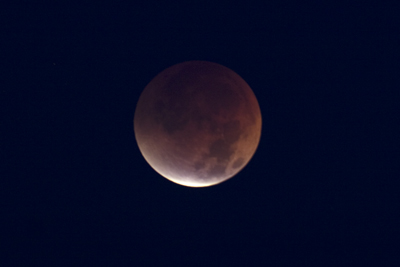
Canon 300D on the Sky-Watcher Equinox 80mm telescope

Update by Tim Harpur
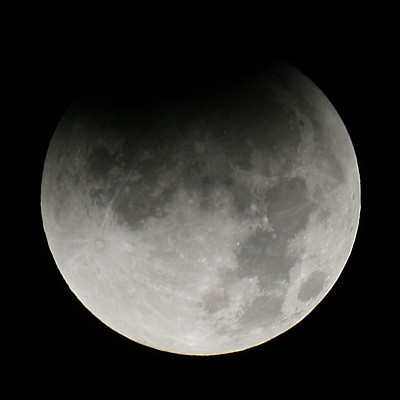
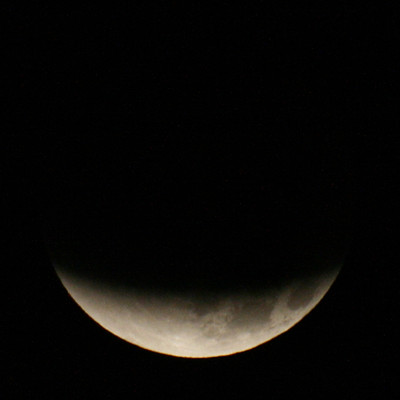
I managed to image from my appartment balcony – it started clear – the middle was clouded – then ended clear again. I didn’t bother to use my tracking GT mount – instead I just set up my on my camera tripod and used my 400mm telephoto lens. I made a short video of shots taken roughly every minute, but even reduced to 200×200 it is 1.36MB so I can’t post it here (it has now been posted on the main page below the CSC) – instead, here are a couple single shots. (Note: Unlike Kerry’s images which show nice detail of the redenned eclipsed area, my images only show the shadow over-taking the moon. I had kept my exposures to 1/60th of a second to avoid trailing as I wasn’t using my tracking mount – I was just informed by Kerry that at these powers an untracked photo can be exposed for much longer – her shots are also untracked – but for 2 seconds. Good to know! I’ll have to do some more tests with un-tracked imaging)

Starfest Images by Bob Christmas

I posted five of my images I took at Starfest earlier this month. If you go to my HAA Gallery page, these are the five thumbnail images on the top row. Click on each for larger views.
Even larger versions of these will be posted on my own web page in the not-too-distant future.

An Interesting and Remote Pair in Cepheus

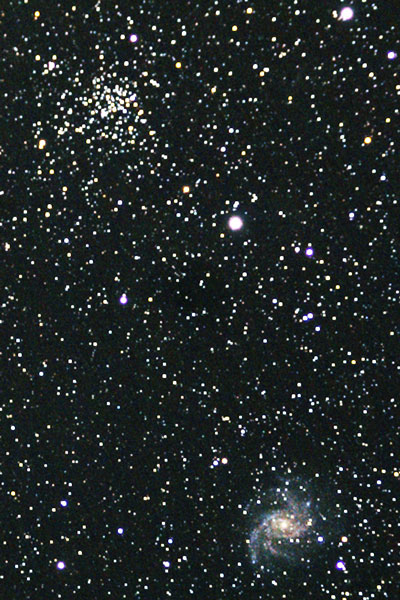
Open cluster NGC6939 and galaxy NGC6946 imaged Thursday night from home with my 80mm scope.
20x3min+darks stacked in Deep Sky Stacker and processed in PS.

By KerryLH
Link to the widefield version gives you an idea of how small they are. http://www.weatherandsky.com/Astronomy/August2007/ngc6939_6946.jpg

While imaging I was enjoying more DSO hunting through the 15×70 celestron binoculars… I was really happy to see M33 which wasn’t even that high in the sky.

That night I saw more meteors than on the peak day. Also noticed one that made an extremely bright flash. I wonder if this is the same one that Tim mentioned when he was up in Tobermory… We both noticed it at around the same time (around 12:30)

Have Scopes Will Travel

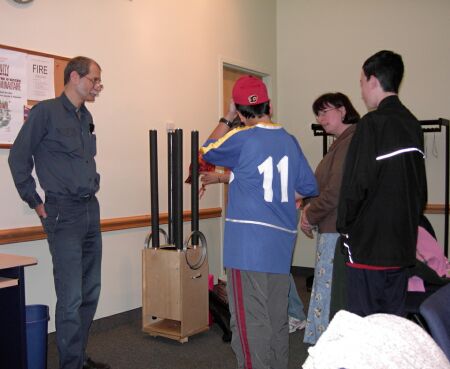
The HAA Traveling Road Show made two stops this past weekend and entertained would be amateur astronomers from Hamilton at the Parks Canada Discovery Centre (PCDC), and from Brantford at the Brantford Tourism Centre (BTC).
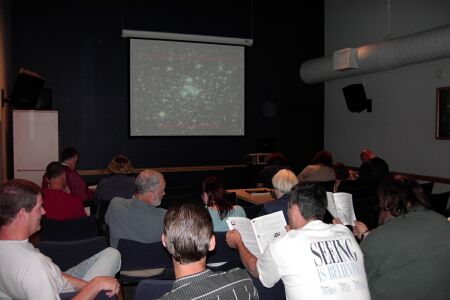
Friday night at the PCDC saw a crowd of about two dozen guests enjoy presentations on observing by Tim Philp, Glenn Muller, and Mike Spicer. Gusting winds outside made observing difficult, but not impossible, and Glenn, Mike, Steve G, and Kerry LH provided views of the Moon, Jupiter, M13 and Albireo.
The highlight of the evening was the bright overhead pass of the ISS and Space Shuttle combination.
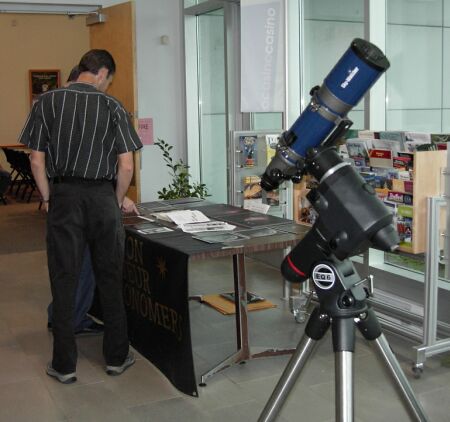
On Saturday, a crowd of about thirty guests who had read Tim Philp’s astro-column in the Brantford Expositor joined HAA members at the BTC to find out more about astronomy and the HAA. On the display table were information booklets and examples of Tim Harpur’s beautiful astrophotography.

Tim P gave an informative presentation and Glenn spoke on the benefits of joining a club.

The weather was even less cooperative than Friday night but the Tekatch’s, Don Pullen, and Glenn set up their scopes anyway for a Q&A session.

Thanks to all those members (mentioned or not) who showed up with their knowledge and equipment. Your efforts were appreciated by all who came out 🙂

Satellite Watching

Help me identify this object! I got home last night in time to go out and watch the International Space Station and the shuttle go past, and stayed outside afterwards with my binoculars for some observing. The ISS/shuttle configuration was dazzlingly bright at about mag.-4 and right on time (of course!) passing nearly overhead at 9:57pm, but then 6 minutes later another satellite of about magnitude -2 (best guess) went by, following a nearly identical inclination. It started in the NE and traveled up towards the summer triangle but passed just NE of Deneb, when it faded as it passed into the Earth’s shadow. So what was it? I don’t know. Although there are lots of things flying around up there, I cant figure out what else could have appeared so bright. It was not in the same orbit as the ISS (during the 6 minutes since the station passed, the Earth turned to the east so any object following in the same orbit should appear west of preceeding object, right?). Suggestions are more than welcome. And yes, the rest of the night was lovely, with many object appearing beautifully in my binos and even Jupiter’s moons showing very nicely. There are more opportunities for you to see the ISS and shuttle tonight and a lovely overhead pass tomorrow night. Check heavens-above.com for times and maps.

Milkyway Collage

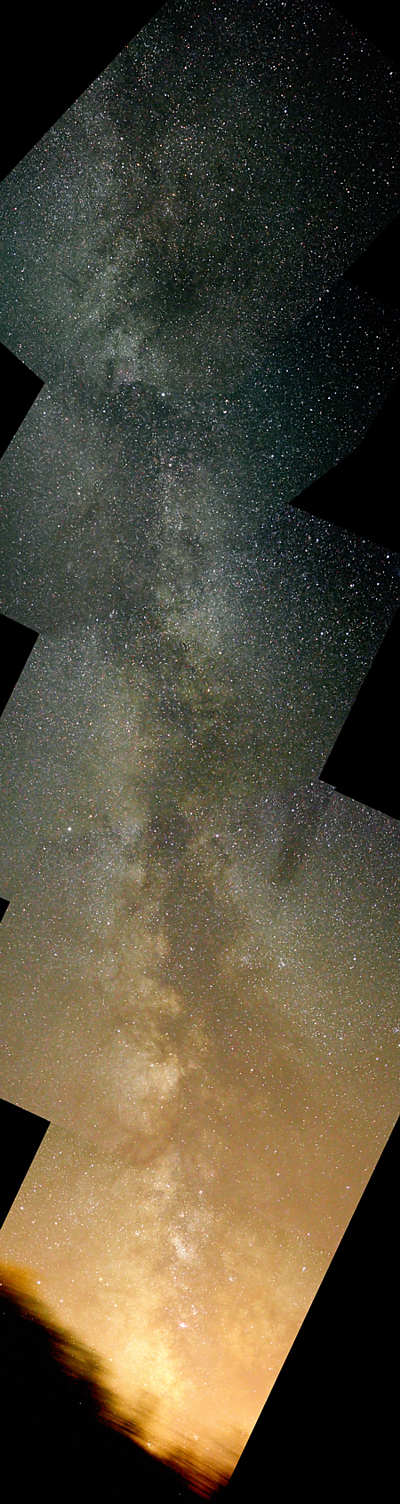
So I spent 4 late hours imaging the Milkyway using an 18mm-125mm zoom set to 30mm f/4 – 6 frames – each frame is a set of 3 x 10 minutes at ISO 400 stacked. Then spent 2 days rotating, stitching, blending, colour balancing…. to get the following image (reduced to less than 2% original size):

Personally, unless printing large scale, I prefer the single frame 10 minute exposure using my 10mm-20mm ultra-wide zoom set to 10mm f/4 (image posted a few days ago) – it looks as good on small scale, no blend lines, and saves quite a bit of time.