The Continuing Saga of Comet Holmes

It was clear last night, of course. That’s because I hadn’t expected it to be and hadn’t made any plans. The fact that our main scope is temporarily down until Monday is also a major factor, I’m sure. The astronomy gods love taunting me.

The first thing I did when I discovered it was clear was to grab Alex, our binoculars and the laser pointer (thanks again Steve!!) and dash outside to show Alex the comet. It was late and she was only moderately enthusiastic. I was afraid it would cloud over any second, but there were no clouds. Amazing. I was surprised to see that Comet Holmes had gotten so big and dim since the last time I’d seen it. However, it was still visible naked eye in the light pollution and prominent in the binoculars. Alex was impressed.

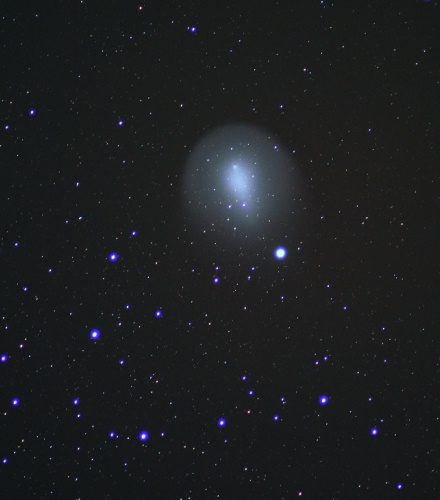
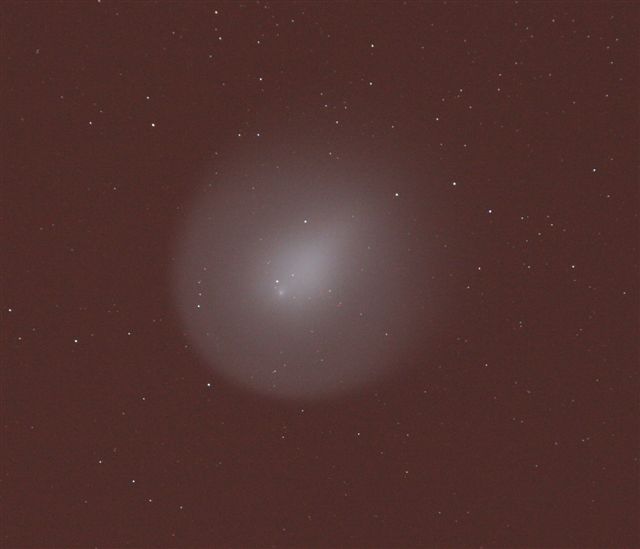
I had left my CG-5 mount set up and aligned in the SkyShed from the last time I was out there a week ago, so I grabbed my 4″ scope and camera and dashed out. I spent the next two hours re-aligning my “already aligned” mount (@#%$!), then taking photos of the comet for about two hours. I’ve included one of them here. Unprocessed and compressed for your viewing pleasure. Exposure was 30 seconds, ISO800, f/6 500 mm (4″ refractor). I took a number of these as well as some dark, bias and flat field frames. I will post the stacked, processed image once I have a chance to.

Cheers,

Ann

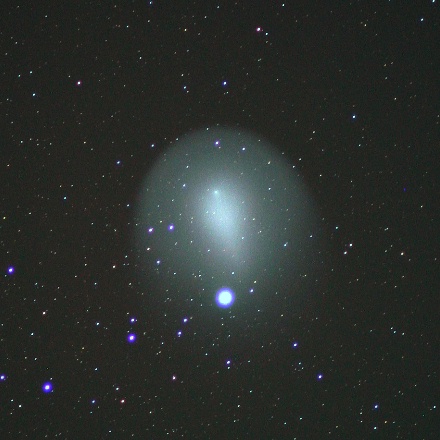
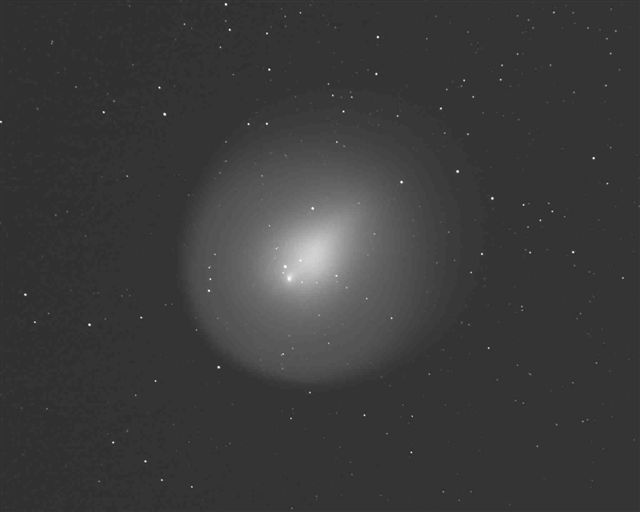
Update: I’ve posted the stacked and processed version of this photo below. There is a bit more detail visible. I think the concentric rings in the halo are an artifact of the processing stage. Comments?

Stacked and processed Comet Holmes image

Grazing Lunar Occultation – try # 3

Well, we’ve been clouded out for our last 2 attempts to see a lunar grazing occultation. Thanks to a great contact, I’ve been made aware of another occultation coming up on Nov 17 (thanks Brad). Will 3 times be the charm???

A regular occultation is when the moon passes in front of a star and blocks its light. A grazing occultation (GO) is special in that the edge of the moon passes in front of the star. By being properly positioned along the path, you can observe the star wink on and off as it passes behind lunar surface features such as mountains and valleys. Astronomers have used this method to determine dimensions of lunar features and the apparent diameter of the star.

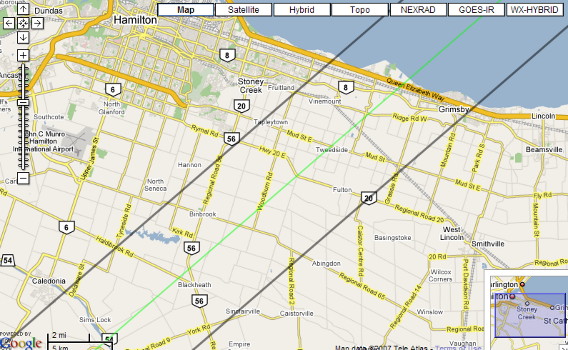
The path of the next GO will be moving through our area at 8:50 pm on Nov 17 (18 Nov 1:50 UTC). It will pass close to Binbrook Conservation area which is one of our favourite viewing locations. However, it won’t be positioned quite as close to the path center as our last attempt. From our regular observing location, we would be barely within the 5km viewing path. This is far enough from the path center that we’d lose some of the effect and details. Therefore we may want to consider observing from a different location along the path. The star to be occulted is SAO 164750, which is a mag 7.8 star. Not visible to naked eyes, but should be easy with binoculars and small scopes.

I’ve added an image of the map with the graze path on it. We are still working out our plans on the actual location where we’ll set up to observe this occultation.

I’ve also provided a link to Google maps which shows the path. Be aware that this page may not load properly in all browsers. I find that I have generally had good results with Firefox. IE has generally been less successful. Your mileage may vary.
Grazing Path

Update: 12 Nov 2007
The current long range forecast (TWN) is calling for variable clouds, 20% POP, low temp of -3C, winds 20km/h from the west. Sunday is currently forecast to be clear – we may get lucky if the clearing trend arrives earlier than expected.

The moon will be about 40-45% illuminated. If I’m reading the charts correctly the occultation will begin in our area at around 20:47. The moon will be positioned 24 deg above the horizon and the azimuth will be 218 (SW) (This means we’ll want to be south of the city along the path for observing). The occultation appears it will occur on the sunlite side, at the SE edge of the moon.

We also have the opportunity to view Neptune which will be mag 7.9 nearby and we’ll be getting into the peak days of the Leonid meteor shower. (peak is expected Nov 18-19) So if the clearing breaks don’t allow us to see the occultation, we may have an opportunity to see some other things in the sky on Saturday night.

Observing location still to be determined. Stay tuned.

cheers

Can you see a tail?

I took this image of Comet Holmes last Friday and then majorly stretched (enhanced) it to see if I could see a similar tail to what I have seen in some very recent images online.

2 min exposures totaling ~48min with the Sky-watcher 80mm

By KerryLH

MSNBC News article about Comet Holmes

Folks:

Here’s an interesting article from MSNBC News about Comet Holmes. It outlines an interesting theory as to how it suddenly brightened.

http://www.msnbc.msn.com/id/21636369/

CBC news article about Light Pollution

Just thought I would pass on this interesting news article that Bill found on the front page of the CBC website.

http://www.cbc.ca/news/background/space/light-pollution.html

Binbrook Sat. Nov 3/07

I arrived at the Binbrook main gate at 8:00pm – shortly after KerryAnn then Don showed up. I stayed until just after 11:00pm when my camera battery was just about to die – Don and Kerry were still hunting DSO’s when I left.

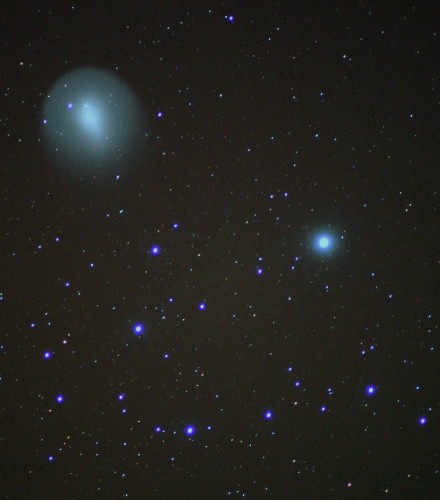
I imaged using my new Canon 40D and timer remote through my Sigma 50-500 APO lens – I imaged at 191mm so I could leave the setup on auto-pilot (no guiding required) taking series of 2 minutes exposures for the Pleiades and 10 second exposures for the comet. The Pleiades and the comet:

_______________________________________________________________________

UPDATE By: KerryLH

As Tim mentioned, I also did some imaging. This time I concentrated on NGC253 Sculptor Galaxy. This almost edge on spiral galaxy looked fairly large and bright in the 6in SCT. Surprising, considering how close it is to the horizon. It is also very cool to be able to see some mottling in the eyepiece. I’m sure larger scopes will show much more.

Don wanted me to get a widefield image of Holmes… so here it is. I stacked a few 3 minute frames. I saw a pic on the web showing a very large and faint tail emanating from the soft edge and fanning out towards Mirfak and Delta Perseus. Pretty interesting eh? Anyway it is really hard to see, but the large fanning tail(extremely faint green hue) is just barely detectable in the image below. I will do another widefield image of this region… but with much longer and many more exposures to see if I can capture it better.

Below is another image which is a composite to try and show the very faint green outer halo and the bright compact inner core. Exposures ranged between 2 minutes and 30 seconds at iso800

Note: I posted a few more pics below in Glenn’s post as well.

Comet 17P Holmes on Nov. 3 by Bob Christmas

I took some more pictures of Comet 17P Holmes just after midnight on Saturday, November 3, 2007 from outside my front condo door.

This comet has certainly grown over the last several days, and, I’m wondering if that’s an ever-so-slight hint of a tail inside the inner coma at about 5:00 relative to the nucleus.

Here’s a cropped version of one of my 20 second exposures, colour-balanced, at ISO 200 through my Tamron 300mm lens @ f/2.8 + Canon Digital Rebel 300D:

Here’s an overexposed colour-balanced and gamma-corrected image; as above, but a 2 minute exposure:

Comet PacMan and the Foxhead Cluster

Kerry, Gail and I got together for an observing/imaging session, last night. Naturally the comet was high on the list for both. An amazing sight in our 6″ reflector, yet it wasn’t until Kerry captured a few images on her computer that we noticed it seemed to have a well-defined bow-front on one edge of the halo and the opposite edge had softened. A closer visual inspection through our dob confirmed it, and the fact that it looks that way in Mike’s picture (below) seals the deal. I’m wondering it if has something to do with sunlight defining the bow-front and the “back-end” being in shade – what do you think..

To me it no longer looks like little Comet Cutie but more like Comet PacMan -LOL! Hopefully Kerry can upload her image(s) soon for a comparison.

I also wandered across an object I hadn’t logged before: NGC 6819. This is a small, compact, open cluster described in the Night Sky Observers Guide as “a small splash of stars”. They range from about mag 11 on up and, within the star field that is part of the Milky Way stream, the cluster is reminiscent of M71. It has also been called the Foxhead Cluster but I couldn’t see any relation.

Although we were enjoying each other’s company, the low temperatures turned the heavy dew into frost that soon coated everything not generating heat. We reluctantly packed up but I’m sure it won’t be long before we’re once again checking out “Comet What’s Next”.

________________________________________________________________________

Update By KerryLH:

Sorry for the late image post… I finally got around to organizing and processing.

Helix was a tough target since it was pretty low and also very faint. I didn’t have much luck with tracking and guiding either… I might attempt this again another time

As Glenn mentioned there is a soft edge to the comet. Look along the lower right edge. 30sec exposure, stretched. It is getting more diffuse so longer exposure are needed now with my f10 scope.

Comet 17P Holmes by Bob Christmas

When I saw the clouds clearing out, around midnight, at the start of the morning of Tuesday, October 30, 2007, I decided to haul my rig out my front door and set it on my front landing, and I snapped a pile of images of Comet 17P Holmes.

This is a very unusual looking comet, but, with it being nearly at opposition, close to being on the opposite side of the Earth from the Sun, we’re essentially looking down the barrel of its tail, if it indeed has one. As for a second nucleus, neither I nor my camera can see one.

Here’s probably the best of my shots; zoomed and cropped; I took this through my Tamron 300mm lens at f/2.8; Canon Digital Rebel 300D; ISO 200; 5 second exposure.

Holmes again, Holmes again

It is just past midnight, and I have just returned home from Binbrook where Jim W., Steve G. and I were joined by a guest for a round of comet watching. Jackie stopped by to make sure that everyone got in the park safely, but her cold kept her from enjoying much of the night. Binocular views were being enjoyed and stories of comet sightings from the past couple of days were being compared while three scopes were set up. As if planned to give our guest variety, Steve set up the GWS (16″ dob), Jim set up his 8″ SC and I set up my small but mighty 80mm refractor. Jim was first out the gate and with his first telescopic view of the comet his shouts of two cores had Steve and I racing to finish our set-ups. Seconds later we were all staring through our scopes and pondering this new development. As the night wore on many images were made (a truly collaborative effort, with Steve’s camera being attached first to my scope and then to Jim’s, and all the while being supervised over by our etherial fourth member). Soon, there was speculation on the true nature of the split core (a third star was immediately agreed upon to be a background star). We plotted the nearby background stars to reference against while we watched for movement of the comet(s) and by the end of the night we were of the opinion that there were two background stars and still one cometary core. But oh, what a comet. Even if it didn’t split as was speculated, it has still been the most surprising comet in many a year and as was said tonight, truly worth the price of admission. I am looking forward to Steve’s images, more member’s comet tales, and more nights with the good company of these fine HAA members.