Asteroid Occultation Anyone?

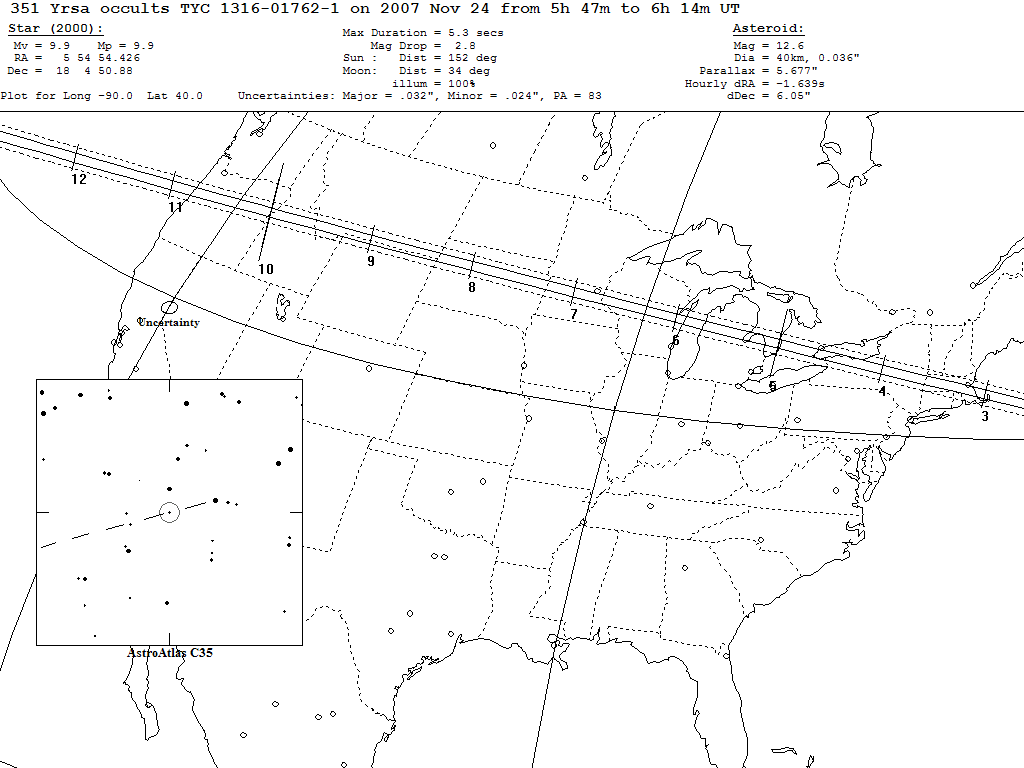
At about 1am Sat morn of 24 Nov, a small asteroid will occult a star that will pass close through our area. If you are interested in trying to capture this event, I have some information below.

The asteroid is 351 Yrsa which is a 40km wide mag 12.6 object. It will occult star TYC 1316-01762-1 which is mag 9.9. (The star is located between Taurus and Gemini) This means the light will be reduced from 9.9 to mag 12.6 (the magnitude of the asteroid).

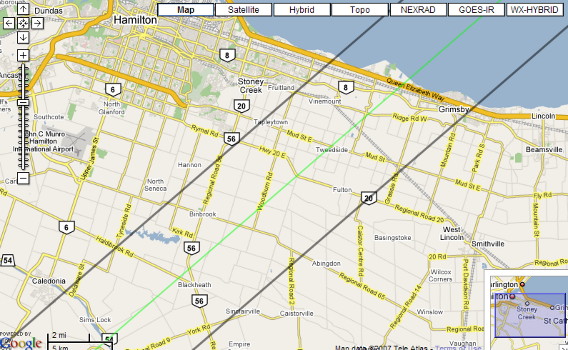
Below is a map of the occultation path.

Path of asteroid occultation

The path image by default is only showing the western portion of North America. If you save the image to your local drive (or if using Firefox, use View Image), it will show the entire area included. You should see that the path passes right along the southern edge of Lake Ontario near us.

It will pass through our area at approx 06:04:32 UTC (01:04:32 EST) and will last for up to 5.3 seconds. The star’s position is at
RA: 05D 54M 54.4258S DEC: +18D 04M 50.879S (Degrees, Minutes, Seconds).

Binbrook Conservation area will be within the uncertainty limits. Ideal might be a road trip to the NW of Torontowould be an area between Burlington to Oakville or west of this area (thanks Glenn), or the Niagara-on-the-Lake area.

More details can be found at: This link including some sky charts.

Good hunting. I guess I should make it clear that I won’t be able to participate in this particular expedition (other obligations). This is for you intrepid explorers to find on your own.

Comet Holmes and Mirfak — Take 2

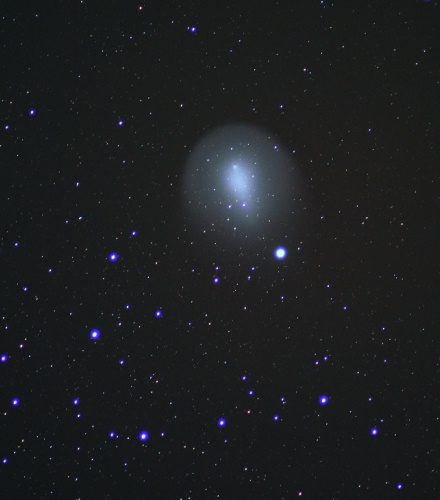
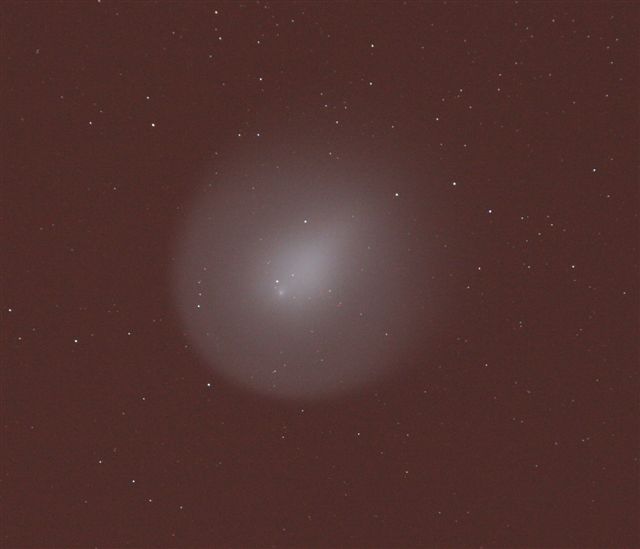
At 1:30-ish in the morning of Sunday, November 18, 2007, the sky in Burlington was clear, and Comet Holmes was visible, right beside Mirfak (Alpha Persei).

I took four pictures of Holmes from outside my front door, and here’s an excerpt of one of them. Canon Digital Rebel 300D; Tamron 300mm lens @f/2.8; ISO 400; 71 second exposure.

Cheers!

Bob Christmas

************ UPDATE ************

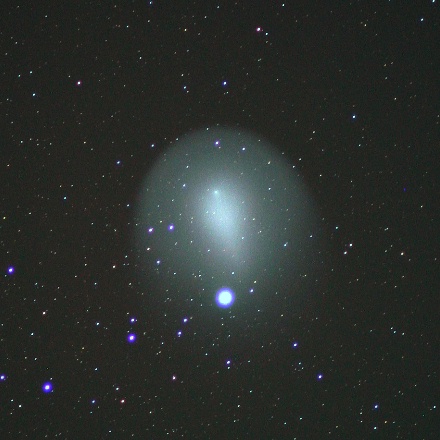
Here’s “Take 3” of Comet Holmes, right above Mirfak, at about 11:00 pm Sunday Night (November 18, 2007). Equipment and settings as above, but 74 second exposure:

… in the same magnification as the one earlier Sunday Morning:

… and here’s the same image, close up on the comet:

Grazing Lunar Occultation Expediton 3

Our third attempt to observe a grazing lunar occultation was unsuccessful, but all agreed that the night of observing was still a big success.

It should be noted that the Clear Sky Clock said that it would be overcast all night, but our favourite weather goddess said that it would clear later in the night. So who are you going to trust? That’s right, so even though it was snowing at the time, Jim W., Jackie F. and I agreed to meet Don P. at Binbrook for the occultation, with the knowledge that it would clear eventually. As Don and Jim set up at the windsurfing parking lot in the park, which was about 500 meters closer to the center line than the hill, Jackie and I searched the skies for the moon with our binoculars. A few brief glimpses of our nearest neighbour through the clouds kept our spirits up, but we knew that there was to be no 7.8 magnitude stars cutting through the overcast. By occultation time there was not even a hint of the moon, and we could do nothing but console each other with the knowledge that this time we had at least seen the moon, which was better than the last two attempts.

Don brought his field kettle, Jackie brought hot cocoa and Jim brought his propane heater, and so after a goodly long while in the cold and dark we huddled together to warm ourselves, inside and out. My thanks to all for making this chill night more warm and bearable.

As the night wore on a small break to the north gave us the promise of seeing Comet Holmes, and soon all binoculars were searching the skies. As if Binbrook held some magical quality, a large and very transparent hole appeared directly over the park and stayed there for the remainder of the night, allowing us to observe the comet and many other wonderful sights. The comet was directly beside Mirfak, and as I had not seen it for a few days, I was interested to see how it had changed. It was barely visible to the naked eye, partly because it has been dimming, but also partly because of its proximity to Mirfak, which cast enough glare to interfere with the comet. Don’s little achromat showed a lovely disk to Mars, and we were able to discern dark surface markings, a sure sign that Mars is nearing its closest approach in a little over a month, and a testament to the fine optics of Don’s scope. The open clusters of the winter constellations, the Andromeda galaxy, the Pleiades, and a good look at not just the great nebula, but all the regions in the sword of Orion were part of a fine night of observing through Don’s scope. The seeing was excellent and the transparency was good too, as we could pick out the winter Milky Way quite easily. Don may have even spotted Uranus through the clouds that surrounded our magical window over the park – not an easy feat! Jim put his scope to good use by obtainig some fine images of the moon, which he shared with the rest of us. Finally, we were able to observe both the moon and the star that had earlier been occulted, thus bringing us one step closer to our first successful grazing occultation session.

We carried our good spirits to the nearest Tim Horton’s for the traditional observer’s doughnuts and coffees, and finished a fine night with good conversation and company. Indeed, another successful occultation expedition for the HAA.

Update by Don Pullen

Excellent report John and my thanks for doing this.

It really was a good night. It was the cloest we’ve come to having success with a lunar grazing occultation in our 3 attempts. As John indicated, we saw the moon peaking through the clouds up to half an hour before the time approached, but then we got socked in by clouds. By the time they cleared over the moon again an hour after the time for the occultation, we could see the star approximately 1 moon diameter away. So close. Next time we’ll nail it!

I had a great time with Jim, Jackie and John. I guess the afternoon snow scared everyone else away, but when the hole opened up, we had very steady skies and great seeing for several hours. We even saw a few meteors whose radiant appeared to be the early stages of the Leonids. Well worth the trip and cold temps. We were lucky that there wasn’t any wind until late which helped to keep the low temps more bearable.

I can hardly wait for our next try. At least we’re getting closer and eventually we’ll bag a proper grazing occultation. My thanks for the fun company last night – we really do have a great observing and sociable club.

It isn’t called “I(can’t)C” for nothing: IC1805 Heart Nebula

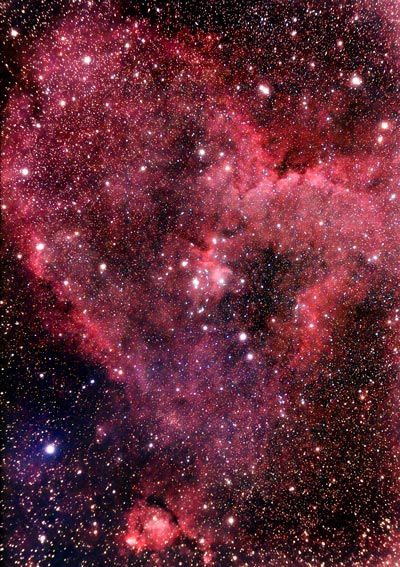
I did get a chance to get out and do some imaging last weekend and also a few days ago. I wanted to try IC 1805 Heart Nebula. Well what can I say… other than this is one tough object. TimH told me one day that IC meant ‘I can’t C’ 🙂 Funny, but true. For this object I had to process my individual raw file and stretch with levels in order to get a bearing on where it was on the frame… then I attempted to re-frame it. This took me a good half hour. Then I started the 3min exposures at ISO 1600 totalling up to 2.5 hrs. After stacking, I saw absolutely nothing but then loaded it in PS and tried to work some magic with layer masks, curves, filters… you name it I did it. Anyway in conclusion: it is possible to image a faint hydrogen alpha target with an unmodded DSLR camera and no LP filter under mag 5.5 skies… but not without a lot of work. It was pretty much overhead at the time so that probably really helped.

Canon 40D with 80mm APO (full frame)

Holmes, Mirfak and Mellote 20 taken with the camera lens… which was piggybacked.

KerryLH

Hubble pictures of Comet P17/Holmes released

I added a comment to a posting more than a week ago that Hubble was scheduled to look at Comet Holmes. I’ve been looking around since then to find them. Well finally some of the pictures have been released.

Follow the link to BadAstronomy blog site to see some of the pictures.
Comet Holmes

One of the pictures show a montage with a ground based image taken by Alan Dyer. I think some of our club members have taken images that easily compare. Way to go HAA AP’ers!

Lunar Grazing Occultation #3 – Update

The weather forecast is degrading for Sat night (not surprising). The Weather Network is now calling for 90% chance of rain or snow. So since it doesn’t look too promising, I’m thinking we may not want to make too much of an effort to see this occultation (that is, try to find a truly optimal location which may require more driving).

Therefore I’m going to suggest that if weather permits, we set up at our usual spot at Binbrook Conservation Area.

This is still within 2.5 km of the path center so we should still be able to see some of the bigger mountains and deeper valleys (5-6 km is the max limit). We might miss out on some of the smaller objects. If we manage to see the star wink in and out even a couple of times, that will be a big success for us. We can always try again later for a better show.

The occultation will begin at around 8:47pm local time. So I’m going to suggest that we begin setting up at around 7-7:30pm. This will be dark enough to do some other observing while we’re waiting. If the main gate is locked, we’ll put our usual combination lock on it so members who know the secret code can get in. Visitors will be welcome and can either walk in or wait to drive in with another member. Of course, if weather is really bad, then we won’t bother going out for this event. We’ll post an update on Sat afternoon.

Let’s hope for clear skies.

UPDATE: 17 Nov 2007 – 2:10pm
The CSC is still showing clouds for the night, but the Weather Network indicates that there will be some clearing later in the evening. It may make the occultation tough to see, but we might still see Neptune, the Leonid meteor shower and maybe a few other things. So I think we’ll take a chance and head out.

I will arrive at the gate between 7 and 7:30pm to open up. Hopefully we’ll see you out there for some observing. If we get lucky to see the occultation, don’t forget your shortwave radios and camcorders along with your scopes and binoculars.

Comet Holmes and Mirfak

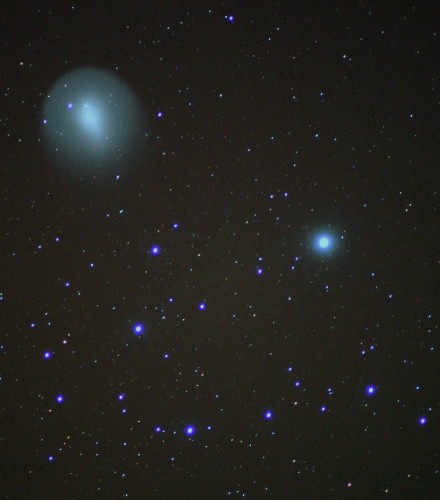
Tonight, it was clear, for a while anyway — long enough to have another opportunity to photograph Comet 17P Holmes outside my front door in Burlington, so, here’s one of my better shots I took tonight. Tamron 300mm lens @ f/2.8; Canon Digital Rebel 300D; ISO 400; 53 second exposure. Cropped. A quickly-processed “rough cut”.

The comet appears beside Mirfak (Alpha Persei, that bright blob of a star on the right).

Cheers,

Bob Christmas

The Continuing Saga of Comet Holmes

It was clear last night, of course. That’s because I hadn’t expected it to be and hadn’t made any plans. The fact that our main scope is temporarily down until Monday is also a major factor, I’m sure. The astronomy gods love taunting me.

The first thing I did when I discovered it was clear was to grab Alex, our binoculars and the laser pointer (thanks again Steve!!) and dash outside to show Alex the comet. It was late and she was only moderately enthusiastic. I was afraid it would cloud over any second, but there were no clouds. Amazing. I was surprised to see that Comet Holmes had gotten so big and dim since the last time I’d seen it. However, it was still visible naked eye in the light pollution and prominent in the binoculars. Alex was impressed.

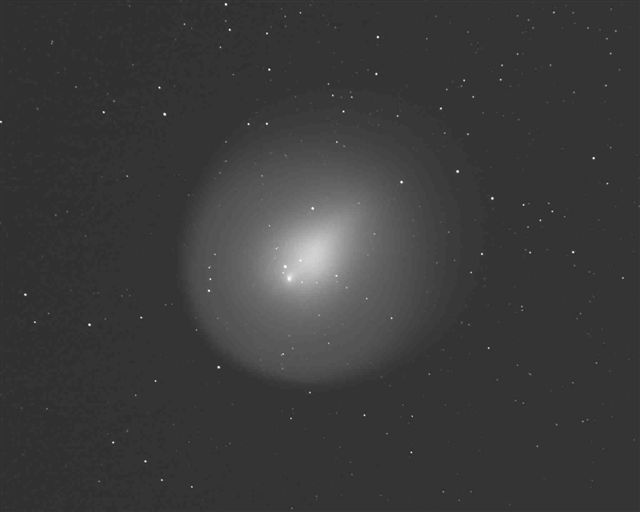
I had left my CG-5 mount set up and aligned in the SkyShed from the last time I was out there a week ago, so I grabbed my 4″ scope and camera and dashed out. I spent the next two hours re-aligning my “already aligned” mount (@#%$!), then taking photos of the comet for about two hours. I’ve included one of them here. Unprocessed and compressed for your viewing pleasure. Exposure was 30 seconds, ISO800, f/6 500 mm (4″ refractor). I took a number of these as well as some dark, bias and flat field frames. I will post the stacked, processed image once I have a chance to.

Cheers,

Ann

Update: I’ve posted the stacked and processed version of this photo below. There is a bit more detail visible. I think the concentric rings in the halo are an artifact of the processing stage. Comments?

Stacked and processed Comet Holmes image

Grazing Lunar Occultation – try # 3

Well, we’ve been clouded out for our last 2 attempts to see a lunar grazing occultation. Thanks to a great contact, I’ve been made aware of another occultation coming up on Nov 17 (thanks Brad). Will 3 times be the charm???

A regular occultation is when the moon passes in front of a star and blocks its light. A grazing occultation (GO) is special in that the edge of the moon passes in front of the star. By being properly positioned along the path, you can observe the star wink on and off as it passes behind lunar surface features such as mountains and valleys. Astronomers have used this method to determine dimensions of lunar features and the apparent diameter of the star.

The path of the next GO will be moving through our area at 8:50 pm on Nov 17 (18 Nov 1:50 UTC). It will pass close to Binbrook Conservation area which is one of our favourite viewing locations. However, it won’t be positioned quite as close to the path center as our last attempt. From our regular observing location, we would be barely within the 5km viewing path. This is far enough from the path center that we’d lose some of the effect and details. Therefore we may want to consider observing from a different location along the path. The star to be occulted is SAO 164750, which is a mag 7.8 star. Not visible to naked eyes, but should be easy with binoculars and small scopes.

I’ve added an image of the map with the graze path on it. We are still working out our plans on the actual location where we’ll set up to observe this occultation.

I’ve also provided a link to Google maps which shows the path. Be aware that this page may not load properly in all browsers. I find that I have generally had good results with Firefox. IE has generally been less successful. Your mileage may vary.
Grazing Path

Update: 12 Nov 2007
The current long range forecast (TWN) is calling for variable clouds, 20% POP, low temp of -3C, winds 20km/h from the west. Sunday is currently forecast to be clear – we may get lucky if the clearing trend arrives earlier than expected.

The moon will be about 40-45% illuminated. If I’m reading the charts correctly the occultation will begin in our area at around 20:47. The moon will be positioned 24 deg above the horizon and the azimuth will be 218 (SW) (This means we’ll want to be south of the city along the path for observing). The occultation appears it will occur on the sunlite side, at the SE edge of the moon.

We also have the opportunity to view Neptune which will be mag 7.9 nearby and we’ll be getting into the peak days of the Leonid meteor shower. (peak is expected Nov 18-19) So if the clearing breaks don’t allow us to see the occultation, we may have an opportunity to see some other things in the sky on Saturday night.

Observing location still to be determined. Stay tuned.

cheers

Can you see a tail?

I took this image of Comet Holmes last Friday and then majorly stretched (enhanced) it to see if I could see a similar tail to what I have seen in some very recent images online.

2 min exposures totaling ~48min with the Sky-watcher 80mm

By KerryLH