
Saturday 23rd of February 2008 | Bob Christmas
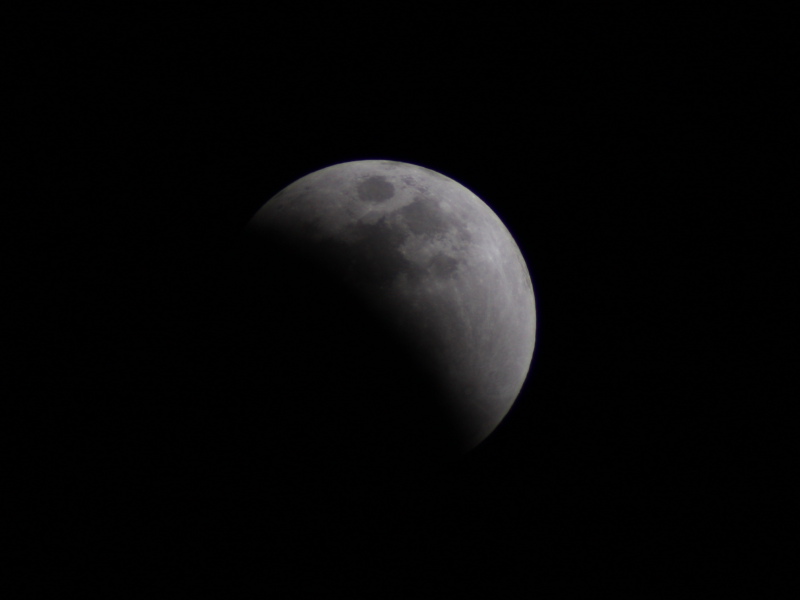
Click here or on the blog entry title to view a larger version of my collage of 3 images from the lunar eclipse of Feb. 20, 2008.
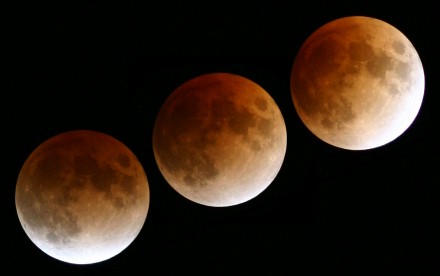
Click here or on the blog entry title to view a larger version of my collage of 3 images from the lunar eclipse of Feb. 20, 2008.
Well, I wasn’t able to join the rest of the gang at Binbrook as I was up in Collingwood at Blue Mountain for the week. I did manage to get out for the eclipse though (and despite the extreme cold – managed to convince some of my family to come out of the warmth and watch also). I imaged using a Canon EOS 40D with a 50-500mm zoom lens. I watched the eclipse from the start (before 9:00pm) until just before totality at which time clouds rolled over – as such I wasn’t able to image the complete eclipse – but got fairly close.

Our HAA members were true to form, braving cold and ice, to set up numerous scopes, binoculars and other equipment, at the Binbrook alternate site.
I was impressed by the clear skies and view of Orion even from my car
as I drove to Binbrook. Unfortunately I could not be there early… as i had another meeting to attend, but when I arrived, the eclipse was about 3/4 total, and there was a convenient parking spot for my car in the front row.
I arrived to find about 14 cars and as many scopes set up in the field adjacent to the parking lot. All the regulars were there, as well as more than a dozen guests who came to see the eclipse first-hand, so to speak.
As has been mentioned, the eclipse is great to see with just about any equipment, including just your unaided vision, but the prospect of an hour of comparative dark skies during such a full-moon-induced clear spell was irresistible to me.
John provided not only an excellent pair of binoculars on a parallelogram so anyone could see the view, but also a keen commentary on what to look for at each stage of the eclipse. He pointed out that there’s a strip of the moon between the partial part and the total part which actually looks bluish, due to the earths ozone layer absorbing the red light from the direct illumination of the sun.
Deeper into the Earth’s umbra, the moon looks reddish, lit by sunsets from all parts of the world at the same time.
I thought about the sun’s elevation below the horizon… as seen from the moon, even the sun which just disappears behind one side of the earth is only 2 degrees (like the view of a sunset 8 minutes old) below the horizon on the other side.
So indeed the perimeter of the earth must look spectacular from the moon when the earth eclipses the moon.
I wondered why we don’t have any cameras on the moon for just such an occasion. I seem to recall the next x-prize is for landing a rover on the moon and driving it around. With any luck they will put an upward facing camera (with appropriate shielding from the sun) on it, and we can have an earthcam vantage point.
I brought my trusty Sky Quality Meter (SQM) and took a reading on arrival. The zenith at 9:45 PM was registering 19.50 (magnitudes per square arcsecond) which is actually not so good. Shining straight at the moon registered 19.01.
Even with the moon eclipsed, the zenith still read 19.75, so I would have to say that even the eclipsed moon, the light reflecting from the snow covered ground, and the residual sky-glow of surrounding communities still added up to about an extra magnitude, as we usually get about 20.5 at Binbrook on dark nights.
I set up the GWS as the eclipse wore on, hoping to catch a glimpse of a few Deep Sky Objects during totality. In particular, I wanted to view M49, but Saturn would also be out and was worth the drive just for that.
Several members had goto scopes set up, and were tracking nicely.
I saw M79, a globular close to the horizon, in Heather’s scope.
M42 had the appearance of a dark nebula in front of a bright nebula.
Jim recorded a video of the moon during the approach to totality.
He also crafted an excellent warm-up tent, with a gas heater and a supply of tim-bits, under the hatch of his minivan. Anyone who was feeling the cold could duck in there for a few minutes and emerge re-energized and toasty warm.
Several members took still photos of the moon from various equipment. Looking forward to viewing their galleries in the next few days.
While the moon was eclipsed, we also were able to tour the sky. Saturn was ideally positioned, and showed 3 tiny sharp moons close-in to the planet, and perhaps 2 more far out. In the FFI with a 13 mm Ethos eyepiece, I could, (once told to look) make out the 3 moons.
Its kind of neat being able to look all around in the eyepiece and see the rest of the sky.
In the GWS I could also see the 3 moons, with a 26 mm 4000 series eyepiece and a “Big Barlow” – Effectively also a 13 mm eyepiece.
Once the moon came out of the umbra, the background brightened up and i could no longer make out the closest of Saturn’s moons in the GWS, but still could see it in the FFI… (I need to clean the GWS mirrors, it’s true).
Saturn was only about 4 degrees from the moon by then, and some moonlight was shining into the GWS and reflecting off the dust on my mirrors, but that’s another story.
My toes were getting pretty cold towards midnight.
It’s true all the advice about dressing warmly. I had on summer clothes and a decent coat, and my boots were safely at home,
but I maintained circulation, literally and figuratively, by making numerous trips to different scopes and sampling the views.
We packed up at about 11:45 PM and reconvened at Tim Hortons on Nebo Road. Excellent conversation and discussions persisted well past 1:30 AM, which is part of the reason HAA is such a great club.
Images By KerryLH
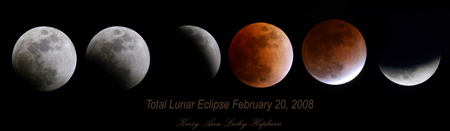
As you can see, I ran out of heat before the end and unfortunately stopped imaging before it was totally over. It was just soooo cold and I couldn’t bare to snap another frame.
Link to the large version: http://www.weatherandsky.com/main.php?g2_view=core.ShowItem&g2_itemId=1135&g2_imageViewsIndex=3
I think I captured that occultation star… am I right?
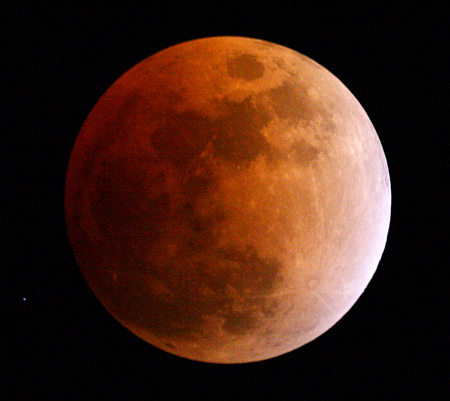
THe entire gang.. wait a minute where did everyone go???
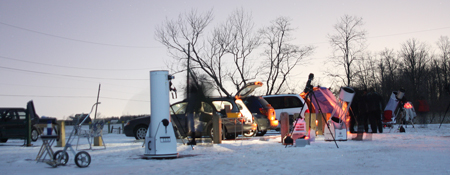
Wow look at all the stars… totality just ending
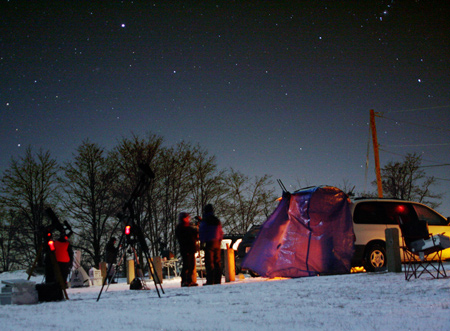
Images by Don Pullen
(My first attempt at AP with the Canon 40D so be gentle with the comments.)
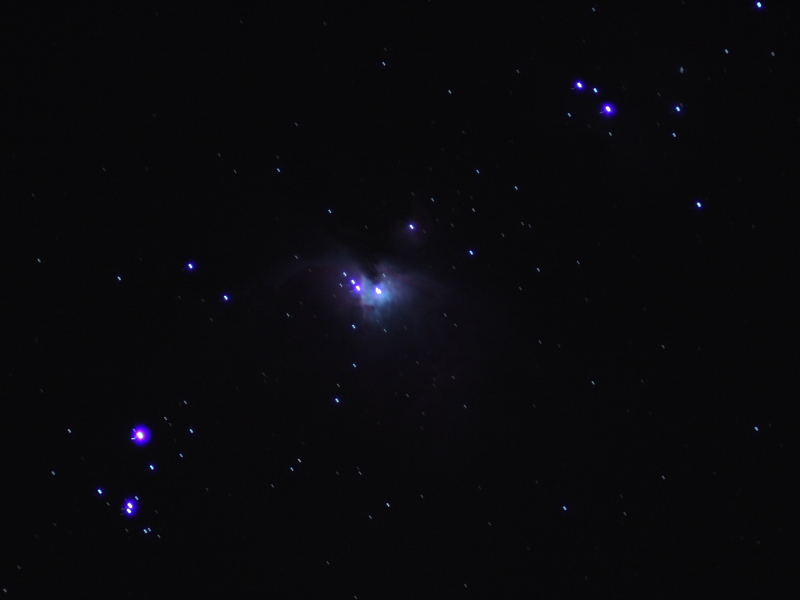
Orion Belt stars with nebula through 100mm f/5 achro scope and Canon 40D at prime focus, 30 sec exposure at ISO 200.
Another group shot. 40D Night portrait mode, 50mm f1.8 lens.
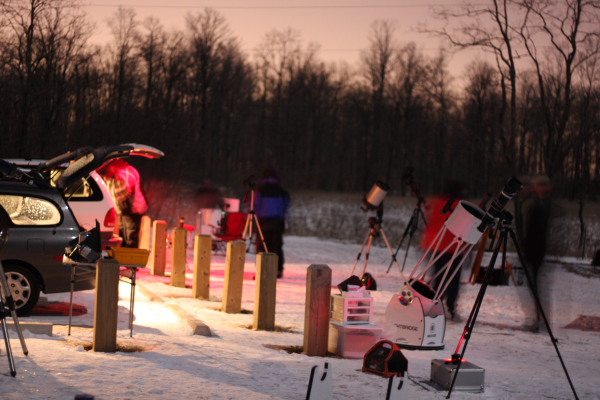
Hopefully some more later once I figure out how to process the other images I captured.
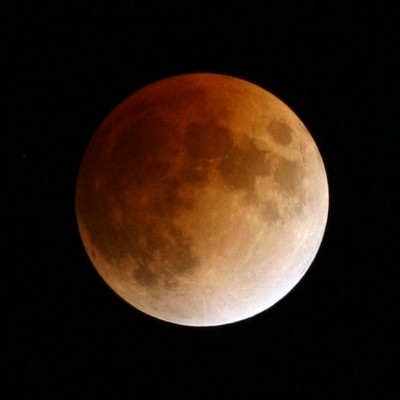
Holy Cow, was it COLD out there! But Holy Cow, what clear skies, and what an eclipse! Despite the cold, I managed to drag my butt out to my townhouse complex parking lot, set up my rig, and snap half-second exposures every 5 minutes from 10-ish PM thru 11:15 PM, at f/4 through my Tamron 300 mm lens and Digital Rebel.
This image is just one of many. More images to follow, as I get more time in coming days to process them.
Due to a waxing moon with an 81% illuminated disk transiting at 9:01pm I waited until midnight to start my observing session on Saturday night (Sunday morning). I wanted to try to avoid the worst of the moon’s glare if at all possible.
Unfortunately there was a trade-off with this scenario: a couple of interesting objects I had planned to observe in Lepus disappeared behind the roof of my house and behind a very “mature” tree. I was surprised to see Orion dip so low towards the western horizon.
It was quite cold again and worse, ice was adhering to the patio stones in quite a stubborn fashion. I got (another) workout trying to remove it.
The first object I observed was the “Clown” or “Eskimo” Nebula (NGC 2392)in Gemini. The Clown is a planetary nebula, where a dying star that is running out of nuclear fuel sheds its outer layers into space. In the March edition of Sky & Telescope Timothy Beers writes that certain “intermediate” types of planetary nebulas are thought to be responsible for dispersing elements into space and eventually these elements “make their way into the next stellar generation. As stars form, evolve, and die, they cook light elements into heavier ones – including those we need for life.” Something to think about as I observed NGC 2392. I could not make out the layered shapes that make it look like an Eskimo with a fur parka hood or a clown’s face. I could see the layers but not distinctly. Back in early December on one of the first nights I had the telescope out I observed this object and I saw more detail.
I had better luck with another planetary: NGC 3242 or “The Ghost of Jupiter”. The nebulosity seemed larger and brighter than with the Clown. The broken-spiral shapes (layers) remind me somewhat of the child’s toy “Spirograph”, but looking as if you made a messed up one.
The moon was still pretty high up so I passed on trying to view any Messier objects. I mean, why torture yourself, the bitter cold is bad enough. “I Want To See (Things)!!!” as Joan Crawford exhorted in an old episode of Night Gallery (a very young Steven Spielberg’s first directing gig). But I digress.
Scrolling through the Celestron’s database through to Variable Stars I keyed in R Leonis. R Leonis is a Mira-type pulsating variable in Leo. It’s magnitude ranges from 5.8 to 10. To me it has a distinctly orange cast. Quite bright. One can keep checking in on this star to see if it is getting brighter or is dropping in brightness. I have not tried to determine the magnitude of variable stars before, but I might start.
Next stop was V Hydrae, a carbon star. I could not find this star on the telescope’s database so I keyed in the coordinates for Right Ascension (10h 51.6m) and Declination (-21 degrees 15′) on the telescopes hand-set under the Go-To RA/Dec. utility and the Celestron slewed right to it. This star looked like an intensely red little point of light over towards the southwestern horizon. According to the “Celestial Sampler” by Sue French V Hydrae is “a dying red-giant star ready to form a planetary nebula”. So perhaps in a thousand years this object will look more like the Clown nebula than the bright little red light it is now.
One of the objects I missed by starting so late was R Leporis or Hind’s Crimson Star, another carbon star and a variable to boot, in Lepus. Maybe next time.
I observed Saturn (how can one ignore Saturn?) again. This time I could see Titan at around 3:00 o’clock at a fair distance from the planet, and then closer to the planet another bright moon, probably Rhea. Again closer to the planet I could just see another speck of light, which turned out later to be Dione. That was all I could see, not as good as Monday when I saw 5 moons.
I ended the observing session with M40, a Messier object that is actually a double star. I put very high power on this double and I still could not split it. There seemed to be a orangey-yellow star extremely tight in to a bluish white star. Nice colours. Can anyone let me know why a double star is a Messier object? Did it look like a comet to Messier?
I hope I have some energy left for observing the Lunar Eclipse at Binbrook, weather permitting. The SCT is not ideal for observing a lunar eclipse. Hopefully I’ll re-energize by Wednesday night.
I finally scored the combination of GWS, Saturn above the horizon, and no fog at the same time.
Unfortunately, i had 2 equipment failures, both related to dead batteries. My red dot finder and my equatorial platform both ran out of gas.
It did not take long to align the scope. I finally decided to label the struts and cans, so that i can reconstruct it again the same way. It will be an interesting experiment to see how far out of alignment it is on restoration. The laser is spreading out due to dirt on the secondary. It’s time for a cleaning.
My friend was there when i arrived, and he helped me lift the base of the GWS from the car. He did not want to stick around while i assembled the whole scope and aligned it, but i was keen to show him Saturn.
I whipped out the GWS finder-scope (a Nexstar 3.5) and first lined it up on the moon to focus it. At that point i discovered the lack of the red dot finder.
(It turns out that home depot is selling ‘tea lights’ powered by LEDs that use the same cr2032 batteries as the red dot finder. For $2.99 you get 2 lights and 4 batteries. I highly recommend them.)
Especially if you keep them with your scope instead of in the living room.
He was impressed by the view of the moon. I failed to align the scope sufficiently to show Saturn. Turns out it was just as well… the 25 mm eyepiece on the finder-scope can render Saturn as not much more than a yellow oblong dot. He would have been disappointed.
I was not disappointed once i finished aligning the GWS and put the 26 mm into it. Saturn came out reasonably crisp and with distinguishable gaps between planet and rings. I could not discern the Cassini division however. I could see 3 moons to the right and 2 or 3 to the left depending on whether one was a star…
My configuration of Cartes De Ciel does not show Saturn’s moons, so i will have to wait on that one. I made a sketch of what i saw for future reference.
I then put in the ‘Big Barlow’ and replaced the 26 mm meade. Saturn dutifully doubled in size. At this point i realized the platform was no longer tracking, and established it was not simply that i had left it on ‘moon speed’… the batteries need charging. I thought about running an extension cord to it and charging it, but decided to carry on.
The 7-21 mm zoom eyepiece was next. I put it on the ‘Big Barlow’ to see what i could see. The zoom eyepiece is not a very high quality gadget, and it made the image worse than the 26+Barlow, even when set to 21 mm. At 7 mm, i could not see the space between planet and rings anymore.
(I guess that works out to 1829/3.5 = 522x magnification)
Without the platform i had to constantly readjust the position of the scope to get Saturn back into view.
It was remarkably cold: just touching the scope to re-point it at Saturn was hurting my fingers… and i even put on gloves at one point. The scope was cold to the touch, and my water actually started to freeze towards the end. (In all fairness, it was in my car overnight too). It was -11.5 degrees according to the thermometer in my car.
The moon in the sky is the bane of all messier hunters (except those seeking M45, i think). It washed out the sky so bad that i could, with difficulty, barely see the stars in Virgo which are connected by lines in the constellation diagrams, but no more than those. The finder-scope, on the other hand, shows more stars than the pocket sky atlas, further complicating star hopping. Directing the GWS into the realm of the galaxies, i expected to see something faint and fuzzy to start with, but the uniform glow of the sky was too much for me. Even M51 failed to show up. I knew i was going to have to wait for the moon to bow out.
Then, dreaded frost started appearing. At 1 AM i had had enough. It took a while to carefully repack the scope and close up the car. I need to get some frost busters going for next time.
However, i did establish that Virgo will be visible during the lunar eclipse and that i can scoop M49 then. And the Big Barlow does not significantly degrade the view through the 26 mm.
I tried focusing on Spica to see how good the seeing was. It resolved to a small disk, with a sparkle that made it look like it was on fire. Unlike mars which i have seen on some occasions to be quite ‘alive’ these flames were only about 1/3 the size of the disk, so i would have to say the seeing was pretty good tonight. Saturn also looked steady.
Someday i will learn not to seek Messier objects while the near-full moon is up, but i had waited too long through cloudy nights to pass up this opportunity. Astronomy is excellent exercise.
Neither the seeing or transparency were good, last night, but after the recent frigid temperatures driven by gale-force winds; -4C and a slight breeze felt positively balmy ? so I put on my shorts (and 6 pairs of track pants under my parka) and ventured out.
I?d timed it so that while I was setting up Gail and I could keep a lookout for the scheduled ISS/Shuttle fly-by. As predicted, a star appeared just above the roof of our house and brightened quickly as it rose to the zenith. Directly overhead it came close to mag ?3 but faded rapidly as it went east.
The quarter Moon also had plenty of altitude and looked magnificent in the binoviewers at low power. At 210x magnification, however, we may as well have been looking at a reflection in a stream. Still, there was plenty of detail to be seen in the gently rippling crater fields.
Mars was close by but, again, the conditions cancelled out any detail that may have been seen on the surface so we dropped down to the Orion Nebula and Trapezium. A pretty sight yet I?d seen it better so, when Gail went in, I decided to follow Heather?s cue and hunt down a few doubles.
Switching out the binoviewers for a 21mm Pentax ep I wandered over to Rigel. A brilliant star, in its own right, there is an extra treat if you can tease the companion out of the glare. At 57x, I could just make out a tiny fleck of light. The 7mm Pentax easily resolved it into a blue-gray speck beside the blue giant.
My next target was Sigma Ori, a multiple star system just below the belt star, Alnitak. The brightest star in this system is an unresolvable double for backyard scopes but the three close members of this cluster make it an interesting sight. Also in the same low power field of view is a pretty triple system, known as Struve 761, consisting of a close, matched pair and a single similar star nearby. Apparently all of the stars of Sigma Ori and Struve 761 are moving in the same general direction and are thought to be related.
Casting my eye to the NW, I noticed that Cassiopeia had flipped 90 degrees since the last time I saw it! Just to its left was copper coloured Beta Andromedae and somewhere between them would be the Andromeda galaxy. I wondered how it would look with the present moonlight and was surprised to see that the companion galaxy M32 was actually easier to spot under these conditions than on “better” nights.
Since my double star hunt had morphed into a double galaxy hunt I pushed the scope to where M81/82 should be. I often have to pan around to find these two but this night I was on a roll and when I put my eye to the ep there was the faint cigar shape of M82. A slight adjustment brought M81 into the same FOV.
After a quick look at open cluster M35 and its companion NGC 2158 the night was capped off, as it had begun, with a satellite ? this one traveling through Taurus.
Well it certainly was cold enough Monday night. At least the wind had died down from Sunday’s arctic conditions.
I determined I was going to observe as long as the wind chill was half reasonable. And it was. I spent 10 minutes shoveling hard snow from my backyard patio to clear a spot for my 6 inch Celestron telescope.
I have a reasonable eastern and western horizon. I pointed the telescope at the globular cluster M79 in Lepus. I was anxious to observe this object as there are not a lot of globulars to be seen in the winter months. But again this object frustrated me. Could not see it. I probably was staring right at it, as the telescope was pointing very accurately tonight. I tried moving the scope through the vicinity it was supposed to be in; I tried different eyepieces – low power, high power, back to low again. Nothing worked. Time to move on I thought. The sky was somewhat bright but the seeing seemed to be pretty good.
I have Sue French’s Celestial Sampler at home. The sound of Tau Canis Majoris Cluster (NGC 2362 or Caldwell 64)and her description of this object intrigued me: “a bright sapphire amid a tiny bed of lesser jewels”. This object certainly did not disappoint, with a very bright bluish white star at the center of a smallish open cluster of stars. Quite nice. According to French Tau is a blue supergiant that shines with the light of 50,000 suns. I could have used some of that heat tonight I can tell you! In addition, it is one of the youngest star clusters known. Young and pretty, I bet this is a pretty popular star up there in Canis Major.
I then decided to give Saturn another look. To me, the rings of Saturn look really closed up. I remember how they looked in 2003, opened to their maximum. But Saturn is still so spectacular. I started looking for Saturn’s moons, to see if I could see more moons than I did in January. Titan I sighted right away at a fair distance from the planet at approximately 10 o’clock (pointer). Then on the other side of Saturn I spotted a moon at about 4 o’clock. I looked a little longer and saw another tiny diamond near by. And then another one to the side of it. The three moons created a cute little triangle to the lower right of the planet. I thought I saw another moon on the other side of the planet from the “triangle”, about half way between Titan and Saturn. I still have to check my Starry Night software to see if this was perhaps Iapetus. I do know from checking Sky & Tel’s “Saturns Moons” that the triangle was composed of Tethys at the top and Rhea at the bottom on the left and Dione on the right corner. I did not spot Enceladus. I think that is one or perhaps two more moons spotted as compared to last time.
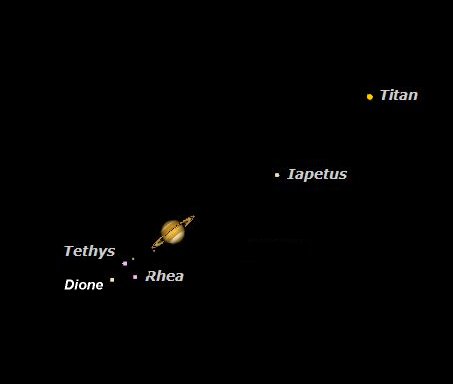
Quite happy with my moon hunting for Saturn I thought I would check out some double stars. Double stars are quite enchanting (to me anyway) and you can observe them even if the sky is quite soupy looking. Tonight I observed Iota Cancri, a pretty double star that is a little reminiscent of beautiful Albireo (I can’t see Cygnus from my home at this time of year – can’t wait until the summer!). I checked out several doubles, including Algieba or Gamma Leonis which is a fairly tight couple of dingey yellowish looking stars. Also observed Theta 2 Cancri (a couple of evenly matched white coloured stars), Delta Geminorum, Castor (an interesting triple star) and I believe Eta Puppis. Just scrolled through the Celestron’s list of doubles and kind of took a tour. I tried to guess the separation in arc-seconds of the stars and then checked on the telescopes handset by scrolling through the “info” to see what how accurate I was. Sometimes I was close, but not always. Need more practice.
I saw Arcturus rising in the East and I thought: I might be able to see M3 in Canes Venatici. I keyed in M3 and the telescope slewed and their it was, a big beautiful globular cluster with handy bright stars in the field of view to help with focus. Even with very high power I could not resolve individual stars, although I believe I was on the threshold. M3 looked a little irregular in shape. By this point the numbness I was feeling in my right foot was starting to spread up my right leg, so I decided to get out of the cold.
I was happy with what I observed, despite the bitter cold.
Too cold? Too windy? Too cloudy? At this time of year, most HAA members just want to observe something – anything! Well, this week there are several opportunities to view the ISS/Shuttle combination.
No matter how many times you’ve seen it, it’s still cool to watch that bright (and getting brighter) golden “star” cross from horizon to horizon – and you don’t need to set up any equipment, or stay outside more than five minutes. It’s the perfect quick fix for Wnter in Ontario.
To find this week’s (local) schedule go to:
Heavens Above.com
Good luck!
I had the good luck to find out that on Saturday evening, Feb 9, 7-11PM, there was a combined exhibition of 3 local photography clubs, Latow Potogragraphers Guild, which meets Tuesdays at the Cultural Center in Burlington, the Hamilton Camera Club which meets alternate mondays in Hamilton (i don’t know exactly where), and the Trillium Photographic Club, which meets at East Plains United Church, in Burlington.
I arrived at about 8PM and found a large gallery dedicated to framed photos from members of the 3 clubs. I did a quick scan of all the photos, for their ‘curb appeal’ and then went around again and looked at them from a technical view, thinking about how they were made and what an effort was put into capturing and rendering them so well. I understand that these photos had been entered in intra-club competitions and had been honoured, so i was seeing the best of the best.
Wandering around among the bright colours and bold themes, I came across several photos by our own Tim Harpur. The milky way, a shot of Orion Nebula, and a few night scenes showing very cool glare from the lights at Stelco (which incidently are not astronomer friendly, because they are shining sideways… we will have to have a word with them.)
I was naturally attracted to the astro-photos, but was also pleased to hear strangers commenting on them, and the photographic effects of the sky in the earth-bound shots too. Not being a skilled artistic photographer myself, it was interesting to overhear the kinds of things photography fans discuss about a photo.
There were 3 AV presentations, slideshows with music, one for each club, featuring the photos of their members. I watched all 3 and liked the one from the Hamilton Camera Club the best. In addition to cool photos, artistically cropped and coloured, they also had a nice effect in the credits, giving the name of the photographer beside one of their photos (previously seen in the slideshow).
I found myself sitting in the row behind 3 HAA members admiring one of the AV presentations
and piped up when the conversation allowed it.
It was a good show and shows the talent of our members not just photographing the sky (a technically demanding task) but also framing and editing, which requires the eye of an artist.
I am glad to have gone and glad to know such fine people.