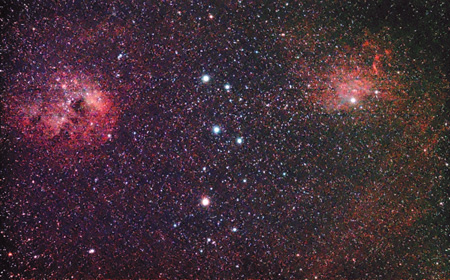
Cloudless skies eventually

Our biggest mini star party of the year was this morning.
We arrived last night to set up for it.

After some coaxing, Don arrived way early to unlock the gate and let me in. I wanted to be all set up before sunset. I watched the sunset, big and red, with a touch of pastel oranges and purples in the high clouds to the west, and realized that M74 and M77 were not going to be there by the time i got the scope set up and the clouds cleared.

Well, after installing 2 new silver handles on the GWS so i can pick it up and put it on the EQP, the sun was down. The process of collimation of the primary and alignment of the finder with the main scope took another 15 minutes… That was the good news. The bad news was that the clouds, predicted by the CSC (but not the American simulations) really did persist. Those of our number willing to set up scopes in advance did so, and we waited for the clouds to clear, after seeing a nice sunset.

It was about 10 PM before the clouds parted, but that did not stop us from having hours of conversation, some even about astronomy(!).

The Sky Quality Meter (SQM) was reading about 18.4 in the darkest direction of the sky, and 17.8 towards Hamilton, which is not much better than a night with a half moon, but that’s because of all the high clouds. Kerry called home to get Bill to clear the skies, and he reported the clouds would be gone a few minutes after 10 but he was ‘doing everything he could’ from there.

I could see Saturn and Mars glowing right through the clouds, and decided to swing the GWS in their direction. After a few seconds I was able to announce that Saturn is in the GWS, and conversations and cookie eating contests were suspended while everyone got pretty fine views of Saturn. Jim and Don also pointed at Saturn. The high clouds made it a bit dimmer, which was good, but still nice and sharp.

Near 10 PM, some of the regulars decided to pack up and head home. We bid them a safe trip but also reminded them of the impending great skies.

This was the night for me to get the XTi to do some imaging through the GWS, along with a Barlow. Mars was so bright that I had to use 1/10 second exposures! It was not long before my card was full. Thanks Kerry for helping me to get it focused.

I also got some excellent shots of Saturn, and will be combining them with DSS soon.
Don imaged a litany of DSOs. Then dewed up. He deployed his backup scope, and continued to image. Jim also dewed over, and discovered a connection failure on his dew shield (the power cord was not pushed into the socket all the way). Luckily several other dew-free scopes remained available. It was about -2C, and there was frost on my car.

Jackie’s mission of viewing the Antenna Galaxy in Corvus paid off at last. We used star charts to point the GWS, and Kerry used GOTO to point her scope. The result was something that for a fleeting second actually looked to me like a stylized W with a loop in the center. I hope the photos bear that out. (not, see below)

We could see Vega, and Deneb, and M57 looked fine, as did the double double, which Kerry was able to see. On closer examination I had to admit the stars were elongated, but i was not seeing pairs.

By the time we left, the SQM was reading about 20.2, in the direction of Corvus, which is pretty good for Binbrook.

We packed up a bit after 2:30, after spending as much time as possible hunting DSOs against looming fatigue. 3 of us headed for TH, to discover that once again, all the donuts were in the trash bin. Oh well, the drinks were good, and i was still full of excellent cookies, and hot chocolate from the park.

___________________________

Update and Photos By Kerry:

What a night and such an incredible turn out. Practically the entire gang showed up. It was a little worrisome in the beginning because it didn’t look like the clouds would clear out nicely… but thankfully it got dramatically better after 10pm and after midnight the entire sky was almost cloud free.

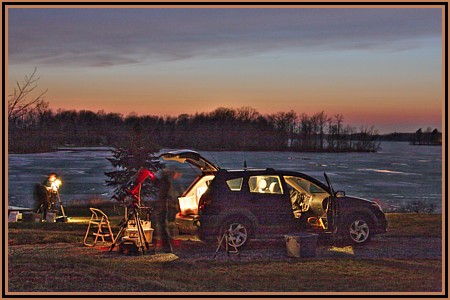
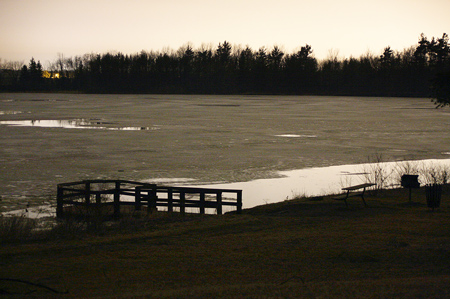
Icy waters of Binbrook at night:
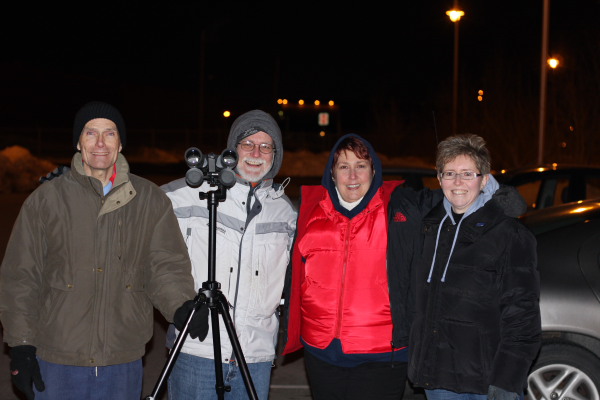
The Gang:
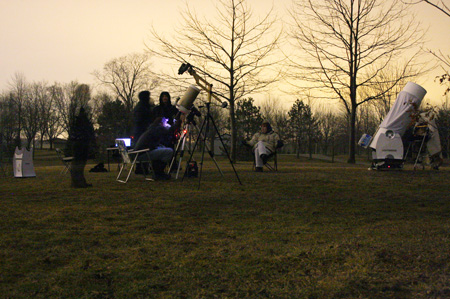
and Dave in the distance with his brand new C8-SGT:

We got a real treat near the end of the night/early in the morning, thanks to Jackie’s obsession with this antenna galaxy. We finally found it in the GWS and could almost make out structure. While we were enjoying the views I dialed it up in Carte du Ciel on my laptop and started imaging it. What an interesting looking pair of interacting galaxies. It was really low in the south and there is a lot more interesting structure that could have been picked up with more exposure time.
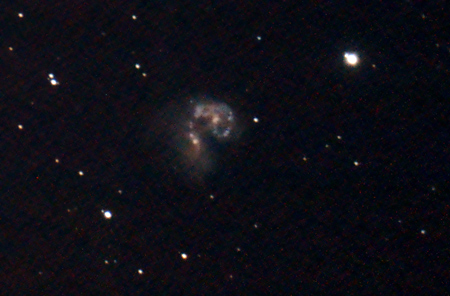
I couldn’t believe I stayed out so late. I also imaged M81… I’ll get to processing that later. We also watched the summer triangle and Scorpius rise and got a sneak preview of a few late spring/summer targets.

Update by Tim Harpur
Well, it was a nice turnout despite the uninvited clouds. I didn’t manage to get any astro-photos so I took the opportunity to take some “standard” photos instead.
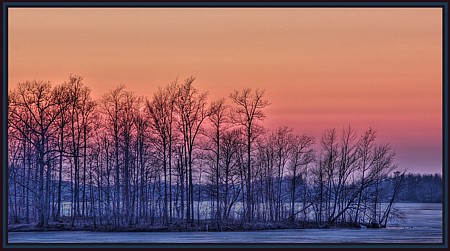
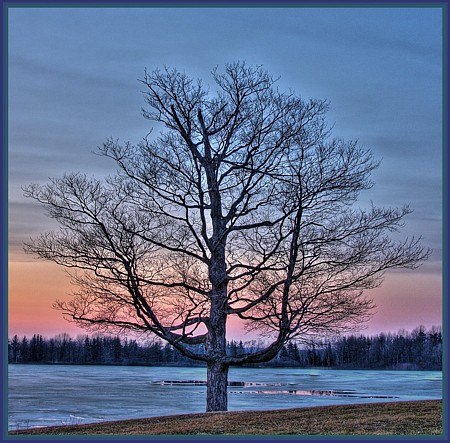
Binbrook under dark steady skies

We got to the gates, all together, at just about 8 PM. After putting on the combination lock, in anticipation of more astronomers, we continued to the end of the road. The sqm read 14.4 in the waning glow of sunset. The half moon was hours away… so many places to go, things to see.

Tim, Wayne and I set up at Binbrook near the pavilion, on the paved road. Jim and John arrived shortly. They aligned their scopes while i constructed and collimated mine.
There are a lot of trees near there, fortunately mostly deciduous, except for one pine tree between me and Andromeda. Weather permitting, the hill has a better view of the sky, but it’s really nice to be able to put equipment down on a dry paved road instead of juggling it. Tim set up his camera for wide-angle shots of Orion, and Jim and John set up their goto scopes. Wayne set up his scope and soon his family arrived to share the views. Saturn, Mars, M45, and M44 were steady and sharp in the scopes tonight.

About 9:30 the ISS and ATV came by for another pass. We were able to see them both in the sky, and track them with the GWS, although one person tracking using the red dot finder and a different one looking through the scope.

Soon we were sharing views of DSOs. John had a wide enough field to show 2 clusters from Auriga at the same time. I fished them up one at a time for practice. M35 has a nearby much smaller open cluster NGC2158 which we were able to glimpse in his and Jim’s scope. A big enough scope can see through trees, and the GWS was up for it.

I was able to point the GWS at M35 with a minimum of effort, and from there down to NGC2158
which was like a very fine pile of small diamonds.

We shared views of various DSOs and eventually John brought out the Pentax eyepieces and we gave them a try. Once the Pentaxes started moving, it was just a case of seeing how much magnification they could bear. M3 was a delight, and improved with magnification each time we tried.

In the GWS it was positively stunning, even at just 150x. We reached for a Pentax 5 mm and achieved 365x, and it still looked nice, with fine stars. I love my equatorial platform… M3 stayed neatly centered for many minutes while we made eyepiece changes and walked from scope to scope to compare.

We put a Big Barlow on the 5 with the GWS, for a magnification of about 730x, and it did not really improve the view of M3 much. But the EQP held it steady. I think i preferred it under more like a 5 mm view (365x).

The LPR filter did not enhance any views from Binbrook. I still hold out hope for it
from other sites I frequent though.

M104, the sombrero galaxy, was easy to find in Corvus. In fact, i was pretty much hitting the nail on the head each time i reached for a M number.

Items we visited tonight…
The double cluster, and some views in Perseus, m42; m44 an easy naked eye target tonight; m45 of course, including in binoculars; Saturn; Mars in cancer; M36 M37 M38; M35 and NGC2158, M51 at midnight (My next SMM object); M35 which looked like it had the outline of a space shuttle with stubby wings, neatly arranged vertically waiting for takeoff. M13, M92, M104. I wanted to try the double double, and M57, but it was through trees and just rising as the clouds rolled in at 12:30 AM. Cygnus was through trees and low over Hamilton when the clouds rolled in. M27 would have been a pretty sight tonight.

I tried to use my EOS again on the GWS. This time with a low profile T adapter it is still too far to focus… but i tried the barlow and that brought things to a focus. Unfortunately, without wanting to risk my night vision, i did not have the time and energy to focus the system, so my first 2 astrophotos through the scope turned out to me more like test shots….
but at least the nut has cracked.

The Hyperion 24-8 zoom eyepiece turns out to be inferior to a good Pentax, as you might expect, and zooming did not help me identify any more stars in the Trapezium. I got stopped at 5 stars. Also, while zooming, adjustment of the focus is required. This is not as i was told at the store… i am not happy with my purchase. I am hoping its ability to save me fumbling for eyepieces on dew filled summer nights will partly make up for my disappointment.

I am happy with the performance of the Big Barlow though. Thanks, Mike. It was such a fine night that i neglected to use the SQM in the heat of the moment. Speaking of heat, it was pretty cold, but there was no dew or frost on the scopes, although a bit on my car. I managed the night without gloves till it was time to heft metal at take-down.

I remembered the SQM on the way to TH… skies on the road away from Binbrook were at 19.75 on the SQM. It was not particularly dark in that regard, but the seeing was steady and transparency was good.

Around 12:30 AM, clouds could be seen rolling in from Hamilton, and we decided to pack up
and head for TH. Turns out, they toss out all the food at 1 AM. Not just move it to the back room, but straight into the garbage. We thought about the energy spent making the food and how it might do better to send some of it to a homeless shelter, or maybe just keep it till the ovens are making the new batch… but alas, no dice. Summertime is going to have even later evenings… i guess we need a backup plan for after-food.

We still managed to spend 80 minutes chatting up a storm about everything from the dark skies of Alsask Saskatchewan to the skies of Mountsberg Ontario, better uses of leftover food, and the magnificent plumage on Turkey Vultures. The Qu’Appelle Valley and the Rockton World’s Fair.

If you know the combination, join us, if not, join the club and ask someone, and find out! The skies are fine, the equipment is able, and the astronomers are friendly!

UPDATE by Tim Harpur
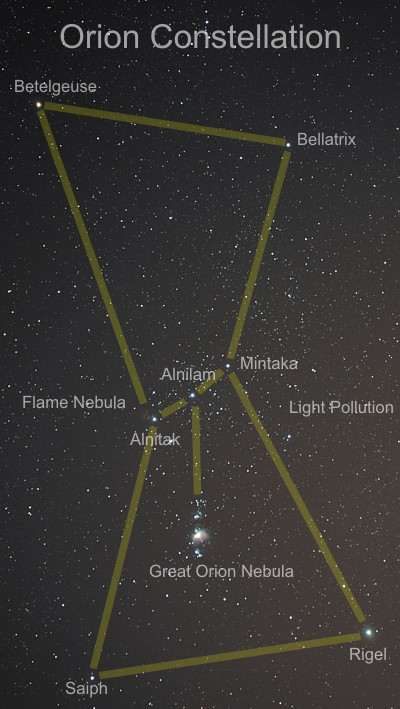
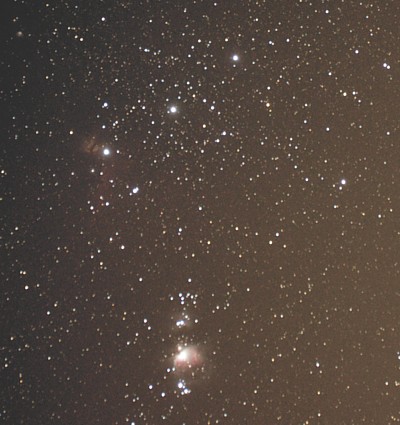
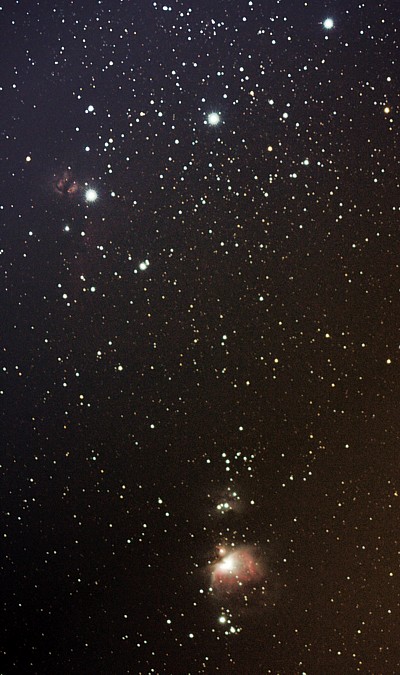
I spent my time testing my 50-500mm Sigma “Bigma” Lens on Orion. The first set is very wide field (50mm)- with Orion being so low in the horizon and setting early – light pollution (seen on the right as I rotated the images 90 degrees CCW) was a major limitting factor. The following were all shot at ISO 1600 – 2 minutes each – then stacked – each image only has about 8 images stacked so not the highest quality.

The following is a close up cropping of the belt from the above images (it is not a seperate shot):

The following image was shot at 161mm.

Touring Gemini from the Gem-‘n-I

It’s actually quicker to drive to Grimsby than to Binbrook from where I live in Burlington; it took about 30 minutes including time to gas up the car (ok, it’s further than Binbrook).

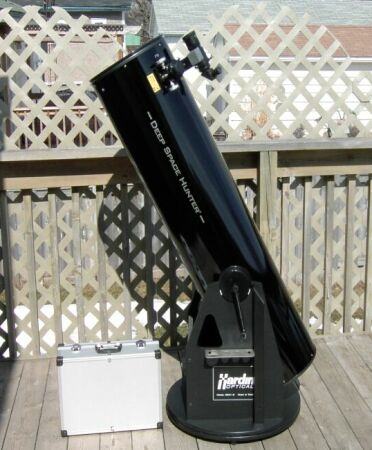
I arrived to see Glenn and Gail’s sleek new Deep Space Hunter telescope set up in the Gem-n-I Dobservatory, and Glenn was busily aligning the finder-scope with the main scope, using Betelgeuse.

The DSH is a solid tubed scope, with a black body and is about 5 feet long. It’s got a well fitting cover for the storage, with some ports that may allow solar viewing also. Springs balance it for setting at any angle.

I decided to unpack the GWS just as a backup plan, in case the queues at the eyepiece got too long. Kerry arrived during the process.

Before the moon rose, the SQM read about 18.8 at the zenith, and about 17.0 in the skyglow over Toronto and Hamilton. It was down to about 18.2 at the zenith once the moon was in the sky. Kerry was keen to view M108 and it dutifully presented itself to her keen eyes. I tried with the GWS but the lack of protection from ambient light made it a very difficult project, which did not come to fruition.

The Dobservatory really cuts the ambient wind down. It’s a fine piece of architecture for the purpose. It also limits stray light from streetlights and neighbors backyards. The Orion nebula came out looking very nice with wings wisping off in 2 directions. The Eskimo nebula in Gemini likewise provided a treat, and we drank in long views of it as it slowly proceeded from one side of the Ethos to the other. We took advantage of the mobility of the DSH and repositioned it a few times in different parts of the floor space.

Saturn’s moons were visible, and the rings were well defined during times of good seeing, with a thin line of shadow above them on the planet. There was a bit of distortion at other times, so it was necessary to wait for the best view. We managed to detect 5 moons of Saturn, and one nearby star, and confirmed it with CDC on Glenn’s able laptop.

The limiting magnitude for stars in the sky to the southeast was about 4.0, and the stars of Monoceros were sometimes visible and sometimes lost in the sky. Nonetheless i eventually did manage to zero the GWS in on M50, but not until i saw it in the DSH and confirmed its star pattern on CDC. It’s times like this when a dark sky is really to be appreciated.

The moon rose at about 10PM and we directed our scopes to it once we ran out of other fuzzies.
Without a moon filter, it was very bright, and virtually full. The terminator was very close to the edge, and there was some crisp detail to be seen there. Taking advantage of a bright target, I see that the focal distance outside the GWS is about 2 inches now that i have cranked up the mirror screws. I am hoping my new combined t-ring-t-adapter arrives soon.

I was delighted to learn a few more features of CDC including the ‘more stars, less stars’ feature, which helps make the chart appear similar to the finderscope image. Thanks, Glenn and Gail, for a fine evening out under the stars!

Hunting down Comet Holmes + some new images

The past two weeks have been a bit better than normal when it came to clear sky opportunities. I’ve been taking advantage of them to catch up on some old and new targets.

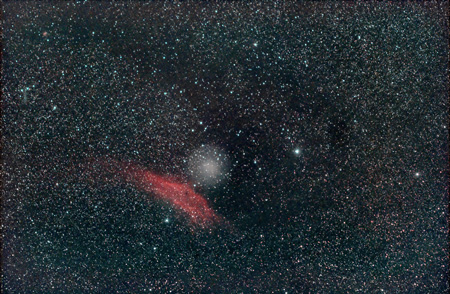
Where is comet Holmes? Well currently it is pretty close to the California nebula. I attempted to image this rare meeting with my Canon camera and 100mm lens piggypacked on my c6 SCT. THe California nebula is about the size of Orion’s Sword. So that should give you a feeling of how large Holmes is now. It is also extremly faint. During processing I was able to pick up detail more easily in the faint HA nebula (with my unmodded camera and LPR filter) than I could with Holmes.

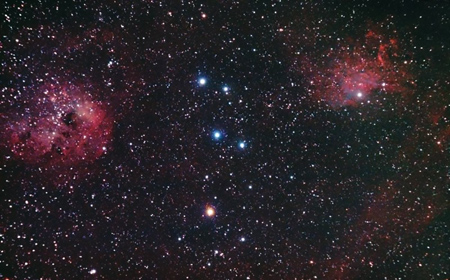
IC410 and 405 revisited. I added about an hours worth more frames to see what improvement I could get. It turned out the viewing conditions that night were horrible. THe sky glow got continually worse as moisture increased in the lower levels of the atmosphere. But I was still reasonably happy with the results… thanks again to the LPR filter. This filter is making me realize that if your skies are reasonably dark (mag 5 to 5.5 or better) then you can probably get by without having to modify (remove the IR filter) your camera.

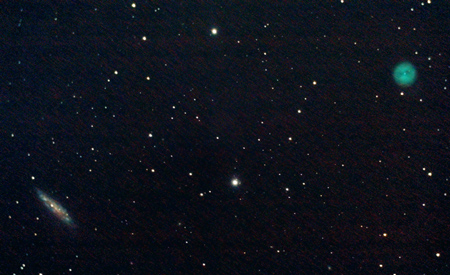
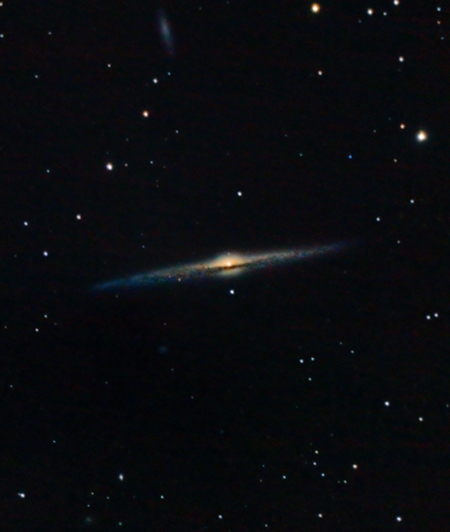
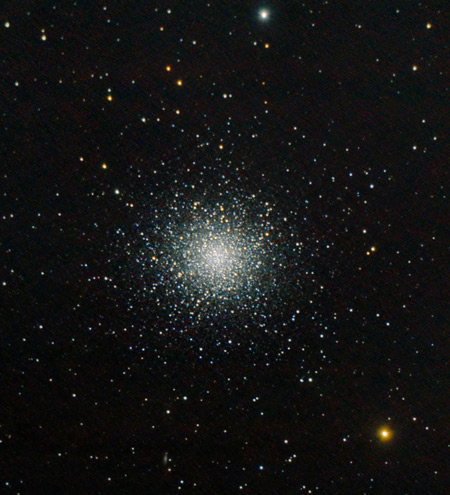
This past Sunday with the moon at first quarter I picked up a new target: M108 and M97 and added more frames to some old targets NGC4565 (one of my favourite edge on spiral galaxies) and M13.

M108&M97

NGC4565

M13 Globular CLuster in Hercules and tiny galaxy IC4617

Image details and more hi-res versions can be found in my latest images section on my site: http://www.weatherandsky.com/main.php?g2_view=core.ShowItem&g2_itemId=101

KerryLH

Impromptu clear skies at Binbrook

I headed out at about 7:10 PM and arrived at Binbrook Alternate site to see John, Jackie, John, and Jim all set up. (maybe I had better change my name to James, or something). It was still light out, so i aligned the Equatorial Platform (EQP) on Kochab, instead of Polaris. I can now say that north is about 4 degrees west of the line of Tyneside road, so no need to wait for the dark if doing visual observing from there anymore.

The moon, well lit, was nearing the zenith. The wind was very slight, perhaps 2 km/h, and the temperature was around -3C. I was alerted to the fact that the GWS would be later requested for a cameo on a certain NGC object, near Spica. Little did I know the target would be large and with low surface brightness. We need no moon for that one. It’s going to be a surprise when we bring it in. At the time, Spica was still below the horizon, so we first slewed to
the double cluster, which came out looking absolutely crystalline in the GWS.

I found a lovely red star in the sky north of the big dipper bowl. Appropriately, it’s name starts with J too, Juza. It’s a fine red star, only slightly variable, near magnitude 3.8

The double cluster was admired in Jim’s scope, while i searched the pocket sky atlas for the best way to find it when not using Goto. I found it under D in the open cluster listing, which also included many other clusters, not just messiers. I now know how to fish up the double cluster without an atlas. I wonder if I will be able to do it next time. If the moon had not been up, it’s practically a naked eye object. I think the moon helped make it better, because it washed out some of the background stars, leaving the brighter ones to be seen more distinctly without distraction, much as a string of streetlights seems to come into view one at a time, out of nowhere as you drive on a foggy night. The other lights are completely hidden.

The trapezium showed 5 stars, but a barlowed 7 mm zoom eyepiece was just too difficult to
keep on target for me to comment on whether there was any chance of more stars. Saturn was showing 5 moons: a bright one, a pair, and 2 slightly more distant moons, one on each side of the planet. I’ll be shopping for some more eyepieces in the near future.

The moon also afforded the most clear and fabulous views this evening. The clarity was almost perfect. There was a slight shimmering to the moon’s surface, but it in no way took away from the very fine white and shadowed nature of the moon. Aperture was giving resolution this fine night, and the scopes were standing up to 150x and 250x magnification without any sign of strain.

John’s excellent Pentax eyepiece brought in Saturn very nicely. The GWS also provided excellent views of Saturn, along with a 26 mm barlowed series 4000 eyepiece, which brought about 70% of the moon’s disk into view in the eyepiece.

A few visitors came by and were treated to positively outstanding views of Saturn, and the moon. The tree line at the alternate site plays a role in target selection, and I am not convinced that it will be a good place to complete a messier marathon.

We decided to pack up a bit before 11 PM, as the moon was so dazzlingly bright that all DSO’s were pale by comparison, literally and figuratively. It took about 20 minutes to pack up the GWS and close the VW so that we were all ready to leave.

The Tim Horton’s was well prepared for our arrival, with nobody at any of the tables, but a few patrons at the drive through. A box of Tim-bits seemed to satisfy everyone at the table and room for a few more guests, had they attended.

We reminisced about many things, including the 70’s the 80’s and the 90’s. Clowns, beards, and blades were considered in all combinations.

The old HAA logo was fondly reconstructed with the help of collective memories. The lineup for new HAA apparel was discussed.

The rims were rolled up and 2 of three of us with coffees won the privilege ‘Please play again’. They were delighted. One free coffee also resulted. I was informed that certain members of our club have unbroken ‘Please play again’ winning streaks, still in play.

A few gems went by, such as discussion about donuts of ‘legendary size’.

Plans for GO#4 were considered, but alas, the kybosh is upon it. Clouds of legendary size are coming our way.

Saturn Observing (Not!) at PCDC

While I had internet access, regrettably I was not able to get to my email this afternoon. After the promising clear skies during the day faded to clouds, I was concerned whether our observing session with the public was going to be canceled or not at Parks Canada Discovery Centre. So assuming the occasional breaks were a sign that we’d be able to do some viewing, I packed the car.

I got to the PCDC early to check out possible viewing locations and give myself enough to set up all the gear I brought. The ground was quite soggy in some spots and snow covered in others. Plus the clouds were looking worse, so I held off on the setup.

By the time 7:30 rolled around, I realized I was still the only HAA member present. I started to call around and found that everyone I tried to reach was either not home or wasn’t coming down. No one could give me a confirmation whether the event was still a go or not. I finally reached Jackie and she indicated she was going to come down shortly after 8.

At 7:45, I still hadn’t seen any members, nor any of the public. I was getting concerned. But just before 8, Heather N showed up and a small family. I set up my binoculars to try and glimpse the moon as it appeared between the nimbus clouds, when only obscured by the cirrus clouds. Needless to say, the view was disappointing. I did enjoy talking to the family and the kids took a look at the moon.

Shortly after 8, Jackie arrived along with Mike J and Steve K. Eventually we got one more member of the public to join us and we had 5 each of club members and public – all out to see the clouds and the fleeting glances at the moon.

HAA Troopers smiling even without breaks in the clouds

While we were all enjoying the discussion in the parking lot, eventually we decided to pack up (just my binos – one of my fastest tear-downs) and the HAA members retired to a local Tim’s for more friendly chat. (P.S. I’ve been having great luck with the Roll up the Rim contest. On Sat I won 2 more chances to “Play Again”. Wow – everytime I play.) Wrap-up occurred just before midnight. As we left, we could barely make out Saturn and Regulus and a halo around the moon from the ice crystals high in the atmosphere. Not a stellar observing night – but fun none the less. Hopefully we’ll try this again soon, but with better sky conditions. Unfortunately Mars is receding quickly and it will be even less impressive than it would have been tonight, had we been able to see it. It has been a tough winter for observing, so here’s hoping Spring will be better.

How can they keep him down on the farm

Noticing the Clear Sky Clock (CSC) predicting a fine night, but checking the maps and knowing lake effect cloud could roll in, I nonetheless packed up and headed for Lynden to do a dry run of the messier marathon to see how I could do on the M74, M77, M33 and M110 while they are still pretty high in the sky.

The SQM read about 17.6 and 16.42 at the zenith and crescent moon respectively.

The Messier Objects taunted me for about 2 hours, while i tried various means to ascertain I was definitely looking in the right direction. The sky-glow over St George is pretty strong and it washed M110 right out of the image, as far as I could tell.

I had 3 mishaps which i plan to avoid next time. I forgot the water bottles and had to rig something up that was using a jug of washer fluid and some baling twine. I neglected to bring my Messier Marathon object list, and therefore, after the first 6, I would have to do some serious book flipping. I knew that it would cloud over around 4 am and that there’s no way I would finish the marathon tonight, so I carried on, regardless.

The third mishap was that Cartes Du Ciel installed on my laptop had only the bright star catalog, and I could not figure out how to add the tycho catalog without the internet. When I zeroed in on something, i was planning to call up the star field and compare it, but alas, not this time.

This was the first time using the GWS since the Astrophotography mod, and as a result I had to realign it. I was pleased that the marked struts repositioned the laser dot in the center of the primary without adjustment.

When I tried the Meade 26MM series 4000 eyepiece, I had to adjust it outwards a bit more before I could bring stars to a focus. (ie, it’s not resting against the focuser stop).

I noticed, to my chagrin, that pointing the scope in a different direction (altitude angle) resulted in a slight shift of the laser dot. I wonder what it means to be aligned, and how far off an unaligned scope is. I know how far it can get when it’s really bad, just not what’s necessary for ‘acceptable enough alignment’. My guess is that the answer is eyepiece specific.
I do know that when it comes to finding messiers, a sharp focus is essential, as some of them appear like fuzzy stars (when there’s skyglow to wash them out).

I looked for M31 and was able to clearly see cassiopia but not much of andromeda, so I had to
verify relative positions of stars to guarantee the place was right. Eventually I got M31 and M32 in the frame, and proceeded to search for M110, but without a decent star chart, there’s no way the pocket sky atlas was going to afford me an unequivocal confirmation of the location matching the eyepiece.

I managed to navigate to M77 and study the space around it. It’s sure faint. Mira was too dim for me to positively identify it against the twilight, skyglow, and approaching haze, and lack of detailed star charts.

Hmmm. I wonder. Is the messier marathon a pointing challenge or a seeing challenge. Since goto is not allowed, I suspect it’s the former. If it was a viewing challenge, then a goto scope should be OK. My 2 cents. So sketching the star field around the putative nebula should count as a ‘sighting’ even if the skyglow precludes positive identification of the item itself. Even the GWS was having trouble cutting through the haze. I am starting to think i need a darker farm. The SQM never read more than 19.7 for the location, even at 10 PM. I will admit the snow reflects a lot of light, but I would love to have equivalent figures from Binbrook for last night.

Dave came to visit me. After explaining what I was attempting, I decided to do some outreach… I slewed to Saturn (actually, a gloved hand can do that pretty fast) and showed my buddy the view. He was impressed. He thought that the yellow spec in the sky might also show rings to the naked eye. I explained that he could probably not see the rings on the planet by looking in the sky without a telescope. I guess he insulted the GWS and I did not notice it.
We also checked out Polaris. I explained it’s a quintuple star, but not the brightest star in the sky.

He wisely headed inside after that, while I considered what to do next.

With M74 all but hidden in the sky-glow, (even though it still had another hour above the horizon) I decided to declare defeat on that one, and try some AP.

Turns out that the GWS is still not astro-ready, (at least for DSLR),
since my T adapter and T ring are collectively still too long.
I can crank the mirrors up some more, but according to my estimate i need another inch,
which is impossible, so i must have something wrong with my estimation.

Without a bright object to operate on, a test of the focal distance on paper was not worth doing.

So it looks like winter 3, smrg 0 for tonight. I will re-pack the car and anticipate the next opportunity. Perhaps lunar observing is the best lemonade.

A nice get together

Well last night was supposed to be very hopeful for observing. I had some HAA friends/regulars come over to do some observing on my driveway. I had the 12in LB out and my AP setup ready to go. There was a really nice turn out with three cars, a few extra scopes and 6 amateur astronomers (including me). Unfortunately we only had about about an hours worth of viewing before unexpected clouds developed over us. Even with the shortened observing session, we still enjoyed ourselves with great stories, cookies and hot chocolate.

IC405 and IC410

I managed to get this image of a faint HA region in Auriga (IC410 and IC405 flaming star nebula). I was very happy with the nebulosity that I was able to squeeze out of this considering I only had 4×4 minute frames (16min) with my unmodded camera and the celestron UHC/LPR filter. This filter is great!!! and I think it (or something similar) is a must have for unmodded cameras. I have tried this region without the filter and the red portions barely show and end up looking more of a dark burgandy colour. Originally I was hoping to get about 1.5 hrs of this target last night. Hopefully I will have more opportunities before it starts to set behind our tall trees.

KerryLH

Remembering Norman Green

Click here or on the blog entry title to read a recent letter to Mike Jefferson and John Gauvreau remembering the late Norman Green.

Globe at Night – How many stars can you see?

It’s that time of year again when you are asked to go outside and count how many stars you can see from your location. Don’t panic – you don’t have to count the entire sky (that would keep one busy for a while – unless its cloudy).

Globe At Night is a program where you count as many stars as you can see in the constellation Orion and report to their website. This is an annual program to track how skies are brightening over the years with increasing urbanization and light pollution. It’s been estimated that more than half of the world’s population now lives in cities.

This is a simple observing program but provides useful information which in turn can be used to help promote policies to preserve dark skies. It is sponsored by GLOBE (Global Learning and Observations to Benefit the Environment) and NOAO (National Optical Astronomy Observatory). It is international in scope. Last year more than 8000 observations were reported from more than 60 countries.

To make determining the limiting magnitude of your skies easier, the website has some charts . You simply match the number of stars you can see in Orion with one of the charts and it tells you how dark your skies are. Print yourself a copy of the charts, take them outside, and begin counting. If you have one, you can optionally use your Unihedron Sky Quality Meter to take a reading.

You’ll also need to know the date and time of your observation, along with your location. Your latitude and longitude which, if you don’t know it, can be found using a GPS or websites such as MapQuest or Google Maps. Or you could use a topographic map – and even city or provincial road maps. The more accurate the better.

Once you have your count and determined the limiting magnitude of your sky that night, go to their website and report your result. You’ll need at least Windows 2000 with a current version of Flash viewer to be able to enter your results. Internet Explorer 6 or later and Firefox worked for me.

It’s a quick and fun observing project and doesn’t require setting up telescopes or standing out in the cold for long hours. However if you’re feeling ambitious, you can even collect data from multiple sites.

The program runs between Feb 25 and Mar 8. Have fun!