Kerry’s photo on APOD

Kerry’s 5 Jul 2008 composite photo of the summer Milky Way over Binbrook Conservation Area has garnered further recognition.

Today her photo appeared on NASA’s APOD (Astronomy Picture Of the Day). This is an internationally recognized site, where professional astronomers review submissions and only select those which are significant, of high enough quality and/or scientifically meaningful. From their comments, it appears to have satisfied all categories.

This link has been updated to point to the permanently archived photo.

http://antwrp.gsfc.nasa.gov/apod/ap080729.html

Well done Kerry!!

Kerry indicated by email that her website has received over 20,000 hits at that time. Understandable. I’m sure she’ll get lots more.

Faint Objects in Cygnus

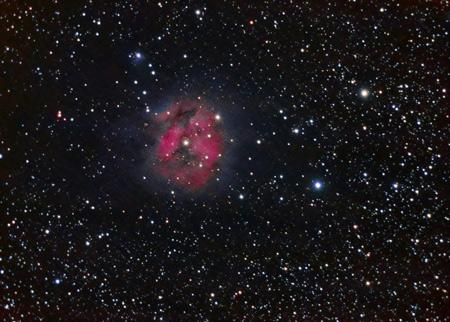
Athough I haven’t posted in a while, I have been getting out for observing and imaging. Last month I concentrated on collecting many frames on the Cocoon Nebula IC5146 in Cygnus. THat target has really proved it self to be a difficult one. The first night I took about 2 hrs worth of 5min subs and the second night I added 3 more hours to it. THe cool thing about this nebula is the area of dust that is surrounding it and trailing behind it, blocking out many of the stars in the night sky. I may attempt a widerfield version of this at a darker site with a wider and faster lens to see if I can show more of it and hopefully get some definition in the very faint and brown dusty portions.

Cocoon Nebula, C6 SCT @f6.3, Unmoddified Canon 40D, 5hrs (5min sub exposures) ISO800

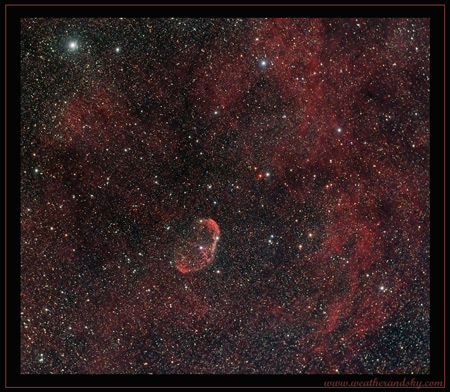
THis past weekend I took on another challenge to image another region in Cygnus. The Crescent Nebula, NGC6888 is a small crescent shaped nebula that is energized by the winds of a bright star within it. YOu can see that surrounding it is a large area of Hydrogen Alpha. Typically these HA targets are very difficult to photograph with unmoddified cameras like mine, but the Astronomik CLS filter really came through for me again to make it possible especailly with only 2 hrs worth of 5min exposures @f5 from home under mag 5.5 skies.

Crescent Nebula, SW 80mm @f5 (400mm fl), Unmoddified Canon 40D, 2 hrs (24x5min) ISO 800
A larger verion can be seen here:
http://www.weatherandsky.com/main.php?g2_view=core.ShowItem&g2_itemId=1746&g2_imageViewsIndex=3

Back in June I captured a few more images of the Western and Eastern portions of the Veil. THe pics are linked below… sorry I didn’t post them earlier. Some of you may have already seen them.

NGC6960 Western Veil + friends
http://www.weatherandsky.com/main.php?g2_view=core.ShowItem&g2_itemId=1668&g2_enterAlbum=0

NGC 6992 Eastern Veil
http://www.weatherandsky.com/main.php?g2_view=core.ShowItem&g2_itemId=1616&g2_enterAlbum=0

KerryLH

Planetwatch 2008

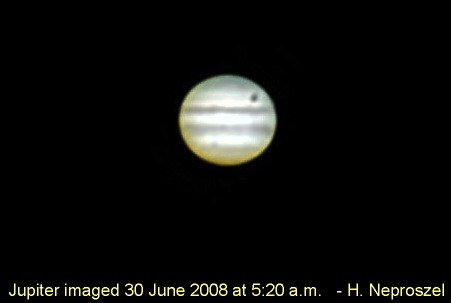
Heather reports imaging Jupiter as it drifted slowly between the trees as seen from her backyard patio. She collected a short AVI on the laptop and set Registax to stack the images into a composite. Her image clearly shows that both equatorial belts are again prominent and the equatorial zome has brightened to its usual cream colour. The laptop laboured while she napped, turning out this stacked image of the shadow transit of Ganymede, way to go, Heather:

Of course, the image posted here is much reduced in size and format to permit posting. No doubt Heather will be giving a talk soon at a HAA monthly meeting, showing more of the images she is collecting with the new scope and imaging equipment. What a great club we have!

HAA Telescope Squad to the Rescue!

Two days before our scheduled public event in Burlington, an urgent plea for help was received via our website:

?I’m looking for some help. I purchased a telescope for my wife. We have not gotten any pleasure out of this as we can’t get it to work properly.?

The email was quickly circulated by our ever-vigilant webmaster, Bob C., and Jackie responded with an offer of help. She suggested the couple bring their telescope to our Burloak Park event where a multitude of HAA members could likely diagnose and solve the problem. Alas, the afflicted couple, Dave & Diane, could not attend at Burloak. What was Jackie to do??? She turned to the HAA TELESCOPE SQUAD, of course!

Jim W., Jackie and myself arranged to meet Dave & Diane at the Binbrook alternate site. We armed ourselves with tools, spare batteries, eyepieces, charts and binocs and headed out to fix that telescope!

When we got to the site, Dave & Diane had already arrived. The telescope was quickly set up and inspected: a nice 130mm f/5 reflector on an equatorial mount! Collimation was within acceptable limits, so we left that task for another night. We determined that the plastic sleeve connecting the motor drive to the RA shaft had been snapped off at some point in time and the motor was not driving the scope. A screwdriver was produced, the RA motor removed and the slow motion control knob installed. We set the mount?s latitude adjustment to about 43 degrees and turned the scope to face north. Beautiful views of the gibbous moon were enjoyed by all and it was easy to track the moon by simply turning the RA slow motion control knob. A new battery was installed in the red dot finder and the Squad began the hunt for the night?s prize: Saturn.

Jim W.?s eagle eyes spotted two bright spots just above the hydro lines across the road and we swung the scope into action! First Mars appeared and a quick glance was all it took to see just about all there is to the red planet right now: its colour. Finally, the jewel of the sky slid into the eyepiece and the view was offered to the telescope?s owner who had waited two years for this moment. ?SATURN!? cried Diane. High fives all around! Various eyepieces were shared and their views compared. (Another benefit of joining an astronomy club: the chance to try out different equipment without having to buy it first!)

Finally, to top off a night of firsts ? a view of Jupiter and its moons. Two happy telescope owners have finally gotten pleasure out of their telescope!! Chalk up another successful rescue mission for the HAA Telescope Squad!

Clearing Skies at Burloak Park

Ten HAA members braved threatening skies to bring astronomy to the people of Burlington last night. Despite heavily overcast skies and occasional light showers, close to 100 members of the public were on hand, some from as far away as Toronto after seeing the event posted on our website!

At first, we entertained the crowd with glimpses of ship & channel marker lights on the lake; distant park signs and whatever else we could find. Most of the visitors had very thoughtful questions about the equipment, astronomy and our club. John G. brought a meteorite and spent some time doing ?show and tell?. Steve G?s remote controlled UFO was a big hit with the kids! Heather displayed some fantastic images of Jupiter taken earlier in the week.

Miraculously, about 10:00 p.m., the clouds began to break up and we spotted the moon. Lineups formed at the 6 telescopes and 2 pairs of tripod-mounted giant binoculars we had set up. Two visitors had brought telescopes in the hope someone could show them how to use them. We helped and the telescopes were soon put to good use! The clouds continued to dissipate until Jupiter and other objects came into view. Natasha, an eight year old aspiring astronomer, spotted the only meteor of the night!

Matthew and Brenda were busy all night long offering views through their giant binoculars. Jackie set up her borrowed Starblaster reflector and I used Alex’s Astroscan telescope as examples of very kid-friendly telescopes. Steve G.?s giant 16? Lightbridge attracted a lot of attention as did the computerized GOTO telescopes of Heather, Jim and Ed.

What a fantastic event! It was the perfect way to put our new banner to good use. We?ll definitely be going back to Burlington!!

P.S. I’m hoping others will add to this post and attach any photos they have.

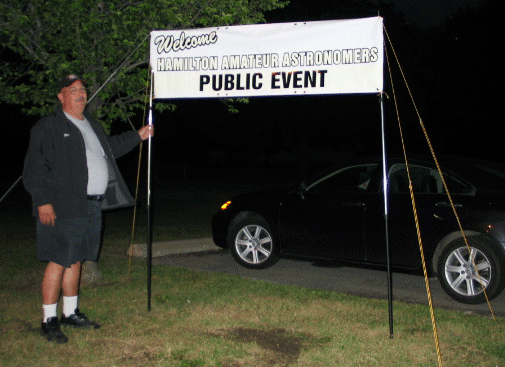
Jim proudly displaying our new banner

Heather & the crowd ignoring the rain

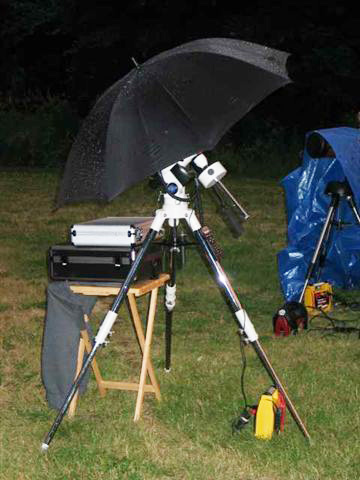
Installing a rain filter.

From John,

The magic that so often accompanies our observing sessions followed us to Burlington and as Ann so capably described, gave us and our many guests great views of the sky on a largely rainy night. I had the pleasure of meeting many interesting and interested people including a youngster half my height (and far less than half my age!) who very properly explained to me why Pluto is not considered a planet any more. I asked if he thought Pluto’s demotion was a good thing or whether he would like to see it considered a planet again. He said that the current status he had explained to me, was correct. I told him that I liked Pluto anyway. The enthusiasm of the youngsters was infectious. Here are a few pics:

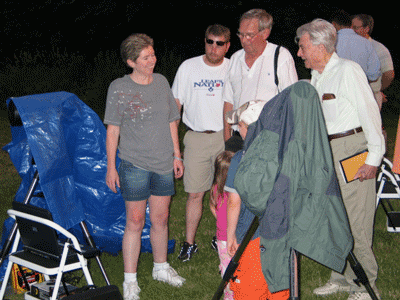
Undeterred by rain, enthusiasts gather at dusk for a night of astronomy.

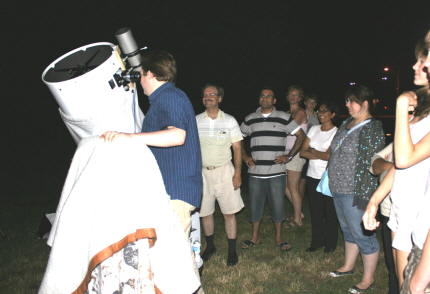
A line up waited to look through Steve’s ‘scope.

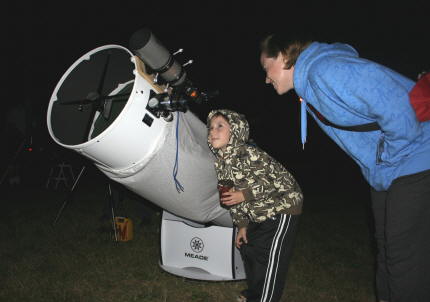
One of our smallest visitors sizes up our biggest scope.

Tired but happy HAA members relax after a very successful public event!

Wind and Rain Reports

JULY 12TH – WIND, RAIN, WAVES OF CLOUD…

The thunderstorm threat kept me from driving to the Burloak Public Night (how did that go?). I took the wet shroud off the pier mount and attached a 6″ Mak while standing on a soggy carpet. As evening wore on the gibbous Moon emerged from waves of windswept cloud, enough for me to marvel at two craterlets in Plato and the terraced walls of Copernicus.

Once it was dark, I dodged cloud banks to capture a dozen 30 second images of M27 to compare with those taken with the 80mm apo a few nights ago. By 11:30 Jupiter had cleared the trees and I showed banding on the planet’s disk, 4 beautiful moons and the about-to-be-occulted star to some neighbours who dropped by.

All in all, not too bad for a thunderstorm evening.

Jupiter and the moon and, well…Jupiter’s moons

A relatively overcast sky kept us from good polar alignment and squashed any hopes of deep sky observing, but Jackie and Jim and I found ourselves on the hill at Binbrook, still hopeful of some lunar and planetary viewing.

Saturn and Mars were in conjunction and at only 3/4 of a degree apart would fit into the same field of view in a telescope. Unfortunately the same clouds that had made for a beautiful sunset also obscured this planetary duo. Since we couldn’t see them both Jim and I used our GoTo scopes to point them at the planets (see, who says I never use my GoTo?). During a very brief thinning of the clouds (no, not clearing…only thinning!) there was Saturn and Mars in the eyepiece. Jim just fit them into the field of view of his trusty 8″ schmidt-cassegrain and after enjoying that view ran over to my small but mighty 80mm refractor and sure enough, there they were. I pulled out the eyepiece to change to a slightly wider field of view but in the time that took the clouds thickened and the planetary pairing was not seen again. Never the less, the magic of the hill pulled through for us and we all had successful sightings.

The moon had been beautiful in the daytime sky but the time night fell it barely showed through the clouds but was robbed of and contrast or detail.

The daytime moon, just before the clouds rolled over Binbrook.

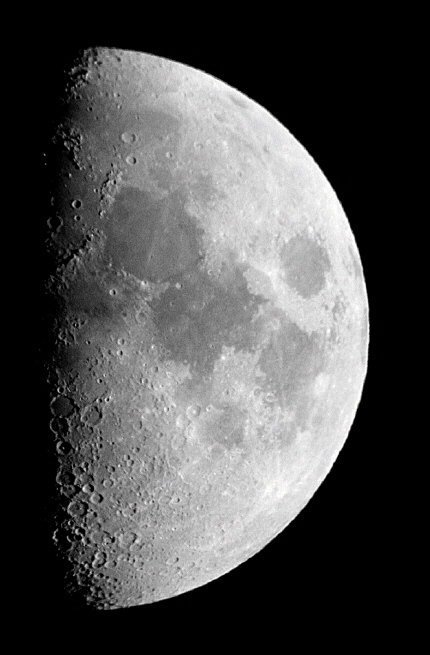
I tried a few shots through my 80mm and was happy with the result. I shot both straight through the scope (prime focus) and afocally, with lens on camera and eyepiece in scope. Here is one of those shots done with a 10mm eyepiece in the ED80:

The moon through the small but mighty 80mm scope.

Jims scope also provided lovely close up views of some wonderful terminator detail. Our closest celestial neighbour never fails to satisfy, even through the clouds!

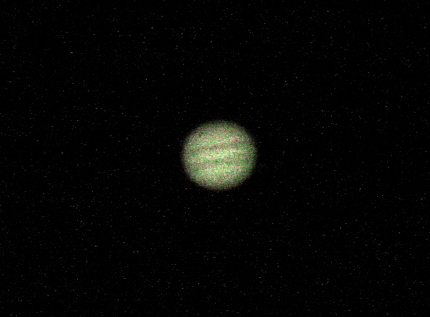
As the night wore on the clouds thinned and Jupiter appeared low in the south. Views through both scopes were wonderful. Jim’s 8″ provided a bright and colourful view complete with 3 moons, and my 80mm was showing lovely detail in the bands, thanks to a filter that Jim gave to me. Although I had been happy with the views before, a combination of a contrast boosting filter and a blue filter made for a strange colour (kind of blue-green) but sharply detailed view. Wow, what an improvement! I had written down the time of Ganymede’s reappearance from behind Jupiter and its shadow but left the paper at home. Since Jupiter was the only thing showing well in the sky we were happy to watch and wait. Just before midnight Ganymede started to emerge from the shadow and grow in brightness. It was a beautiful sight and great fun to watch it move out of shadow and in to sun. Perhaps most remarkable of all was Jackie’s sighting of Ganymede before it emerged from shadow! Without any prior knowledge, Jackie correctly noted the exact location of Ganymede’s reappearance before it appeared! To finish off the evening I even tried to take an afocal image of Jupiter. It shows absolutely nothing noteworthy, but here it is anyways.

This afocal shot of Jupiter shows none of the beauty visible through the eyepiece, but it was worth a try!.

Our perseverance and unwillingness to be deterred by clouds paid off and the three of us had a wonderful time, and all HAA members do when out together. See you in Burlington on Saturday!

CAREFUL WHAT YOU WISH FOR??..

Over the past week the reader might be wondering why there have been little or no Reports of HAA observing activity. The simple answer is that this past week has been, as one observer put it, ?the best stretch of clear sky during a no moon phase in his memory.?

That is not an exaggeration. The sky was surprisingly clear on Sunday 29 June, catching some observers off guard. They were certainly ready, willing and able by Thursday 3 July, which started a four-day observing marathon, ending the night of Sunday 6 July.

Each night of observing was glorious and somehow offered a different flavor of activity, making it special in its own way. There were those beautiful Binbrook sunsets. There was observing, sketching, AP and deep discussion. Jokes, space toys, kids, friends, family and best of all laughter filled the park. The park curious came to look before heading home, and each were welcomed with true HAA fanfare. Then around 2 am, sometimes later, when all was said and done, we packed up for the Horton’s and the traditional HAA nightcap.

The fortunate observers were off work during this marathon, while others found a way to make it through their day. And there were naps, those precious few hours to take the edge off, to get us through. These were days of strained eyes, bad food choices and stamina. Certainly this marathon was not planned. The clear skies just kept on coming. But the most remarkable thing was, that through it all, our excitement and enthusiasm for the night sky never waned.

It truly was an wonderful week of observing, the ones memories are made of, and it goes without saying we made quite a few.

Jackie

The great M68 Rescue

I arrived on Sunday evening at Binbrook before 8PM, hoping to be set up and able to scout out M68, the next item in my Sequential Messier Marathon. Here’s a picture of my team, in a huddle before the action began.

Ed had his ED80 on a tripod, and was watching for the first sign of polaris to get it aligned. I set up the GWS on the hill, after trying to estimate whether there was more horizon from there or from the newly made, excellent boardwalk beside the parking lot at the bottom of the hill.

I snapped some nice sunset pictures, as i waited for darkness. Ann arrived with Alex and Shaune, and proceeded to set up binoculars, and lent me a copy of Uranometria with all the stars i need to get there.

I had my excellent Flying toy saucer again, and it was again a big hit. It flies so high, it’s like scary to think the wind is blowing it out over the lake, so i turn off the power and watch it come falling out of the sky, only to land with a 50m of dry land to spare. It makes an excellent photograph to do a time exposure as it ascends, because of the LEDs on its sides, spinning around. Here’s a picture Kerry took on Friday evening.
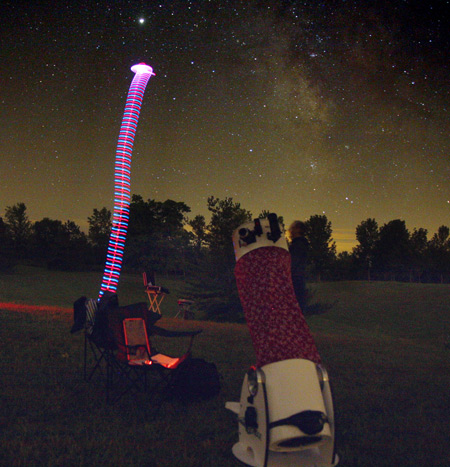
A timed exposure of a luminous object can be impressive indeed

I had also used Cartes du Ciel to print out star charts with stars to 10th magnitude, to get from Corvus to M68. For reference, i also printed enough stars to navigate within Corvus, as practice.

As the sun got lower below the horizon, astronomical twilight started to end and more stars became visible. I strained to navigate the GWS along my designated star hopping path. It turned out that due to the residual sky-glow and extinction, my star chart had way more stars than the sky, and those in the sky were farther apart than the size of my finderscope, making star hopping a practical impossibility.

I guess an industrial approach would be to have a set of star charts printed with different limiting magnitudes. Use of a laptop computer to generate the charts onthe fly would be another option, at risk of losing night vision in the process. It turned out that the limiting magnitude through the GWS was about 8, and that meant that seeing M68 was going to be problematic. Atmospheric extinction at low altitudes of view really swamps the star field.

At about 10:22 M68 set, as viewed from ED’s goto… i mean the location in the sky where M68 is was below the tree line. At the last minute i decided to try an astrophoto of the area to see if i could stretch something out of it. It turned out that at the bottom of the hill, the horizon is slightly lower.

After M68 had safely set, i fished up the chart for the ‘Footprint Nebula’ and started to star hop from Alberio towards it. Now, instead of too few stars, i had too many. The GWS was showing about 2000 stars in a field where the chart had about 50. Jackie and i painstakingly made our way towards it, and got there in a few minutes. I am certain the star field was correct. I made a sketch of the stars i could see and all were on my map. Unfortunately, even with a nebula filter, no nebulosity was seen.

By then, it was approximately midnight. For an experiment, i slewed the GWS (actually rather quick since it’s a dob) down to the spot on the horizon where previously i had been looking for M68, to see if later at night, more stars are visible at low altitude. Even the mighty GWS could only see one star at the top edge of the trees, a far cry from the 2000 in cygnus. So my conclusion is that extinction is real and real nasty.

But not forever, in the case of M68. In early December, it will be a morning object, and i will be out looking for it then. In the meantime, i will be doing Astrophotography, sharpening my star hopping skills, studying some books and participating in the many public events the HAA has planned for the summer and fall.

Many sincere thanks to Jackie, who took my quest as seriously as i do, (or maybe even more so) Ann, and Ed, for being there with me as i tried for the impossible dream.

Steve
Aka Don Quixote searching up new windmills….

Taking Advantage (of all those blue blocks)

If you ask me, these past few nights of solid blue on the CSC is just what we deserve – and you just have to read the blogs to know that many HAA members wasted little time in taking advantage of it. Personally, I divided my time between our backyard observatory and the observing hill at Binbrook.

Starting with Thursday, Gail and I did a bit of comparison viewing with our 6″ dob and the 12″ dob; that is until Gail expressed her dislike of standing tiptoe to view the zenith through the 12″ – you see, I hate bending when I don’t have to, so, like I did with the 6″, I put some legs on the base of the 12″ to raise it up a bit – but it appears I’d miscalculated the height of my observing partner. Anyway, to bring harmony back into the (our) Universe, I cut the legs down by 3″ – call it “reverse-engineering”.

Friday night, we answered the call to join the other HAA “keeners” at the conservation area where we spent our time comparing the views through no less than nine scopes and eating fresh donuts (thanks, Steve). The night was capped off zapping the alien-looking, spaceship-type, weird-lights-in-the-sky, only $49.99 at your local mall, craft with our laser pointers.

On Saturday night, I was tempted to make a return trip to Binbrook, but I wasn’t happy with the collimation of the 12″ dob. Whereas the 6″ would easily show the companion to Polaris, the faster ratio of the larger scope was less forgiving to misalignment. So I took my screwdrivers and barlowed collimating laser and gave the big dob a thorough overhaul which, I’m pleased to say, did the trick. Not only did I have a fine view of the North Star and it’s little friend but the Double Double in Lyra was easily resolved, as well.

My other goal, in staying home was to see how good my local sky was on a good night when most had gone to bed. My laser pointer had a bright beam about 11pm suggesting that there was a lot of particulate in the air, though I’m unsure if it was dust, moisture, or a combination of both. Sometime after Midnight, the scope in the middle of the back yard starting collecting dew on the OTA but the one on the observatory pad, which is not under but near to our large walnut tree remained dry.

By 1am, I could make out the Milky Way. It was fairly distinct through Cygnus near the zenith but just barely visible above the “spout” of Sagittarius. Sunday wasn’t so great, and tonight there is some heat haze and a few clouds but I see the Moon beckoning me so I think I’ll take advantage…