Moon shadow, moon shadow…

The indications were good for observing last night and for the first time in eight (8) weeks Gail and I opened up the dobservatory.
Our main target was Jupiter and, though it was fairly low, we could still see a fair amount of banding with our 6″ Newtonian. And, there was an extra feature – just below the NEB was the tiny but distinct black dot of Europa’s shadow. The moon itself was still in transit and not visible against the planet, however, Cartes Du Ciel indicated that with a little vigilance we would soon see it emerge from the planet’s limb.
We continued tracking the shadow while I got our 12″ ready for some DSO’s until, eventually, a small blip began grow on the edge of Jupiter. Slowly it gained definition as pale round spot until it separated completely and the moon began to “drift away” from its host.
By then it was dark enough for decent views of the Ring nebula and M13 with the 12″ dob – and a testament to the steadiness of the atmosphere over Grimsby, this night, was how well resolved the individual stars of that cluster were, even at low power – we’ve rarely seen it prettier.
We nabbed a few more favourites after that but, being a worknight, didn’t stay out too late. Fall is approaching and we’ve high hopes for many more such nights in the next few months 🙂

Moon Rise

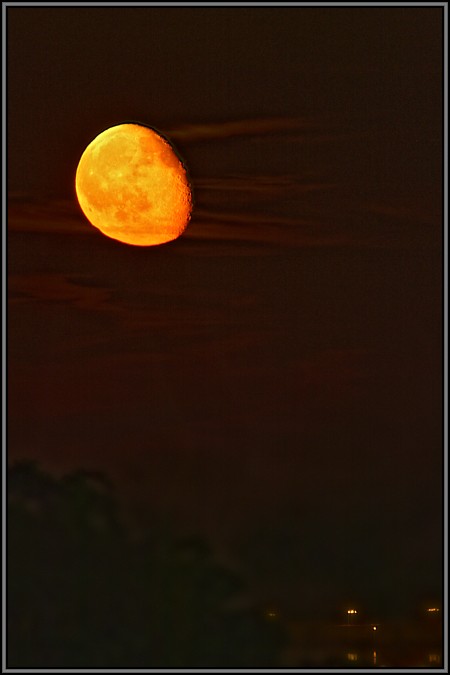
I had a chance to catch the moon rise last night. I had hoped it was going to rise above the Skyway but unfortunately it rose just to the left from my vantage point.

(Perseids)Public night a great success

Arriving at the Conservation area, rainsoaked clouds seemed to threaten our night, but as 8 p.m. approached, the clouds dissipated and drifted off to the east, leaving us a beautiful clear sky. A rainbow gave us promise of a great evening to come.
People started to arrive early, even though the skies were still threatening. As scopes were being set up, John G gave a very entertaining presentation on meteor’s to the 25 or so early arrivals. This was well received by adults and kids alike. As the skies darkened, people lined up at the scopes to catch early views of Jupiter and the Moon. We then began serious meteor watching. Throughout the evening, a lot of meteors were seen by many thrilled people. By 10:30 kids were getting cranky, and most of the public observers were leaving. Most club members in attendance, hung in there for some late observing. Wow!! this was another extremely successful HAA public night.

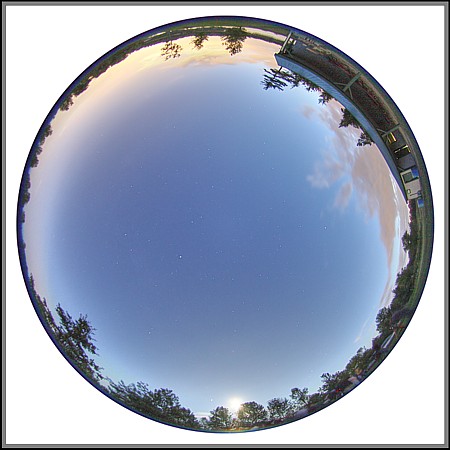
A fisheye view of the HAA Perseid Public Event (taken by Tim Harpur)

Perseid night at Binbrook

About 40 HAA members and members of the public came to Binbrook Conservation Area, were greeted by members at the gate and directed to the pavilion area where we had set up about 6 scopes and plenty of lawn chairs. John gave a very fine presentation on meteors and what to expect in the night sky, also involving some of the audience members in demonstrations of star and planetary orbits. It was an excellent 20 minute talk as the skies darkened and the real show in the sky began.

The moon was up and fogged the sky sufficiently to prevent seeing some of the stars in the little dipper and presumably also washed out some of the dimmer meteors. As Mike mentioned, the meteors are very quick, coming and going within a second. I saw about 10 fireballs over the course of the evening but missed a few beauties that garnered exclamations from some of the crowd members lucky enough to be looking their way.

I set up the GWS in hopes of being able to find Boattini 2008 but it was way too faint to be seen when the moon is up, and the moon did not set until after 1 AM. However the GWS did come in handy for examining a few well-known double stars, Jupiter, the Moon and M13, which looked fine.

I was able to point another members scope at M13. It had a finderscope but the field of view was too small for me to orient on the sky. I groped my way to Alcor and Mizar, then put my laser against the scope tube, adjusting it to point in the direction of Alcor and Mizar. Then i swung the whole scope, laser and all, to M13 and ended up on target.

I served my assigned time at the gate, greeting and dismissing visitors, and then returned to the main crowd in time to help with some of the take-down. After waiting for a couple more fireballs to round out the evening, and providing a feast to a plethora of hungry mosquitoes, i packed up the GWS and left at about 1:30 AM.

Starfest 2008: Kerry’s Rendition

I also had a great time despite the weather. We were lucky to have ‘astro celebrity’ Susan French and husband Allen French setup beside us. Both her and her husband were really wonderful people and so nice to talk to. THey definately got me more excited about observing, and checking out the objects that people typically overlook. I was also happy to have had the support of my fellow HAA friends during the Starfest International Salon of Astrophotography. I recieved an honourable mention (3rd place) in the deep sky category for my M42 image (the one I took back in the fall). It was pretty nerve racking at first especially after hearing the critiqing of each of the images. About 45+ images were submitted, which apperently was on the low side of what they were expecting so they had to combine the beginner and advanced categories into one.

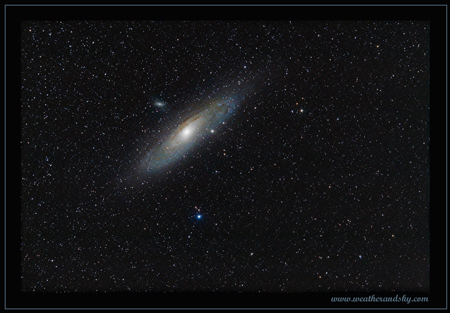
We did have a fantastic clear Friday night where I decided to setup for some imaging. I had lots of issues and one of them included a broken dew heater, but I did manage to capture about 14x3min of M31 (widefield) with the Canon 40D and 100-400mm lens, unguided on the cg5-gt mount.

Canon 100-400mm @200mm f5.

Larger version: http://www.weatherandsky.com/main.php?g2_view=core.ShowItem&g2_itemId=2080&g2_imageViewsIndex=3

When I needed a break I would pop over to Steve G to see what he was up to. One of the highlights was finding and seeing Comet Boattini 2008 in his scope (the GWS). Pretty amazing since it is mag 13.5…. think of all the other comets that can be found in 16in of aperture.

My relatively inexpensive Costco tent held up alright with some leaks during the monster rainfalls. I also realized that the tent doubled as a ‘poor mans’ Astro tent. I was able to fit my 12in LB under the vestibule and observe most of the lower southern sky from there. It had good protection from the dew, sun and a rain (well sort of). Steve took some pics so perhaps he’ll send me a few so that I can post one.

Overall the talks were really informative and that alone makes it worthwhile to go to Starfest. I unfortunately got home sick and packed up and left right after the dinner and final presentation.

KerryLH

Starfest 2008 a great success

I arrived on Wednesday evening and set up the GWS and my tent, with plenty of time to spare. I started out viewing Jupiter through clouds so thick that at times it could not bee seen with the unaided eye. I was able to see bands on the planet and moons when the clouds were not too thick. Some neighboring campers from Sarnia were there, and we toured the sky comparing views in her 8 inch and my 16 inch for various galaxies.

Don had staked out our prime territory on the hill and i moved in effortlessly. We erected a network of poles and ropes and soon had our HAA banner flying high and proud. We tried making a tarp into a picnic shelter. It held fine but had no wind resistance and soon was flapping. I took it down late at night, just as the lightning was approaching.

A visit to the local hardware store the next day for some pipe clamps perked it up enough to stand all day despite the wind, but when the rains came, it was too much for it again. This time, the pegs were tearing out of the ground. Bring on the spiral tent pegs for next time. With multiple pegs at each corner, it was again standing, but the fatal blow came when the grommet ripped out of the corner of the tarp. We got our $1 worth from it, but it was beyond repair given the tools we had.

Wednesday evening had lots of clear intervals and i stayed up until about 2:30 AM checking various directions for deep sky objects, and watching for early Perseid meteors. It rained overnight and i got a little bit of water in the tent, but fortunately, i had put my air mattress in the lowest part of the tent, and the water collected under it, harmlessly. Thursday evening was also good, with plenty of sucker holes to provide a window to the sky beyond. I tarped up the GWS in time to brace for Friday’s storms.

Friday night was clear almost all night, and i was still up at 5 am when the sun started to rise, chasing Orion into the sky. There were low clouds to the East by then, so it was not worth it to keep observing. Steve, Kim, and Alan from BC were visiting family at the park, and strolled up the hill. It was nice to show them the sky, and i fished up a lot of DSO’s from memory, but needed help to find M17, which Dave provided. The SQM read about 21.02 in the darkest parts of the sky, and 20.7 elsewhere.

I looked for IC289 and was able to find it in the GWS, but it’s pretty faint. Perhaps i will see it again at LSPP and the darker skies will show it more definitely. On Friday i was able to fish up 2 boattinis and Uranus and Neptune. Pluto evaded me. It’s going to be a binbrook object, or perhaps something to find at LSPP.

Saturday night was cloudy at first, but after the entertaining and informative talk about the LHC, there was a giant sucker hole (space between the clouds that blows away) in the sky which gradually expanded to almost the whole sky. It was pretty hard to keep dew off things though. It’s time for me to make eyepiece heaters for the GWS to get things more secure.

I had a long chat with Attilla who came up the hill where he could see an uncovered big Dob out after midnight. I learned a lot about many topics. The upshot is that a bigger scope does better than a smaller scope, and that atmospheric seeing does not degrade the view in a big scope. Bigger really is better. I was very happy to hear that.

Electricity was intermittent, probably due to water getting into the circuits and tripping them. It’s a real convenience to have electricity, and noticeable when it’s gone. For a while I plugged into the VW for power, but eventually, just ‘roughed it’. I was able to get internet connections at intervals, and have a big thank-you for Kerry who upgraded my CDC to have comet display in it now.

Saturday night was much cooler than the previous few nights, and i think i will augment my list of gear for LSPP to handle ‘cold weather’ camping somewhat.

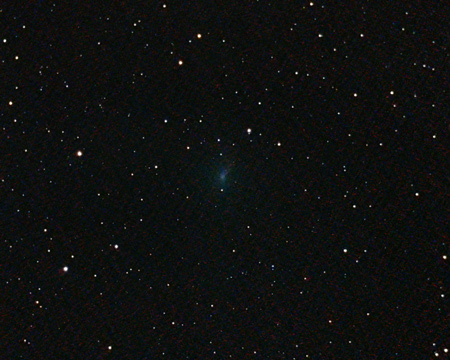
Comet Boattini 2008 J1

A few days ago I had the opportunity to image this very small 13th magnitude comet. I was only able to capture about 7 x 5 min frames with the 40D and C6 SCT @f6.3 before clouds thickened and it became invisible. Since the comet moved over the course of 35 minutes, I had to use Deep Sky Stackers comet stacking method where it allows you to keep the comet and background stars from trailing. You can see in the image that there is a very small tail.

I’d love to get a visual but haven’t had the chance yet… but I have a feeling that it may be too faint for my 12in from home.

Canon 40D, c6 SCT @f6.3 ISO 800, 7x5min

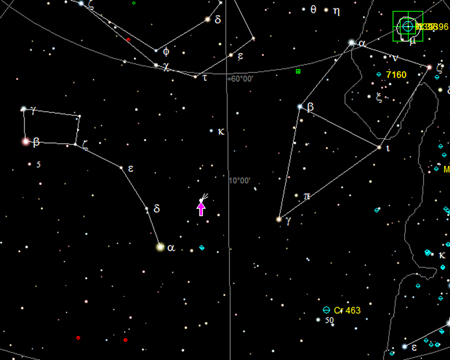
Location of the comet after 11pm

KerryLH

Not Just Light Pollution

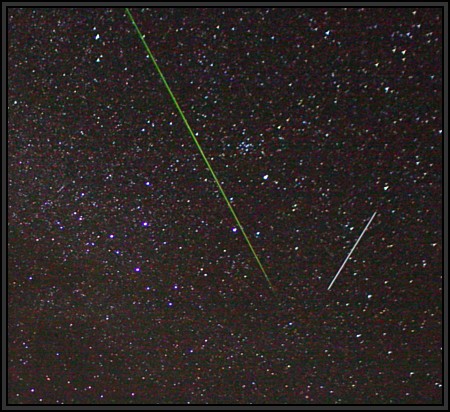
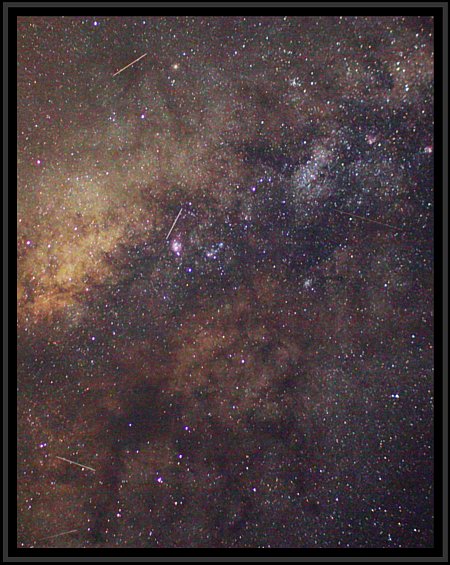
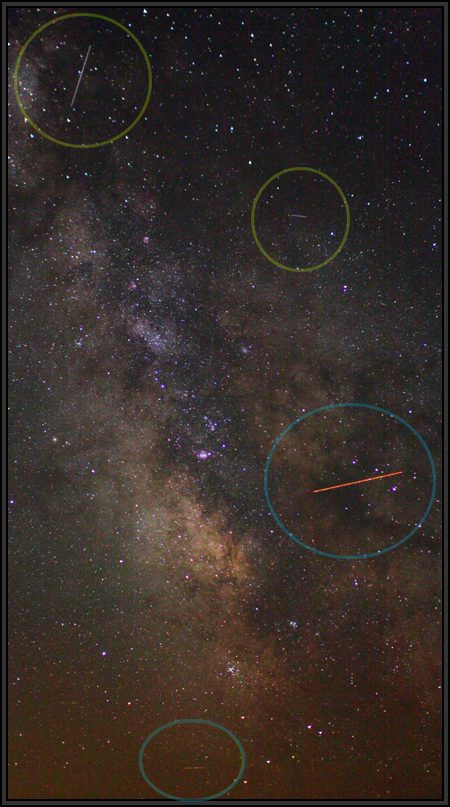
Last night I was at a dark sky site (Emmitt Lake – just south east of Tobermory) – absolutely no light pollution – so I set up and started taking 10 to 15 second exposures of the night sky. About 120 images in all. No skyglow. Nice high contrast images. When I started to process the images I discovered pollution of a different nature spread through all but about 10 of my shots… almost every shot had between 1 to 4 satellites or planes tracking through. All of the following images were taken using a Canon EOS40D, a 30mm f/1.4 Sigma Lens, and a standard camera tripod – no tracking. None of the following images were stacked (wouldn’t do any good since the main targets are moving) – single shots of 10 to 15 seconds at ISO 1600.

A meteor (green trail) and a satellite caught on this shot:

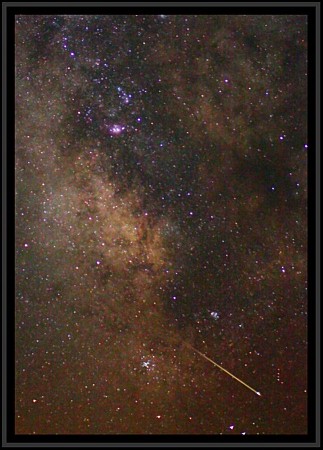
A meteor caught just as it started to dissintegrate:

There are 6 satellites tracking through this image – actually, I think the two faint ones are micro-meteors as they are longer (thus travelling faster) and much fainter – can you spot them all?

I have zoomed in a bit and highlighted 4 of the satellites from the previous image (there is actually a faint fifth satellite or meteor that I didn’t highlight and the sixth satellite/meteor was cropped out of this shot):

And another with 2 satellites and 2 planes tracking through:

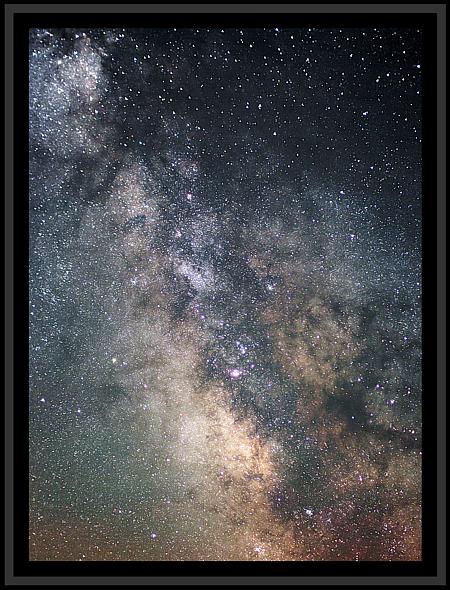
Most of the other shots had only 1 or 2 objects passing through – by stacking multiple frames these objects can be digitally removed – as in the following image created from 26 ten seconds exposures:

A quick trip to Cherry Springs

With the dark of the moon approaching, Ed and I decided a week ago that we would head for CSSP this week. Little did we know that the first Saturday of August is the Woodmen’s conference, which would
result in us being kicked out of the park one day sooner than we expected (not to mention a bit of extra noise in the mornings). Ed got there Monday afternoon and had an outstanding clear night. I arrived on Tuesday afternoon, in time to set up for dusk.

It took about 2 hours to get the GWS and tent all constructed, aligned and ready.

At about 10 PM i strolled to the gate to close it, so that lost travelers would not drive through the park. I met up with 2 families that had come for the view, and were trying to find things in the sky. I showed them the north star, big dipper, and a few other constellations, as well as the Milky way, of course. I explained to them what makes this park and the area around it so special for astronomers. Then i invited them to come to the GWS and see things firsthand.

What followed was a tour of the reasons for going to cherry springs… clear views of Nebula, Galaxies, etc… I showed them M22, M11, M17, M51/M52 and M57. Also M13, although i could not find the propeller… i invited them to look for it.

They left happy at about 11 PM.

Later in the evening, I was able to quickly and easily fish up M69 to M78, but missing M68, I will be practicing this more than a few times till December. Finding M74 and M77 are something that needs to be practiced for the Maxi Messier Marathon, so it’s a good investment in that regard. I made sketches of the star fields for them, as they appear in my eyepiece view. M74 is very subtle, even from Cherry Springs. Picking it out of the twilight must be very difficult without a detailed idea of the star field.

Skies were clear at first, but eventually a bit of high haze moved in. By 2 AM the haze was gone and the stars were all out again. I continued my tour of the sky.

I packed up the eyepieces at about 4:30 AM as the thin crescent moon was rising and gathering haze was again veiling it in mist. A gentle wind was keeping the flies away, which was nice, and there was no dew.

Wednesday, we turned on the car radio and got a weather report. They predicted 18 hours of clouds and rain, starting just after lunch. I wrapped the GWS with a tarp, and Ed covered his 2 scopes.
We left them ready for use should the rain subside.

The rains came as a light drizzle, and I took the opportunity to have a nap. The Woodsmen were setting up for their annual festival on the weekend, and we would have to leave the park at noon on Thursday. I was glad i did not pack the GWS into the car, because eventually the rains stopped, and
the sky begain to clear. I configured my laptop to operate the camera remotely, and also helped Ed to do the same for his 300D.

Tiny spaces were starting to open between the clouds at about 6 PM, and the clouds had gone from a nondescript haze across the whole sky to textured fluffy overlapping clouds.

I was able to create a time-lapse sequence of the sky around the setting sun, with about 300 frames. I made the mistake of using a constant exposure time, and eventually the frames were all black, but it’s the thought that counts… The sky was 80% clear by the time the sun set…

In the evening there were about 20 official visitors to the park and Maxine was doing a sky tour for them. I brought my binoculars over so they could view the star field around the milky way, and a few other binocular objects.

Eventually the clouds returned, and the skies were pretty bleak from about midnight onwards, but I did get a chance to see the wonder of the skies several times in the clear intervals. Fog was blowing in from the surrounding valleys. I was done at about 1 AM.

We packed up and left the park by 11 AM on Thursday. It took about 2 hours to tear down and pack everything up. The woodsmen were in the process of erecting tall logs for the lumberjacks to climb and saw off.

Sounds like the festival would have been a sight too. It’s on today.

First light with new lens

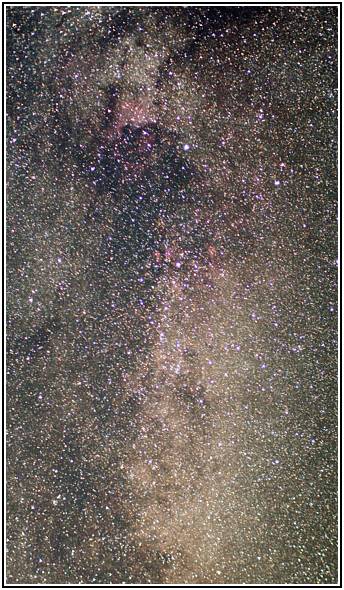
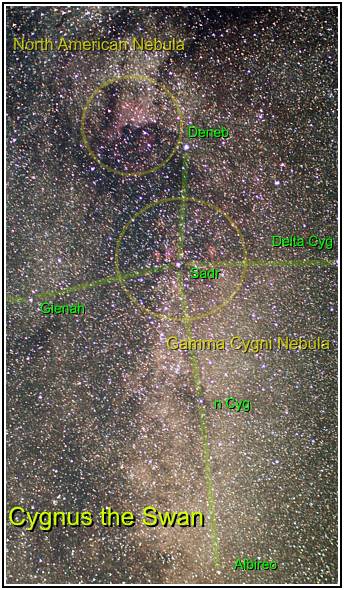
So I tried my new lens out last night with some success (despite a bit of haze/cloud). The following was shot without tracking (standard camera mount) – using a 30mm fast (f/1.4) lens on a Canon EOS40D. It is a stacking of light, dark, and flat frames. Exposure was 15 seconds at ISO 1600 – in all there were 20 light frames (normal shots) used. Star trailing was just barely becoming evident – I will try using 10 second exposures next time. This is just another example of how astro-photography does not require a lot of expensive gear (or a lot of setup and alignment time).