ISS over Hamilton

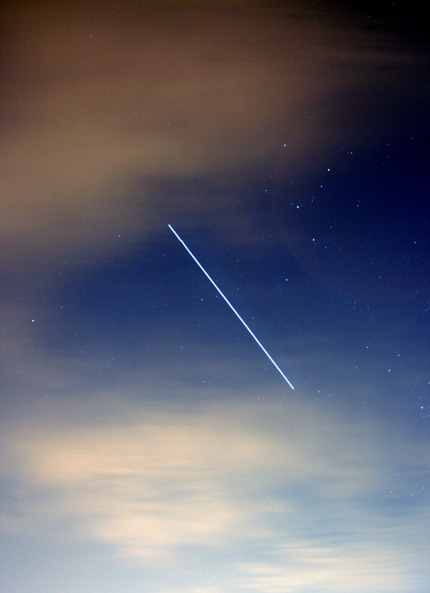
I was all ready with camera in hand (well, on a tripod) and looking forward to a well placed pass of the International Space Station and the shuttle Endeavor over Hamilton this evening. Naturally, just before they were due to arrive, clouds rolled in. Of course, this big piece of space hardware is so bright that it showed easily through the thin cloud and light pollution. Here is a shot of it going behind the clouds and in front of Cassiopeia.

ISS and Endeavor over Hamilton

There are more passes visible this week, so be sure to take advantage of this opportunity to see the ISS and space shuttle, and don’t forget to wave at the astronauts on board as they go by!

2009 RASC Handbooks – $16.87 each

These handbooks contain a wealth of data about the coming year’s celestial events,
and many chapters about astronomical topics.

I am buying one…

Since there are already 11 members requesting a copy,
I will be able to pass the quantity discounts to any who
email me in the next week or so to reserve a copy, for payment and
pick-up at our Dec 12 meeting, or otherwise, by special arrangement.

Please email me at chair@amateurastronomy.org

Update:
We are up to 14 orders now. They will be purchased early next week.
Speak now or be prepared to pay more later.

Steve Germann

Bob Christmas’ Update Personal Astro-Images Web Site

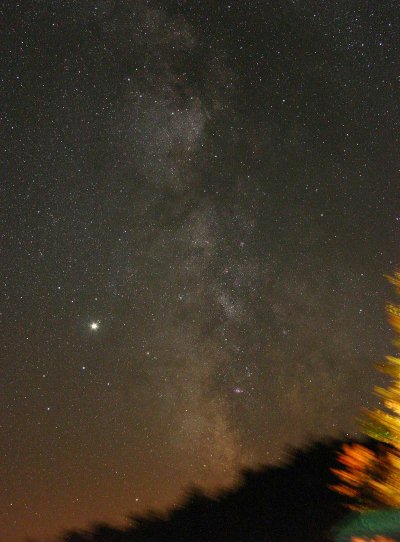
My own web site of astrophotos and comet images has been updated with some of my most recent images (including the Jupiter and Milky Way image below).

My digital images page is:

http://home.interlynx.net/~bxmas/rpcDigitalImages.htm

My page of comet images is:

http://home.interlynx.net/~bxmas/rpcComet.htm

Bob C.

To Infinity And Beyond!

For the past couple of years, Gail and I have spent an evening showing the grade six class of Grimsby?s Park Road Public School the showpieces of the night sky.
Last Wednesday (Nov. 5th) would be our third outing and proved to have the best turnout yet as the teacher had invited another school?s grade six class to join us.
We couldn?t have asked for better conditions and Gail soon had a line up, at our 6? dob, to look at the Moon and Jupiter while I entertained another group with views of M31/32, the Ring Nebula, and Albireo as captured by our 12? reflector.
One of the parents also set up a Meade ETX so the 35 kids and 20 adults had a variety of scopes to look through. A few had brought binoculars so my laser pointer got some use as I showed them where to find the Pleiades, Andromeda Galaxy, and Brocchi?s Cluster (The Coathanger).
About 8pm, everyone was ushered into one of the portable classrooms where I gave a short presentation designed to answer some of their most pressing questions such as how many stars are there?; what is a black hole?; what is a worm hole?; and do galaxies ever collide?
For that last one I?d downloaded a small animation program called Colliding Galaxies which I think went over really well as the kids kept asking me to ?do another one!?.
We all had an excellent time, and one or two of the adults expressed some interest in the HAA so perhaps we?ll see them at a future meeting.
If you?d like to download the galaxy crashing program for yourself, you can get a free demo version at:
http://www.colliding-galaxies.com/Site/e-down.html

Glenn

A Warm November Night

Unable to resist these mild, heady days of November, a small group of us met on the hill at Binbrook for a lovely night under the moon and stars.

Jim, Jackie, Andrew, Don, Heather, Moe and I all enjoyed lovely views through five different scopes. Andrew’s big dob showed the dust lanes in the Andromeda galaxy very well, and Heather did some fine star hopping to locate Uranus. I enjoyed a wonderful moon and the good company.

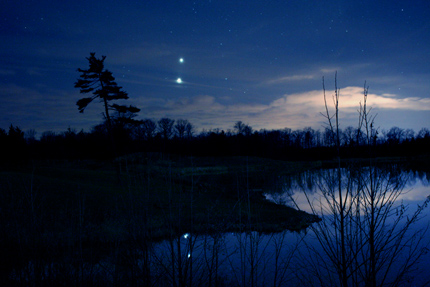
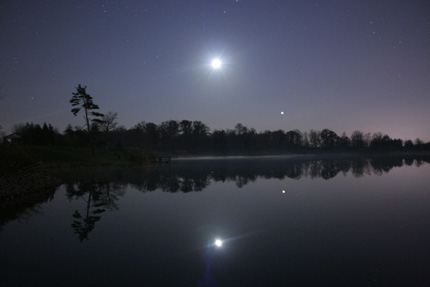
The Moon and Jupiter set into the west, while their reflections rise to meet them.

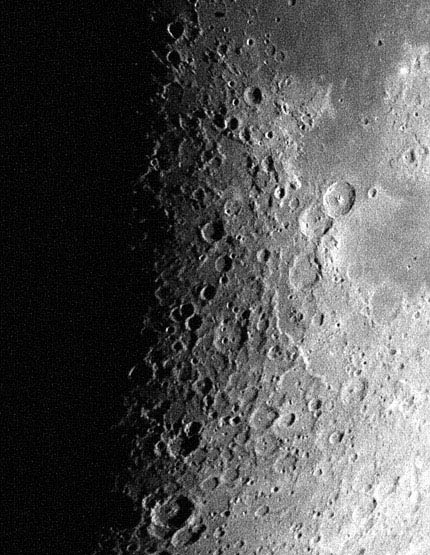
The moon showed a wealth of detail. This image was shot afocally by holding my camera up to the eyepiece of my telescope.

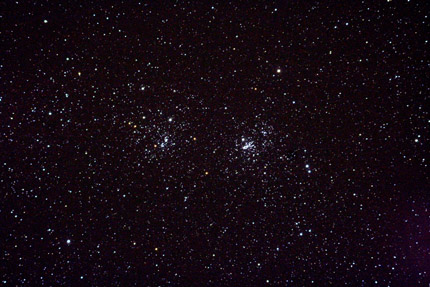
The Double Cluster in Perseus, a fall classic. This is a single 3 minute exposure taken through my 80mm refractor. The original image shows a bucketful of stars

Adventures in AP without AP gear

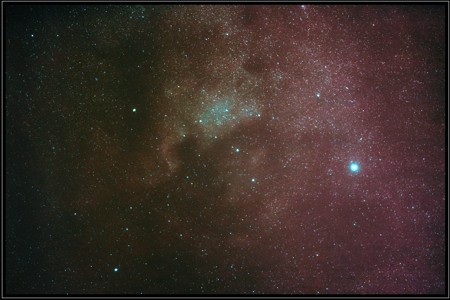
I imaged the North American Nebula last night – again without the aid of any tracking or dedicated astro-gear. It’s a tough one and extremely faint – I wasn’t able to get much detail or correct colour balancing by stacking 1.6sec exposures but it is visible:

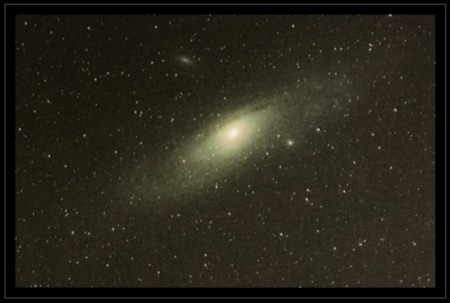
The following is an untracked image created from stacking 99 x 1.6 sec exposures of Andromeda:

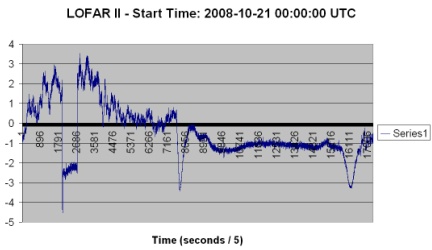
LOFAR II confirms solar output is VERY LOW at present!

This is a LOFAR II Report from Mike Jefferson, who has commented about the lack of flare and sunspot activity on the Sun these days. After all, we’re near Solar Minimum at the time of posting.

Here’s a graph of LOFAR II readings from October 21, 2008:

First Light with the new QHY8 CCD

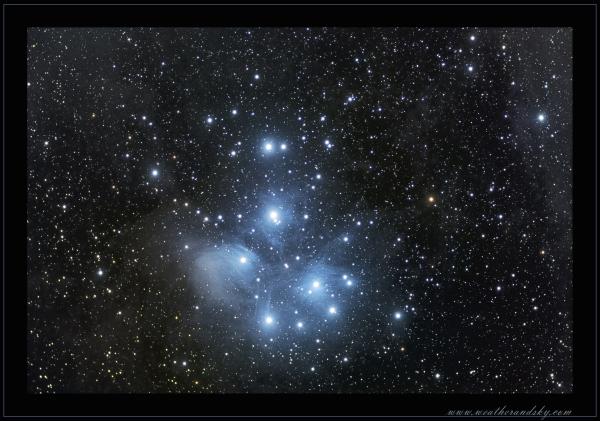
Thursday had an absolutely spectacular night sky. Even with the bit of light pollution in Grimsby, the Milky Way certainly was a fine sight to behold. Anyway that night was also my big chance to test out this nice little dedicated astro camera before the weather turned bad.

The technical Specs: http://www.qhyccd.com/QHY8.html
A nice review on it http://www.iceinspace.com.au/index.php?id=93,489,0,0,1,0

After taking the image below I am starting to realize that it is a really amazing camera for the price (well before the CAN dollar dropped) and is so much more sensitive and has way less noise than my
Canon 40D DSLR. The image below is a collection of 5min frames totalling 4hrs from home (orange zone/mag5.5- 5.7) I tried to stretch the image enough to show some of the really faint dark nebulousity. I also didn’t have to do any noise reduction. My previous attempt at imaging this target was with my 40D from Cherry Springs dark site in PA (same 4hrs total) and I could not get this much nebulousity without having to fight a tremendous amount of noise and banding.

Larger version is here with all the details and size options on the right side.
http://www.weatherandsky.com/main.php?g2_view=core.ShowItem&g2_itemId=2203&g2_imageViewsIndex=2

I acquired the image in Maxim and stacked lights, flats and bias frames with Deep Sky Stacker (no darks were used). Guided with PHD. Ultimately I’ll be trying to do everything in Maxim except for post processing which I do in PS.

KerryLH

Orion, The Flame, and The Horsehead – no tracking

Again just a camera and camera tripod – NO telescope and NO tracking tripod.

The following image is a stacking and post processing from 27 x 8sec exposures at ISO3200 taken with my 30mm lens.

The following image was taken using my 150mm APO – also taken without the aid of a tracking mount. This image is a stacking and post processing from 67 x 1.6sec exposures at ISO3200.

For the record, the previous image required:

less than 1 minute to set up
no polar alignment
less than 4 minutes to take ALL of the frames

and no more gear than my camera, a 150mm camera lens, and a standard camera tripod

Just think what we will be able to do in a few more years – ISO 102400 here I come!

A close up cropping from that same image:

Move over Betelgeuse

I have a new favourite star. I came across it while panning the constellation Lyra to see if I?d habitually overlooked anything on my visits to M57 or Epsilon Lyrae (the double-double). As I skimmed south-west of Vega, last night, my scan was suddenly brought to a screeching halt by the reddest star I?ve ever seen.
How red was it? It was so red that I actually spent several seconds checking my optics, even to the point of re-cleaning my glasses, to make sure that its brilliant ruby-red colour wasn?t due to some chromatic effect.
I had found T Lyrae, a carbon star with a redness rating of 5 which on the scale of 1-5 is as red as they get. All carbon stars are variables, and T Lyrae is listed as an LB which puts it in the slow irregular class. This means that a regular period for its brightness fluctuations is not evident or that not enough data has been collected to discern what that period might be.
Regardless, with a magnitude range of 7.8 – 9.6, there will always be plenty of sparkle to set this fiery jewel apart from the surrounding field of dimmer white stars.
The coordinates for T Lyrae are RA: 18:32:20 DEC: 36:59:55
In late fall, Lyra becomes an early evening constellation so make a point to grab this one while you can.

Glenn

UPDATE:

Ann Tekatch reports that T Lyrae attained its maximum known brightness this past August so is expected to be in its dimming phase. Carbon stars get redder as they get dimmer so this will be an interesting star to keep tabs on (while we can). – GM

I just had another look at the light curve for this star, Glenn, and it’s all over the place! Red stars are difficult to estimate and the data for T Lyrae seem to reflect that difficulty. My best guess is that it is dimming, but only time will tell. It’ll be interesting to follow it and see what it does. – Ann T.