The Hundred Hours of Astronomy, HAA Style

Everyone is invited to the Spectator Auditorium on April 3rd for the monthly meeting of the
Hamilton Amateur Astronomers club. Our distinguished list of speakers and demonstrations is sure to please.

This month following John Gauvreau’s interesting and informative preview of what’s in the sky in April,
Bob MacDonald of CBC Radio’s “Quirks and Quarks” will be addressing the club on topics astronomical, in a way that only he can.

It’s sure to be an enjoyable evening for everyone.

After the meeting, there will be observing of Saturn in the parking lot if the sky is clear enough.

The meeting gets underway at 7:30 PM and will be finished before 10 PM, but the astronomy outside may
last a good deal longer.

Here’s a map of the location:
http://maps.google.com/?ie=UTF8&ll=43.259999,-79.892535&spn=0.001344,0.003001&t=h&z=19

HAA Brantford Public Astronomy Night

Members of the Hamilton Amateur Astronomers will be sharing an evening of Astronomy, telescope equipment demonstrations, and viewing of Jupiter, the Moon, and other celestial objects. The Brantford tourism center also has a fine auditorium and there will be several informative talks during the evening.

We will be setting up October 24th, rain or shine, at 7 PM, and will remain until about 11 PM. Note that daytime clouds often dissipate as evening approaches, so plan to come regardless.

Here’s a map of the location:
http://maps.google.com/?ie=UTF8&ll=43.167869,-80.243124&spn=0.001346,0.003001&t=h&z=19

Come early to see what it takes to assemble and set up a telescope, or come on time and get a good look through those same telescopes. Either way, enjoy the talks, indoor demonstrations, and handouts.

If you have a telescope, bring it along: we can help set it up and point it at Jupiter for you.
If you have binoculars, by all means bring them too. Binoculars are an excellent and easy to use way to get more from the sky.

As part of the International Year of Astronomy, we will also have some handouts to interest
children and adults.

Perseids Meteor Shower Public Event – August 11

Members of the Hamilton Amateur Astronomers will be sharing an evening of Astronomy, telescope equipment demonstrations, and especially viewing of the year’s most attractive Meteor Shower, the Perseids.

Each year around August 11, there’s a noteworthy increase in meteors coming from the direction of the constellation Perseus. Since August is usually warm and fair, it’s an ideal time to bring an air mattress,
and perhaps a warm blanket, and just stare at the sky, watching for the big ones.

We are fortunate to be able to invite the public to the Binbrook Conservation Area, after normal hours, for this ever-popular free event. Starting at about 8 PM, we will assemble on the hill by the pavillion. After some short talks about what’s in the sky that night, and how best to watch for meteors, the sky will darken and the show will begin.

Because the park is open for business beforehand, you will have to come at 8 PM, on August 11, with
a rain/cloud date of August 12, or, if you have already paid to be there for the day, simply remain, and come to the pavillion. We will let you out at 11 PM when the evening winds down.

Here’s a map of the location:
http://maps.google.com/?ie=UTF8&ll=43.100137,-79.835914&spn=0.001347,0.003001&t=h&z=19

Although meteor showers are not much for Telescope viewing… (in fact, you will notice that most meteors seem to shoot across the sky while you are looking the other way in a telescope), you can still bring
binoculars for a peek at the sky while waiting for the meteors to show.
Binoculars are an excellent and easy to use way to get more from the sky.

As part of the International Year of Astronomy, we will also have some handouts to interest
children and adults.

Astronomy Day in Hamilton

Members of the Hamilton Amateur Astronomers will be sharing an evening of Astronomy, telescope equipment demonstrations, Solar Observing during the afternoon, and viewing of Saturn, the Moon, and other celestial objects. Astronomy Day is scheduled to coincide with the best time to observe the Moon.

Solar observing from 2-4 PM, at Van Wagners Beach Park,
(see map for the afternoon here)
http://www.amateurastronomy.org/sites/confedpark/confedpark.jpg

will be followed with more activities in the evening, at a different park.
We will be setting up on the lawn at Bayfront Park, (Known to Google as Harbourfront Park), on May 2nd, with a rain/cloud date of May 3rd, at 8 PM, and will remain until about 11 PM.

Check back here on May 1st to see which date has been chosen. Note that daytime clouds often dissipate as evening approaches, so we will be checking the weather predictions carefully. If it rains, that’s a different story.

The park is at the junction of Bay St and Harbourfront Dr (near Strachan St E).

Here’s a map of the location:
http://maps.google.com/?ie=UTF8&t=h&ll=43.269136,-79.869334&spn=0.001318,0.003001&z=19

Come early to see what it takes to assemble and set up a telescope, or come on time and get a good look through those same telescopes.

If you have a telescope, bring it along: we can help set it up and point it at Saturn for you.
If you have binoculars, by all means bring them too. Binoculars are an excellent and easy to use way to get more from the sky.

As part of the International Year of Astronomy, we will also have some handouts to interest
children and adults.

Upcoming Public Night in Burlington

Members of the Hamilton Amateur Astronomers will be sharing an evening of Astronomy, telescope equipment demonstrations, and viewing of Jupiter, the Moon, and other celestial objects.

The Burlington Burloak Park has an excellent dark southern horizon, and not too much interference from the city lights, so it’s sure to be an enjoyable evening with interesting things to see.

We will be setting up in Burlington on October 3rd, with a rain/cloud date of October 4th, at 8 PM, and will remain until about 11 PM. Check back here on September 25th to see which date has been chosen. Note that daytime clouds often dissipate as evening approaches, so we will be checking the weather predictions carefully.

Here’s a map of the location:
http://maps.google.com/?ie=UTF8&ll=43.367916,-79.727719&spn=0.002683,0.006003&t=h&z=18

Come early to see what it takes to assemble and set up a telescope, or come on time and get a good look through those same telescopes.

If you have a telescope, bring it along: we can help set it up and point it at Saturn for you.
If you have binoculars, by all means bring them too. Binoculars are an excellent and easy to use way to get more from the sky.

As part of the International Year of Astronomy, we will also have some handouts to interest
children and adults.

Tonight’s Beautiful Conjunction

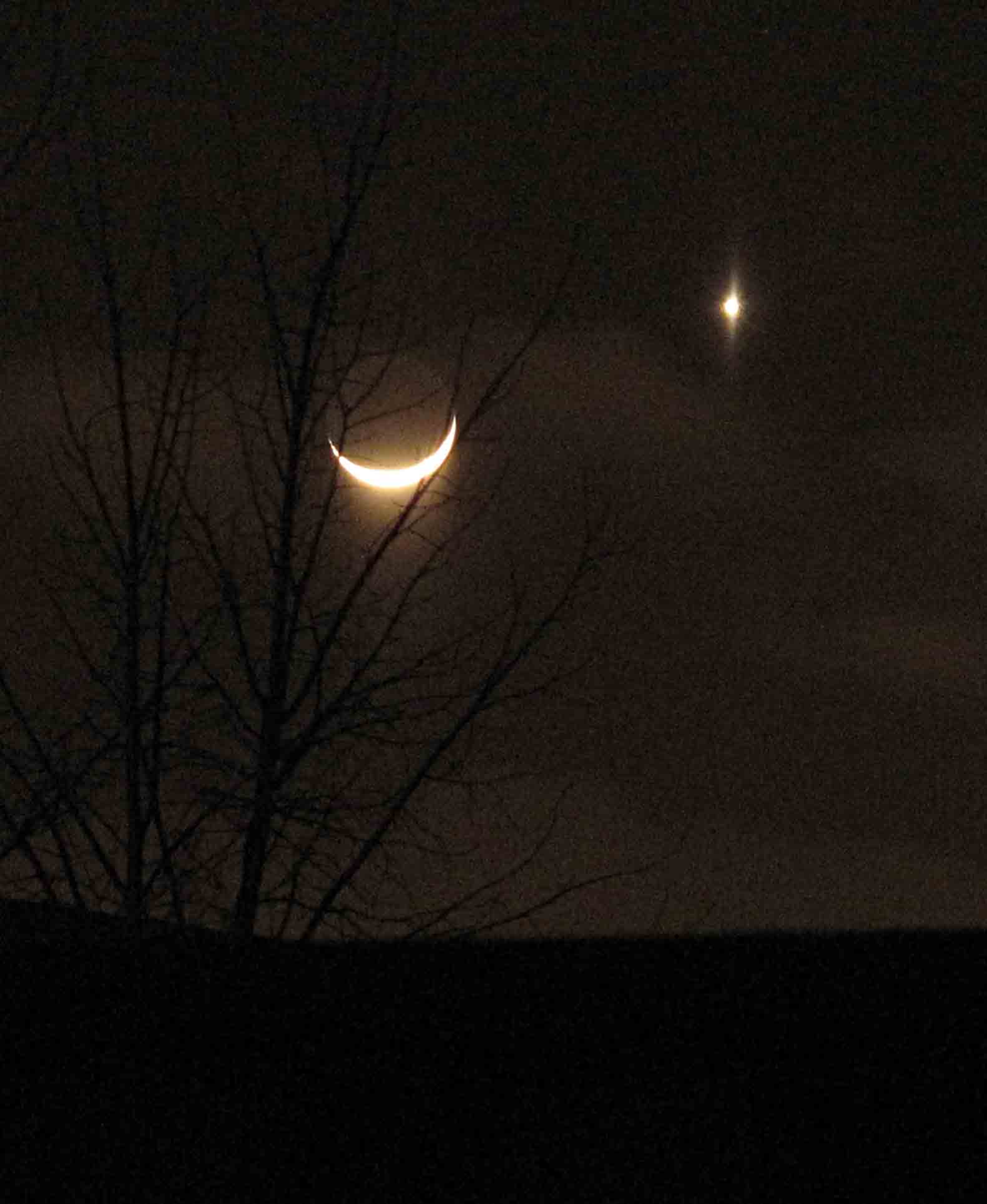
I hope you had a chance to see the conjunction of Venus & the Moon tonight. It was spectacular! I snapped a quick photo hoping to record this beautiful pairing but my photo doesn’t even begin to do it justice.

Venus & The Moon

Comet Lulin and Saturn

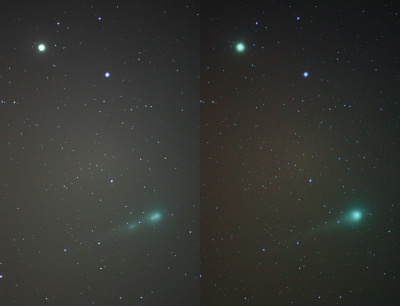
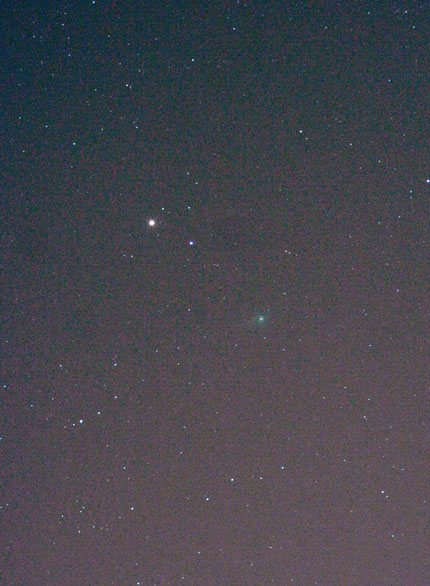
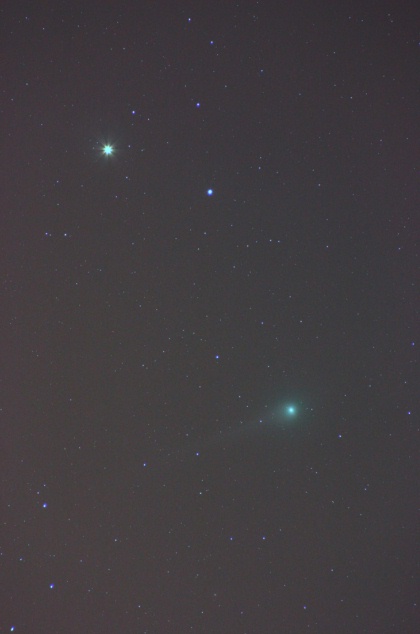
A lovely view through a scope! Ann’s drawing is impressive for its accuracy; check how the stars match up perfectly to Bob’s photo. My photo, taken a little after 3am, is nowhere near the quality of Bob’s, but I include it here so you can compare the comet’s change in position over the 4 hours between Bob’s photo and mine. Visually, I agree with Ann; the comet definitely appeared elongated, and gave the impression that you were seeing the tail. What a treat we had tonight!

Saturn and Comet Lulin

Saturn and Comet Lulin (1st rough cut)

This is a single-frame image of Saturn and Comet Lulin I took at my brother’s place in Mountsberg, on February 23, 2009, at approximately 10:53pm. Equipment: Canon Digital Rebel 300D; Tamron 300mm f/2.8 lens set at f/4. ISO 1600; 63 second exposure. Colour balanced and gamma-corrected.

— Bob Christmas

Saturn and Comet Lulin, by Bob Christmas

Comet Lulin & Saturn

Here is a quick sketch I made at 11:03 tonight of Comet Lulin as it passes by Saturn. I used a 4.25″ Astroscan telescope at about 50x for the sketch. The comet appeared as a dim, oval- shaped patch oriented roughly east-west. The little scope was bouncing in the breeze and I couldn’t detect any detail in the comet. It appeared uniform in brightness to me.

Ann T.

Sketch of Comet Lulin & Saturn

Question

Here is a puzzle for you all, and I hope it is one that you can solve, since I really want to know the answer!

A few minutes ago I was outside, binocular viewing from here at my Hamilton home. I had some nice views of the usual suspects like M42 and the Pleiades, but I was really there to have a look at Venus and see if I could see the crescent phase of Venus through both my 10x60s and my 15x70s (the answer was ‘yes’ in both).

Casting my eye around the sky I noticed a bright star in the east and pondered for a moment, since there is no star that bright in that part of the sky. Sure enough it was movng and certainly a satellite, as it was moving at a steady pace and direction and showed nothing more than a snigle, steady light. It brightened considerably until it was about mag -2 or -3 (brighter than Sirius but not quite as bright as Venus). I was certain that it was the ISS, since only the space station could appear that bright, but it seemed to be moving rather slow for the station. I checked on the Heavens-Above web site (http://www.heavens-above.com/?lat=43.250&lng=-79.833&alt=92&loc=Hamilton&TZ=EST), and no ISS passes were scheduled at that time. In fact, nothing that bright was scheduled and nothing following the path I obseved this object on was was scheduled either. There was one satellite that matches the times perfectly, but not the orbital path (http://www.heavens-above.com/PassDetails.asp?Size=600&SatID=16182&lat=43.250&lng=-79.833&alt=92&loc=Hamilton&TZ=EST&Date=39867.0031120895)

So here’s what I know:

-Visible at 7:00 to 7:03pm (at it highest), Feb 22
-moving east to northwest ( from the head of Leo to just above the bowl of the Big Dipper then past the Little Dipper then fading)
-mag -3 (but fading as it moved past north)
-moving slower than the ISS usually seems to (which indicates a higher orbit)
-even through my binoclars it appeared as a single, steady point of light

Good luck, team! Let me know what you think.