Astronomy Day 2009

What a successful International Astronomy Day!

Despite some clouds, we had pretty good weather for both the afternoon solar observing session, and for the evening Lunar/Saturn public events.

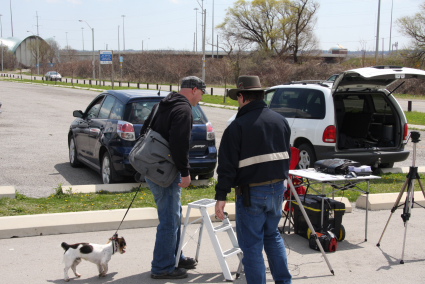
In our afternoon event down at Lakeland Community Centre, we had 5 scopes set up from a 40mm Coronado PST up to an 8″ Schmidt. This provided a great variety to see the Sun with different luminosity and spectral views. Regrettably the small sunspot from earlier in the week had gone around the edge of the Sun, so we couldn’t see it, but Joe had some videos and images he collected from the SOHO website to show our visitors. However a little later the Sun did put on a bit of a show with a few small but distinct flares which we saw in the PST.

Even the dogs enjoyed the views of the Sun. So much for Sirius being the “Dog” star.

We had about 30-40 people show up, mostly drop-ins from the walking path nearby. Few had seen any of our promotions, however some had. A breezy afternoon with lots of clouds, but enough breaks the wait wasn’t too bad and most everyone who stopped got to see the Sun. A little last minute email blast on Fri resulted in a videographer from CH News coming out and doing a small segment on us which appeared on the 6pm news.

CH News and others enjoying the show between the clouds breaks.

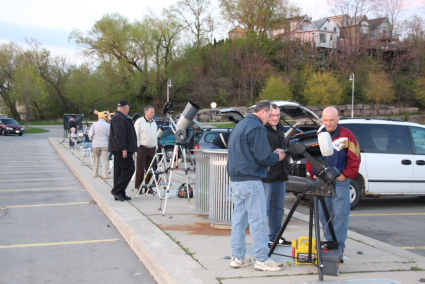
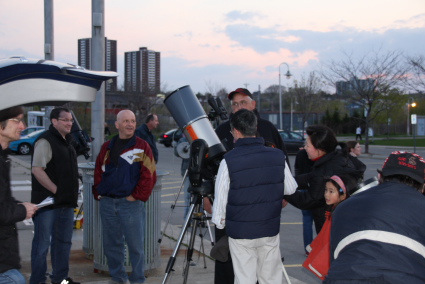
The evening session at Bayfront Park was very well received. We had more than a dozen scopes and when you add in the binos, we had about 2 dozen optical instruments trained at the Moon and Saturn. About 20 members of the HAA were on hand to share their love of astronomy with the public. I think each and everyone of them did our club proud. I saw so many smiling faces as people left.

Astronomy Day 2009

We guessed we had about 130-150 people show up to enjoy the show. Many had seen one of our promotions, but a fair number were just in the area and were curious about the hub-bub. However the actual number may have been higher. We were so busy answering questions from a very interested audience, that we didn’t often take the time to look up and “count” the crowd. I think everyone who had a scope or bino set up had some crowd at one time or another. People were really interested in the different views each of the instruments would provide.

Sometimes we had traffic jams at scopes to just get a view when the clouds parted.

We handed out HAA brochures, copies of the EH and thanks to the generosity of SkyNews, free copies of their magazine they had donated to us to the information hungry crowd.

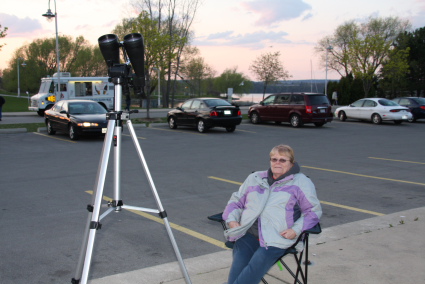
Brenda giving her big binos a chance to cool off after collecting so many lunar photons.

Towards the end of the night, I noticed standing quietly off to the side was Steve Ruddick from CH News with his son. Steve had called me earlier in the day and had expressed a personal interest in astronomy and made a point of stopping by. We had a nice chat and I was quite pleased in his interest.

By 10:30, things were starting to wind down, so we gradually packed up and 6 or 7 of us reconvened at a near-by Tim’s to relax and reflect on a successful day and night.

Our thanks to everyone who came out made this a very worthwhile event. It was great to share with the Hamilton area once again.

Upcoming Lecture by Dr. Christine Wilson: “Galaxy Collisions, Star Formation and Galactic Evolution”

This is from Mike Jefferson.

As part of the Origins Institute’s Public Lecture Series, Christine Wilson is going to be the speaker at The Origins Institute at McMaster University this Tuesday, May 5, 2009 at 8:00pm. The talk will take place at the Michael DeGroote Building, right behind the McMaster Medical Centre. You can park on King Street for free.

Click here for more details and information.

Raptorfest was a fine day

When I arrived, Glenn had already set up a solar system walk that disappeared to the far corner of the open field behind the Centre. There were 11 TV tables, some with heavy weights on them to keep them from blowing away, and each having an appropriate write up and photograph of a planet firmly attached with duct-tape.

I set up my binocular parallelogram and pointed it towards Pluto. It was too windy to use Glenn and Gail’s 6″ Dob but it made a nice addition to the display.

At times, the wind was almost gale-force behind the building. I did not think a wind could blow that hard on such a nice day.

Joe McArdle set up his 4 inch reflector, with a Baader solar filter, for views of the sun, and it was interesting to compare the magnification and contrast of Joe’s neutral density filter to Glenn and Gail’s Coronado PST.

Joe’s telescope was able to track the Sun, while the Coronado had to be re-pointed from time to time.

I noticed that a part of my binoculars has snapped, making it difficult to retain focus on the left eyepiece. I guess this is my chance to adjust it so that the diopter setting on the right eye will allow travel through the range that works for me to use both eyes without the glasses, so it’s good news that it broke, in a way.

G&G also had a nice little Starblast which was pointed at the “planets” along the walk. Lots of the kids who looked through it were struck by the fact that “it’s upside-down”!

Everyone enjoyed a look at the Sun through the Coronado. I saw a couple of flares, and later in the afternoon one of them seemed to get a twin, nearby. My efforts to try afocal photography through the eyepiece were unsuccessful, although I did get a red circle.

There was some cake to share after everything was done.

I watched some of the raptor presentations. It was amazing to listen to the cameras click when the red-tailed hawk put out her wings to steady herself in the wind.

I learned how to pick up and carry a snapping turtle too.

On the astronomical side, about 100 people had a good look at the sun, and almost that many went for a solar-system hike, and had a look through the terrestrial telescopes.

All were advised what kind of scope not to buy, and many who already had telescopes mentioned they don’t use them much because they cannot get them to align.

Many HAA brochures were handed out, and we had a chance to remind people about Astronomy Day on May 2.

400 Years of the Telescope – Sunday afternoon

Channel 17, WNED in Buffalo is broadcasting “400 Years of the Telescope” at 4:00 p.m. on Sunday, April 26.

For more information on this documentary, follow this link: http://www.pbs.org/soptv/400years/.

Ann T.

Sunset conjunction – Sun 26 Apr 2009

If the weather cooperates (and it rarely seems to), there will be an nice conjunction at sunset on Sun 26 April 2009.

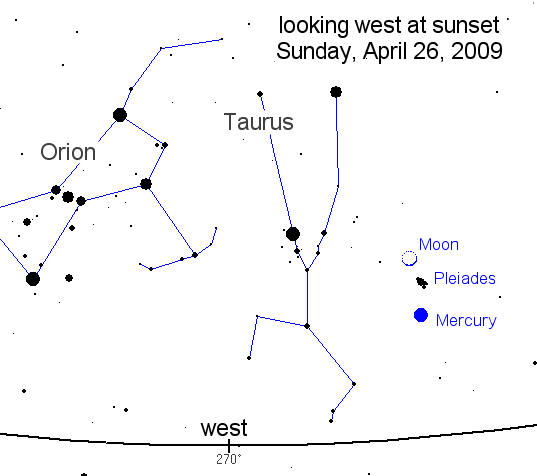
Just after sunset while it is still twilight, the Moon, Mercury and the Pleiades will be visible within a binocular field of view near Taurus. The Moon will be a whisper thin crescent, just coming out of new Moon and should be visible first (look for possible Earth shine on the “dark” side). The Mercury will pop out as a 1st magnitude “star”, and then the Pleiades star cluster will appear. (sky map shown below)

(Taken from NASA website)

If you have a telescope set up, then you may be able to resolve Mercury into a crescent. But because it is nearing its relative maximum elongation (at the end of the month) as seen from Earth, it will be a fuller crescent than the Moon.

You don’t even need a telescope or dark skies to enjoy this event. Just a clear view to the western horizon. Your eyes are enough to appreciate this presentation. But binos or a scope will always be quite welcome to help enhance the view of the terminator on the sliver Moon. And of course they will reveal hundreds of stars in the Pleiades instead of the 6 or 7 we can see from within the city with just your eyes. Always a beautiful sight.

This isn’t a particularly rare event, but it is infrequent. So try and take advantage of it while you can. If the skies are cloudy on Sun, you could try again on Mon 27 Apr, but the moon will be slightly larger and further away. Still worth the view.

Reminder:
RaptorFest is this Sat 25 Apr (10am to 4pm) and the HAA will be present during the day with some scopes, binoculars and information about astronomy and the HAA. Come out to lend a hand or just give your support.

Details can be found here: RaptorFest

Update Tue 28 Apr 2009
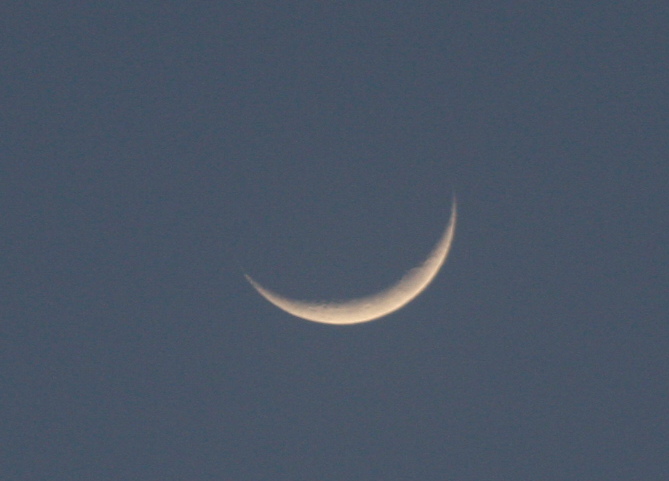
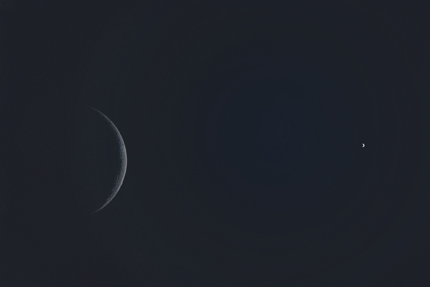
Well the weather didn’t cooperate on Sun as expected, but I did get some clearing on Mon evening. The clouds were coming in from the west before Mercury and the Pleiades became visible, but at least I was able to capture the 2 day old crescent moon. Here’s a scaled down image.

2 day old crescent moon.

April 2009 Astro-Images on Bob Christmas’ Web Site

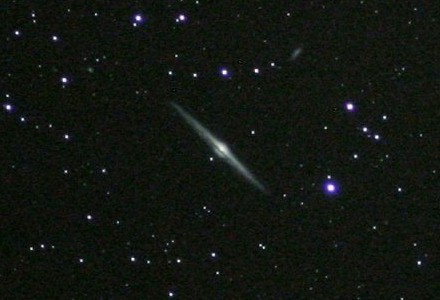
NGC 4565 by Bob Christmas

I posted some of the astrophotos I took up at Spectacle Lake in mid-April on my personal website (Click on the title).

Look for the thumbnail pictures labelled “new”. Click on any thumbnail to enlarge.

Bob Christmas

Venus Occultation (sort of)

Well, right now there’s a beautiful occultation of Venus happening, but all I see are clouds.

A few hours ago my alarm went off and somehow I knew before I stepped outside that it was going to be clear. The air just had that feel to it. And sure enough, there was a sky that was just dark enough to show Arcturus in the west and Vega high overhead. Looking to the east I noticed Jupiter first, shining very brightly, and then, still behind some trees, I spotted Venus and the Moon in the predawn sky. Lovely!

I set us my scope and turned it to Jupiter first. The air didn’t seem too steady and although it showed four moons and some bands, the view wasn’t great. Perhaps the scope needed a few minutes to cool down (ah, the beauty of a small scope; it really does only need a few minutes and not hours like some larger scopes) but I wouldn’t get a second look at Jupiter because already the clouds were coming in from the southwest.

Turning to the main event, I was able to get both the Moon and Venus in my wide field eyepiece at the same time. Both showed the same crescent phase and this symmetry certainly added to the aesthetic value of the view.

The Moon approaches Venus (in the larger image you can see the crscent phase of Venus clearly)

Most noticable was how much brighter Venus was than the moon. This shouldn’t be surprising since Venus’s albedo (surface reflectivity) is around .7 (making it one of the brightest objects in the solar system) and the moon’s albedo is .12 (making it one of the darkest). Still, it was interesting to see it demonstrated so clearly in the eyepiece.

Unfortunately, those clouds just kept on coming, and true to the forecast the sky was completely cloud covered before the occultation started. It is now fully daylight and fully overcast. I’m sure the HAA has proven to be one of the more active groups around when it comes to grazing occultation expeditions, even though many of us have yet to actually see even one! Like Ann said, at least we’re consistent. See you at the next one!

Maybe next time!

Venus – Moon Occultation Wed 22 Apr 2009

The weather forecast is looking rather marginal, but there may be a chance to view this rare occultation event.

Starting just after 9am on the morning of Wed 22 Apr, the thin crescent Moon will pass in front of (occult) Venus. Even though it is daytime, both objects are bright enough they should be visible. If you can take some time off from work or school, you might want to try this. You won’t need any special equipment, your eyes are all you need. But if you have binoculars or a small telescope, they will make the sight more impressive. They will also allow you to see Venus as a crescent instead of just bright dot.

Caution: Since the sun will be up, please be very careful not to point your binoculars or your scope at the sun as this may cause permanent eye damage.

Ideally you might like to set up before sunrise so that you can more easily locate the Moon and Venus. But the forecast is indicating rain and clouds even at 5am. However there may be a break just around 9am which may allow us to see this event. Unfortunately I can’t tell at this time if during the breaks, we’ll have lots of high cirrus clouds which will block or obscure the view.

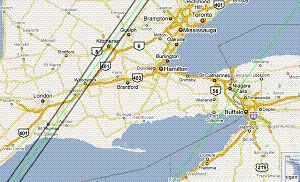
I’ve included a map below which shows the area which will experience the occultation. We are smack dab in the middle of the green lines. This means that we will see some of Venus covered by the Moon (Grazing Occultation). The light of Venus should brighten and dim as it passes behind the mountains and valleys on the Moon. If you are NW of the Green/Black line combination, then the entire surface of Venus will be covered (standard occultation). If you are SE of the single Green line, then you will see the Moon pass over top of Venus without being covered (conjunction).

Venus Moon Occultation Path

Venus Moon Occultation Path

Here’s a link to the page with the interactive Google map. This will allow you to zoom in or out as much as you want to find the best area.
Interactive Map

The Moon will approach Venus starting at about 9am. First contact should occur at about 9:10am. And the entire event will take about 10-15 minutes.

Sky and Telescope also has some info about this event.

To view this, it is best to find a open area with a good view to the East and South. Possibly a large park or shopping mall lot. If the conditions look promising, I’m going to try and set up at Lakeland Community Centre at 180 Van Wagners Beach Rd in Hamilton (east of the GoKarts).

Try to locate the crescent Moon first – it will be about 33degrees to the upper right of the Sun. Then look a little to the lower left of the moon and you should be able to spot the bright light from Venus.

Meteor Shower:
And also remember, if you get up early enough and the sky does open up for you, be on the look out for members of the Lyrid meteor shower which are peaking in the early morning as well. Unfortunately you are not likely to see these once the sun rises.

Good luck and good hunting.

HAA at Raptorfest – April 25th

As mentioned earlier by Chair Steve, on Saturday, April 25, in Winona, from 10am to 4pm, there’s the annual RaptorFest festival. Some members of the HAA will be there with a daytime astronomy display. (Solar observing, and telescope and binocular demonstrations).

The binocular demonstration will be of special interest to bird watchers in that binoculars allow good views of distant nests to be shared.

Since it is also the dark of the moon, there may be an evening observing session at a location to be determined.

Here’s a link to the Raptorfestival web site:

http://www.raptorfestival.com

Directions can be found here:

http://www.raptorfestival.com/Html%20Pages/Directions.html

For members who wish to set up equipment, the gate should be open by 9am. We’ll be on the back (south facing) side of the building under the overhang.

Hope to see you there.

More Images from Bob Christmas

I posted three of my images on my HAA Gallery from my trip up north last week (April 2009). Links are below.

M81 and M82, by Bob Christmas

Galaxies M81, M82, NGC 2976 and NGC 3077 (excerpt shown above),

M101 (The Pinwheel Galaxy),

and Open clusters M46 and M47.

More images are coming soon to my own web site. Stay tuned.

Bob Christmas