Far Side of the Moon

Tonight I took my little Orion short tube 80 out on to the deck (this is not my ED80, of which I have so many good things to say) and set it up on a camera tripod. I had a look at Saturn and then the moon. Noteworthy was the excellent view of the eastern limb of the moon, provided by a very favourable libration.

Libration is a word that comes from the word “libra” which, as you know (being astronomers), means ‘balance’. In this case it refers to the balance of the moon on its axis. Since the moon’s rotational axis is tilted compared to its orbital plane and since its orbit is eccentric (hey, I can relate!) it means that sometimes we see the moon from one angle and sometimes from another. Overall, from Earth we can see about 59% of the moon’s surface.

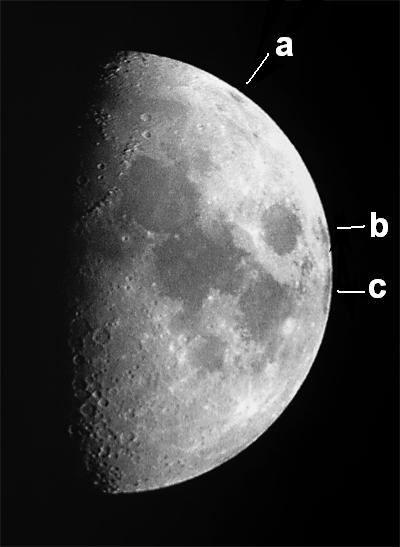
Tonight the moon is tilted so that we can see the eastern edge favourably. Normally at first quarter we would notice Mare Crisium, the very round mare near the eastern (right-hand) edge of the moon. With this favourable libration we can see beyond Mare Crisium, to Mare Marginis (labeled ‘b’), Mare Smythii (labelled ‘c’) and Mare Humboldtianum (labelled ‘a’). Mare Smythii and Mare Humboldtianum are the only two maria named after people (an astronomer and an explorer). Mare Marginis means ‘The Marginal Sea’ or, more colloquially, ‘The Sea on the Edge’. Guessing from how much surface beyond these maria shows up in the picture, I figure we must be able to see at least 95 degrees east longitude. That’s 5 degrees into the far side of the moon! This isn’t a really rare thing to observe, but it sure is fun.

If it’s clear over the next couple of days, go out and try to see these maria for yourself. You just might see the far side of the moon!

a – Mare Humboldtianum b – Mare Marginis c – Mare Smythii

(photograph taken afocally through a very cheap 80mm f/5 achromat. The giant letters labelling the maria were not really hanging there in space, so when you get to the eyepiece you’re just going to have to figure out which is which for yourself.)

Great Outdoor Community Festival

The HAA turned out in force for Binbrook’s Great Outdoor Community Festival. There were at least seven telescopes and an equal number of binoculars set up to view the sun, birds and various sights in the park. The weather co-operated for the most part and we had terrific views of solar prominences, white light views of the spotless sun, purple martins building nests, and even a canoe-eating swan!

We were fortunate to be near the children’s craft area and were visited by many families.

It was a long but enjoyable day. Special thanks to everyone who helped or lent moral support: Steve, Don, Jim, Brenda, Joe, Heather, Moe, Ann, Alexandra, Andrew, Kerry, Bill & Skye, and Tim Philp.

Cheers,

Ann Tekatch

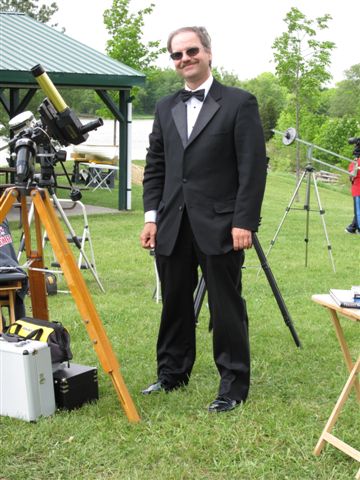
P.S. Steve set the tone for the afternoon. Remember, though, that black ties are optional for evening observing…LOL

“Germann. Steve Germann.”

Observing Neptune This Week

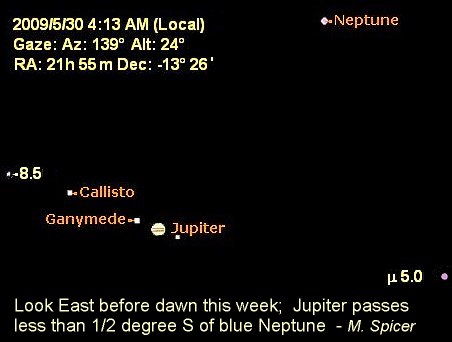
Neptune, normally difficult to find, will be in the same low power field of view as Jupiter
this week, and well worth a peek in the morning sky.

See Jupiter and Neptune in the same low power field

Neptune, served up fresh and blue.

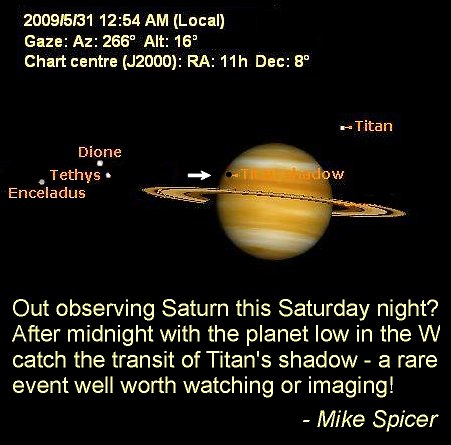
Catch Titan’s Shadow on Saturn, 31 May after 1 AM

Fearless leader at Cherry Springs

(Steve reporting on his 4 night astro-camp-out at Cherry Springs.)

I arrived one day late, as events in town delayed my departure until it was impractical on Wednesday night. That was my first mistake, as by all accounts Wednesday was every bit as good as Thursday.

I arrived on Thursday in time to see the sunset, and get all set up and collimated.

By then, the internet was working. Gone are the days of the $15 phone call to let folks at home know I made it safely. Hooray.

With Wifi, it truly is the ‘Ideal Astro Park’. There’s nothing like it within a thousand miles…

Star hopping at CS is, as Ann says, a cinch because there are so many stars visible, even without a finderscope.

By some stroke of bad luck, the CSC got reprogrammed to try for June 24 instead of May 24. We looked up a nearby clock for some consolation.

I made several excellent improvements to the GWS while there. I repositioned the finderscope onto the main barrel, so that the scope now does not need a counterweight, and it sits, without applying the brake, at any orientation, and does not even swing when tilted by the equatorial platform.

Josh has a LB 16 too, but he has worked wonders on it. Starting with new coatings for the mirrors, and continuing with special covers to protect it from dust, and finally, all of the metal has been powder-coated black or sparkle-red. It’s a beauty.

I had only one step up on him, the EQP, which allowed me to hold a magnified view without adjusting the scope.

Josh also lent me his laser collimator, and it showed that my laser is off kilter, explaining some issues focusing. Fortunately, I was able, after collimating with Josh’s, to get my laser to point in the right direction. Now I just have to keep it together.

Finally, he suspected correctly that some of the screws on the GWS have worked loose. He was right! Some were barely finger tight, causing the scope to shift when tilted to the zenith.

It was worth the drive just as a telescope clinic. Thank-you Josh!

I plotted the position of Pluto, and star hopped to it. Pluto was not found. (That was before re-alignment mentioned above)

It’s at 14th Magnitude, but the stars on the chart are only 12th Magnitude… I found 6 stars not on the chart, but none were pluto (this time).

I was hopeful to see all 9 planets in one night. Maybe next time. (For me, Pluto will always be a planet. I remember the mean distance from the sun, which I memorized when I was 7 years old… 3670000000 miles.)

The eastern horizon as viewed from CSSP has a lot of trees… I walked to the end of the airfield to see if the view opens up at all. Not much, really.

I continued my sequential Messier Marathon, picking up M69, M70, M71, M72, and M73.

I then tried the reverse SMM, starting with M109 and working backwards, to M101.
I developed effective geometric star-hops for them. (I have seen M110 dozens of times, so
i called the latest of those the de-facto first step in a reverse Sequential Messier Marathon)

M100 was a problem… there’s very little in terms of stars in the field near it, that are bright enough to be on star maps. Here’s where the Deep Sky Image Catalog comes in handy, showing the star fields and shapes of the Messier Objects and many others.
Subsequent nights were too soupy for easy galaxy-hopping.

Several people wondered how I fit the scope into the VW. A few were there to see the final result when I packed it back up again.

Sunday evening started out very hazy, and it was difficult for me to make out
more than 2 stars in Lyra. Eventually it cleared… in the meantime I tried out the newly-aligned optics on some favourites, including M13. It turned out the soupy skies made appreciation problematic.

We had some visitors who were camping across the road… university students who are studying ‘Observational Astronomy’. They learned some from us.

As the skies cleared the transparency remained bad, but improved.
I also tried going up again, from M3 onwards (M1 and M2 are too close to the sun these days). I got up to M20 in rapid succession. Nothing like the first time I tried them.
I have to admit I have learned a lot about star hopping in the meantime.
Later clouds started going by, and eventually the dawn caught up with me.

In the morning, everyone was packing up, and the CSC for a nearby community showed
wall to wall clouds expected on Monday night. I should have just put my feet up and waited for the computation due at noon, but decided to pack up and head for home.

Next time, the plan is, go 2 days sooner (ie, Tuesday night) and stay regardless of the CSC. Also, bring something to do if it rains, such as, some astrophotos to edit, or perhaps a guitar.

Orion Setting… a sign of a new season

I imaged this on April 17th in Binbrook Conservation Area. I met up with the gang there for some casual observing. We all had a nice time and there was a pretty good turn out. FOr this image I was really hoping for still waters so that I could get a reflection of the stars but the wind started to pick up as the night wore on. Anyway, this comprises of two 20 second frames taken with the Canon 40D and Sigma 17-70mm lens (17mm@f2.8) on a tripod. The two frames were only used to give more vertical depth to the scene.

Larger version: http://www.weatherandsky.com/main.php?g2_view=core.ShowItem&g2_itemId=5146&g2_imageViewsIndex=2

WIFI and Naglers and Bears, Oh My!

I?m just back from Cherry Springs State Park in Pennsylvania and I can?t say enough about the fabulous dark skies there!! I?ll blog my experiences and hope that others add to this post.

Jim, Jackie and I arrived on Wednesday under a clear, blue sky. Jim?s scope was acting up on him and he didn?t get to use it that night, so he made good use of his binocular mount. I had my homemade 8? dob and had no trouble at all star-hopping because there were so many stars visible. At midnight, I checked the SQM reading and it was 21.93!

The Milky Way swung overhead in the early morning hours and it drew us away from our telescopes. The dark lanes and star clouds were amazing. We spent a fair bit of time just sitting in our lawn chairs to soak in the view!

Steve arrived on Thursday evening ? another fabulous night (SQM at midnight: 21.84 – with the Milky Way overhead later on, the SQM dropped to 21.74) ? and he treated us to fantastic views through the GWS.
Jim found the problem with his scope (faulty batteries, I believe) and spent the night touring the sky. I tracked down Markarian?s Chain ? a line of galaxies in Virgo/Coma as well as the Bug Nebula, the Antennae galaxies and many other deep sky objects that just aren?t visible in an 8? scope here in the southern Ontario light pollution dome.

Thursday afternoon, the park finished up installing WIFI and we were able to access email and the internet from Jim?s laptop. With the installation of WIFI, I would have to say that Cherry Springs is now the perfect astronomy field!

We did some sightseeing on Friday morning. While Jim was navigating a narrow, winding road through the beautiful Pennsylvania forest, Jackie spotted a black bear and hollered for Jim to stop the van. It soon became apparent that it wasn?t a bear, just a big, black dog. As Jim said: Ursa Major turned into Canis Minor!

Jim, Jackie and I ended up leaving on Friday afternoon ? earlier than planned. Sunstroke, black flies and sleep deprivation had me fantasizing for home and a weather report of less than perfect skies for Friday night was all it took to set me packing. Jim agreed and he and Jackie decided to leave as well. Our fearless leader, Steve, had planned on a week?s stay and he remained along with Jackie?s campstove, whatever supplies we could offer and our promise to take the clouds back home with us!

Next month, there is a star party at Cherry Springs State Park. The Cherry Springs Star Party runs from June 18 ?21 and I hope you can join us there! Here is a link to their website: http://www.astrohbg.org/CSSP/Information.html

Ann T.

P.S. An extra big THANK YOU to Jim’s mom for supplying tons of yummy food for all of us to enjoy. Her butter tart squares gave us the energy to observe all night!

OBSERVING NOTIFICATION

Recently the HAA started sending emails to notify the members when there will be observing at the Binbrook Conservation Area (an example was sent two nights ago, on May 12th). Although we had previously simply posted this information on the website blog (that you are reading now) this practice was discontinued to ensure the safety and protection of the park and our members.

It seems that not everyone is receiving the email notifications. We would like to work toward finding a solution the meets the needs of our members.

If you did not receive the email from May 12th, but would like to receive future email notifications, please contact the Observing Director at observing@amateurastronomy.org , with the subject heading “DID NOT RECEIVE”.

If you are receiving these emails but would rather not receive any future emails about observing opportunities, please contact the Observing Director at observing@amateurastronomy.org , with the subject heading “NO FUTURE EMAILS”

Thank you very much for your help with this matter. The nice weather is coming and I would like to see as many people as possible have the opportunity to get out and observe with the club. In the mean time, anyone is free to contact me (observing@amateurastronomy.org) if they would like to go observing and want to know if the park will be open, and of course the Alternate Site is always open to anyone who wishes to use it. If you have any questions please feel free to contact me, and lets get out and have some fun observing!

A Fine Night at Binbrook

A clear night was too much of a temptation for myself and three fellow members, despite the fact that it was a weeknight. Ann, Jackie, Jim and I met at the hill in Binbrook for an evening with a little bit of everything for us.

Jim was eager to try his hand at astrophotography using his new digital camera, and immediately had it attached to his scope. Saturn proved an appropriate first target, and even on the little viewscreen on the camera we could see that several moons had been captured. I am looking forward to seeing the results of his efforts!

Ann was set up quickly with her 6″ dobsonian, and I was only able to find time for one view through it. Ann allowed me to have a peek at one of my favourite galaxies, NGC4565, and the view did not disappoint! Through her scope this edge-on galaxy appeared razor thin, and at times the seeing would give us a brief but startlingly clear view! I was sorry that I did not allow myself any more views through Ann’s fine scope.

I enjoyed taking a few pictures of the sunset over the lake and then set up my little scope. I think my favourite views though, were with the unaided eye, as we had two Iridium flares and a passage of the International Space Station. It’s always fascinationg to me when they appear right on schedule. The Iridium flares were listed as magnitude -4 an -5, and it’s amazing just how bright that looks in a dark part of the sky. A couple of us were able to follow the ISS through our scopes and it appears as a very distinct and odd shape.

For a good part of the evening we were joined by Jim Douglas, the park superintendant. Jim was a welcome addition to the group and gave us lots to talk about, from the results of clean-up day to plans for the upcoming 50th Anniversary Event on May 30th. I encourage you to attend and participate, as the HAA will have a presentation and there will be lots of other things going on that day. Most interesting of all were the little tidbits about the park that Jim described so enthusiastically, from wildlife signs to a honey tree. Thanks to Jim, I am now looking forward to more daytime visits to the park to see what I have been missing in the dark!

Keep an eye out for email notices of when the park will be open for another evening of observing, and join us if you can!

The International Space Station appears as a streak in the sky as it passes over a familiar tree in Binbrook.

Upcoming Astronomy Talk

This coming May 5, at McMaster, there’s a Free astronomy talk about Galaxy formation
and cool stuff.

8 PM for 1 hour.

Here’s the abstract…

Beyond the Visible Universe: Galaxy Collisions, Star Formation, and Galactic Evolution

McMaster University, Michael DeGroote Centre for Learning and Di ? Hamilton, ON

The astronomical research of the next decade will focus on understanding the origins of planets, stars, galaxies, and even the universe itself. Millimeter-wave radio astronomy is a novel and crucial tool in this quest for origins, because it allows us to probe into the cold, dark regions of space where many of these formation processes occur. This talk will illustrate the promise and potential of these techniques by examining spectacular galaxy collisions that have triggered intense bursts of star formation, as well as new results which shed light on the more quiescent star formation which is the norm in galaxies like our own Milky Way. In addition, the talk will describe how new facilities currently under construction, such as the Atacama Large Millimeter Array (ALMA), promise a revolution in our understanding of the origin of structure in the universe.

It’s got some overlap with our Speaker’s presentation on Feb 13, so if you missed that one, you might
catch up if you get to this talk.

Steve