Comet Christensen (C/2006 W3) by Bob Christmas

Below is Comet Christensen (C/2006 W3) in Aquila, within the cacaphony of stars that is the Summer Milky Way.

Equipment: Canon Digital Rebel 300D, Tamron 300mm f/2.8 telephoto lens on Super Polaris mount at ISO 1600.

Location: Spectacle Lake, Barry Bay, ON, around midnight September 15 –> 16, 2009.

Excerpt from an image which is a composite of 11 shots (11 X 65.18 seconds (on average)) = 11 minutes 57 seconds of total exposure.

Stacked and processed using DSS.

Comet Christensen (C/2006 W3) by Bob Christmas

Magitude of this comet is approximately 8.5.

This comet is moving southword through Auriga for the balance of September and part of October.

More info and finder charts here:
http://www.aerith.net/comet/catalog/2006W3/2006W3.html

Early Morning Venus

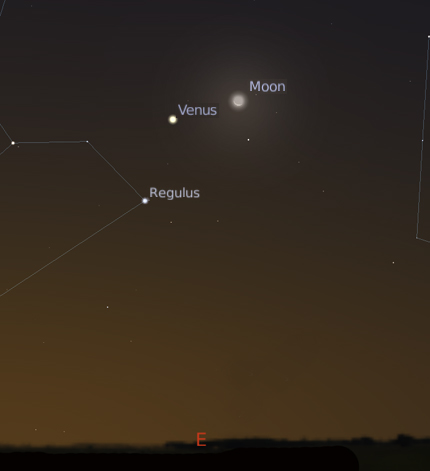
If you’re an early riser, try stepping outside tomorrow morning for a view of Venus and the slim crescent Moon, which will be paired low in the east before sunrise. The Sun comes up around 7am, so there should be a lovely view starting around 6, if you have a view to the east that allows you to see the pair very low to the horizon. Once the sun is up, keep an eye on the pair, as they are both bright enough to view in the daylight.

You may notice a star to the lower left of Venus. That is Regulus, the brightest star in Leo. Keep an eye on it over the next few days, as Venus moves closer and closer to it. By the morning of September 20th, the Moon will be long gone from the morning sky, but Venus and Regulus will be a lovely pair, only half a degree apart. What a magnificent ‘double star’ that will seem, with just the eye or through binoculars. Through a telescope, Venus shows a small gibbous phase, but here is a good chance to compare the colours of Venus and Regulus. How do they compare to you?

The Moon, Venus and Regulus on the morning of September 16th.

Bob C. Back At Spectacle Lake

I’m back at my favourite dark sky “preserve” at Spectacle Lake near Barry’s Bay, Ontario.

I arrived just before 5 pm Sunday, and I was bagged. But later on, when the night sky was clear, the adrenaline rush wiped away any tiredness.

And Sunday night was beautiful, despite the presence of high, hazy cirrus cloud.

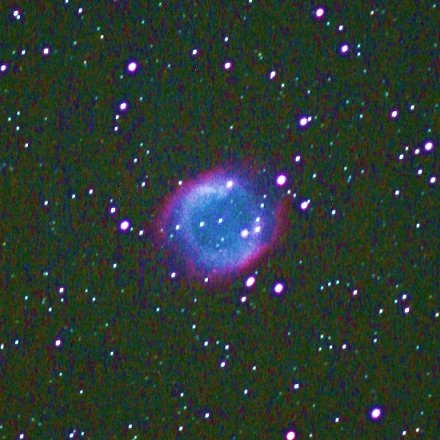
Here is the Helix Nebula (NGC 7293), in Aquarius, from just after midnight (therefore Monday morning). This is a cropped version of a stack of 7 images (7 X 92 seconds on average) for a total combined exposure time of 10 minutes 44 seconds. Images taken with Canon Digital Rebel 300D with Tamron 300mm f/2.8 telephoto lens on Super Polaris mount at ISO 1600. Stacked using DSS. Another version will be posted later.

Bob Christmas

The Helix Nebula (NGC 7293) by Bob Christmas

What to do during Full Moon

The weather has finally improved just in time for the last long weekend of summer and wouldn’t you know it – it’s full moon! As all (cynical) amateur astronomers know – if it’s clear, there must be a full moon.

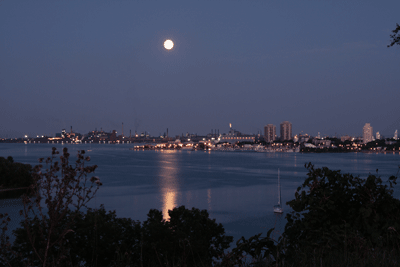
Here is a photo I took from York Blvd. near the high level bridge tonight of the full moon rising above our fair city.

Moonrise over Hamilton

Jupiter Moonless

1:12am Well, it’s 1:12am and there are no moons. I gotta say, it looks pretty strange.
I can clearly see both Europa’s shadow and Ganymede in front of Jupiter through my small but mightly 80mm scope, and a wealth of other detail on Jupiter. Still, pretty strange

1:25am I can’t see Europa itself, which is also crossing in front of Jupiter. I can only see Europa’s shadow, and Ganymede of course. Ganymede is so much bigger than Europa, so the limit of my telescope is somewhere between Ganymede and Europa. Europa also has a higher surface brightness, so it may be harder to pick out against the bright cloudtops of Jupiter.

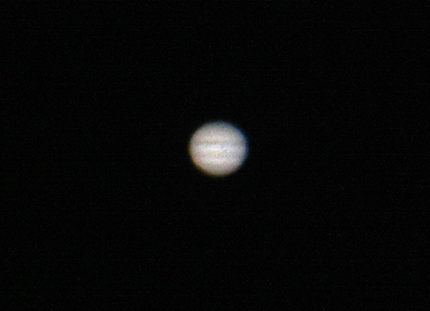
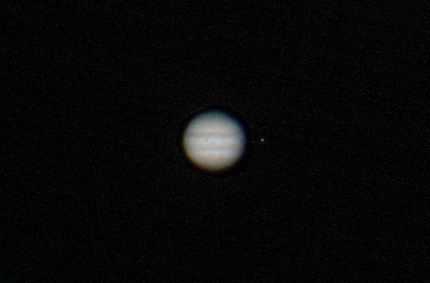
2:05am I’m taking some photos through the eyepiece (afocal) just to show that there are no moons. I don’t really know how much good a photo is of something that isn’t there…

2:20am Wow! The photo actually shows the major bands and two little marks that are Ganymede and Europa’s shadow. I’m not saying it’s a great shot, but it’s something.

2:35am Yeah, it’s over. Io has popped out of the shadow and Jupiter again has a moon. I tried another photo and it barely shows Io. I suppose it is still partly shaded, and it is so much smaller than Ganymede. I just thought that since Ganymede showed up so well…

2:49am Exactly on schedule! Europa is coming off the limb of Jupiter. It is like a little pimple on the edge of the planet. Also, Ganymede’s shadow is now visible on the other side of Jupiter from Ganymede itself, and it looks huge in comparison to Europa’s shadow. It also appeared right on schedule. You could set your watch by this stuff (and people used to!) Don’t you just love Newtonian physics?!

3:02am Show’s over for this year. Well, for the next 10 years. Next time this happens it will be 2019. Right now, it’s time for bed.

Time 2:08 No moons, but Ganymede is actually visible near the center of Jupiter.

Time 2:35 Io has appeared from out of Jupiter’s shadow.

Rare Jupiter Event Tonight!

Clear weather is coming just in time for an unusual and rare event for telescope observers. Jupiter’s four Galilean satellites are constantly orbiting around their giant parent planet, and always provide an interesting and entertaining show for observers. This Wednesday night the moons of Jupiter will again amaze us, but this time with their absence!

On the night of September 2nd (morning of September 3rd) starting at 12:45am, none of the moons will be visible for a period of nearly 2 hours. This type of occurence, when all four moons are invisible, occurs about 10 to 20 times per century. The last occurence was a mere 16 months ago, but we will not have another chance to see this for 10 more years, in 2019.

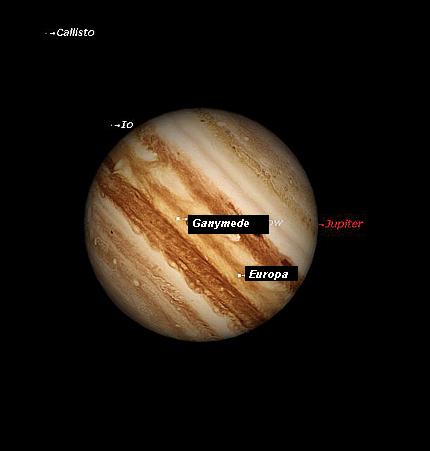
During the time when no moons are visible, Ganymede and Europa will be in front of Jupier (transiting), Callisto will be in Jupiter’s shadow (eclipsed) and Io will start out behid Jupiter (occulted) and then come from behid Jupiter but stay in its shadow.

Here’s the whole line-up of events for that night (from Sky and Telescope)
Wednesday, September 2, 2009
23:28 UT, Callisto enters occultation behind Jupiter.

Thursday, September 3, 2009
03:44 UT, Io enters occultation behind Jupiter.
04:00 UT, Europa begins transit of Jupiter.
04:46 UT, Ganymede begins transit of Jupiter. (NO MOONS VISIBLE)
04:56 UT, Europa’s shadow begins to cross Jupiter.
06:32 UT, Io exits eclipse by Jupiter’s shadow.(End of No Moon Period)
06:46 UT, Ganymede’s shadow begins to cross Jupiter.
06:50 UT, Europa ends transit of Jupiter.
07:50 UT, Europa’s shadow leaves Jupiter’s disk.
08:24 UT, Ganymede ends transit of Jupiter.
08:44 UT, Callisto exits eclipse by Jupiter’s shadow.
10:24 UT, Ganymede’s shadow leaves Jupiter’s disk.

After posting a couple of blog entries encouraging you to go out and observe the ever-changing parade of Jovian satellites, I now hope you enjoy this chance to not see any of Jupiter’s moons!

The positions of Jupiter’s moons around 2am

Lunar landing sites imaged

Well, they were imaged by the LRO, but it’s still impressive.
These images are about 4 feet per pixel. There’s 5 landing sites shown.
I guess they did not get Apollo 12 yet.

http://www.nasa.gov/mission_pages/LRO/multimedia/lroimages/apollosites.html

Check them out!

An Exciting Night on Jupiter – Part Deux

As the evening started, Callisto and Io were on one side of Jupter while Ganymede and Europa were on the other side. Within a span of a few hours Ganymede moved in front of Jupiter, followed by Europa, then Ganymede’s shadow appeared and Europa’s too. Io then moved behind Jupiter, and just after the clouds rolled in Europa and Io would have both emerged into view again, within minutes of each other, but on opposite sides of the planet. Phew! That’s a lot, but it is what we observed tonight. Even better, it is also the kind of action that goes on every night and can be seen in even the smallest telescope.

Tonight, I used my Burgess 5″ achromat refractor and a variety of eyepieces. The best view came through a borrowed binoviewer, which really works well on bright objects like Jupiter. The globular cluster M13 was disappointing through the binoviewer, and M17, the Swan Nebula, was really neither better nor worse. Double stars and open clusters were very nice though.

Returning to Jupiter, it appeared as an apparent 3 dimensional disk, rich in detail. The seeing started out poor, but as Jupiter rose higher in the sky the image became rock steady, and we were able to follow not just the shadows, but the moons themselves across Jupiter’s face. Ganymede appeared as a large disk in front of the white equatorial zone, while Europa was visible, but barely. The shadows appeared inky black and showed considerable difference in size. Notice that although Europa was the second moon to move in front of Jupiter it was the first to move off. That is because it is closer to Jupiter than Ganymede, and moves much quicker in its orbit. While in front of Jupiter, Europa actually passed by Ganymede, like a race car on an inner track.

Every night it’s something different. What will if be tomorrow? Go out and see this spectacle for yourself, now showing in the sky above you!

(All right, I’m going to give you this one rather than make you look it up yourself. On Friday night (Saturday morning) at 2:30am, Io is going to graze Europa. From our perspective here on Earth the disks will appear to actually touch! Use the highest magnification that your scope and the atmospheric seeing conditions will allow, and enjoy!)

I look forward to reading your reports here on the blog, or email them to me ( observing@amateurastronomy.org )and I will be happy to share them.

HAA member gets APOD for August 26

Today’s APOD is Kerry-Ann’s winning photo from Starfest.

Once again she has shown us what can be done with with equipment many of us have handy.

I am so proud of our members’ abilities and the awards they have received.

Well done, Kerry-Ann!

http://antwrp.gsfc.nasa.gov/apod/ap090826.html

Observing to night

I will be going out to the alt. site on Tyneside rd. tonight. If you would like to join me please come along. I am planing to arive there about 8:30 pm. Make sure you have bug juice as the mosguitos were very bad the last time I was there.