Closest Full Moon of the year

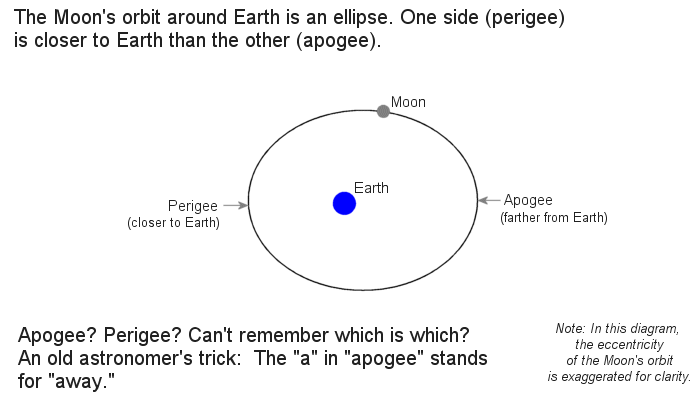
There’s been lots of talk about Mars at our meetings and in the blog since opposition is occurring tonight. But there is another interesting thing in the sky keeping Mars company tonight. The Moon will be full on Sat 30 Jan and it also will be at perigee. Like all orbits, the Moon’s is elliptical and gets closer or further away from the Earth throughout it’s orbit.
Perigee
Link to larger image

As it turns out, this full Moon (Also known as the Wolf Full Moon), will be coinciding with its closest approach. This means it will be larger than usual (both actually and apparently). Try to catch the full Moon rise in the East just after sunset. Combined with the atmospheric effects, this full Moon should appear a lot larger than normal.

And as a bonus, tonight the Moon will be within 6 degrees of Mars (conjunction) – also at its closest to Earth for the next few years. Both are in the constellation Cancer. So you have a double treat. Here’s a chart to help you find them. These both could fit into the field of view of low power binoculars.
Moon and Mars
Link to larger chart

The forecast is calling for a fair amount of clouds over the next few days, but there should also be some good breaks. So keep an eye on the sky and get out when it opens up. Be sure to let us know about your observing activities.
(images and charts from SpaceWeather.com)

Today’s APOD

Today’s Astronomy Picture of the Day is by our upcoming guest speaker, Alan Friedman. Alan will be visiting us in April and is sure to give a fascinating talk. Be sure to see his spectacular Mars image on the APOD website by clicking on the link below, and then go out and observe Mars yourself!
http://antwrp.gsfc.nasa.gov/apod/astropix.html

Mars at closest position to Earth and other Mars news

Opposition
Today (Jan 27, 2010) marks Mars closest approach to Earth for the next 26 months or so. Today we are about 99 million km from Mars (in Aug 2003, we were about 58 million km), but on Friday Jan 29 we’ll be at opposition (exact opposite direction from us and the Sun.) The difference is explained by orbital mechanics. In simplified terms, our orbits are not parallel with respect to each other so Earth is pulling away from the Sun while Mars is getting closer to both the Sun and Earth, but not at the same rate. As a result, closest approach and opposition do not fall at the same time (but are generally close to each other).

This weekend is calling for some clear skies so get out if you can to see Mars at it’s best for the next 2 years. Even so, Mars won’t be much more than 14 arc-seconds in size. But at the Burlington Public Night last week, I was able to make out the polar cap and some of the larger surface features in my 5″ refractor without a lot of magnification.

Spirit
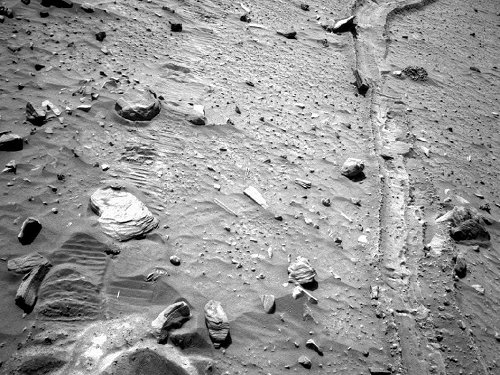
As I reported at the Jan HAA meeting, the Mars rover Spirit has been stuck in one place since April of 2009. NASA, JPL and APL engineers have been trying to figure out ways to free Spirit from its location.

Last tracks that will ever be made by Spirit

Regrettably now it’s official (as of Jan 26) that they have given up and they will no longer try to free Spirit from its current position.
Spirit

Instead Spirit will now enter a new phase of life as a stationary science platform doing additional chemical analysis and try to determine more info about the nature of the planetary core.

How long it will last will be dependent upon surviving the winter. It is now mid-fall on Mars and the tilt of the solar panels (which provides power to the heaters, electronics and radios) is getting less and less energy each day. If it can’t get enough energy to keep warm enough through the winter, then it may not survive. If it does, then it could last for many more months or years in this final location.

The good news is that the other rover, Opportunity is still going strong.

Phoenix
In a related note about Mars exploration, you may remember the Phoenix lander from 2008. It landed in the far Martian north in June and was supposed to last to Sept, but got another 2 months after confirming water ice under the polar cap. Its last transmission was Nov 2008 when the winter had advanced and solar energy dropped to a level incapable of sustaining Phoenix.
Phoenix Wake-up call

Now that spring is approaching and the sun is getting higher(more energy for the solar panels and batteries), NASA has planned a series of calls to Phoenix to see if it survived the winter. While it appears to be unlikely, there is a slim chance. The first calls went out on Jan 18 and will be repeated several times over the next few months. Orbiting satellite Odyssey will be positioned to listen for any weak signal and relay it to Earth. So far there hasn’t been a reply, but it’s still early and potentially lots of frost on the panels. Conditions may improve over the next few months.

Burlington Public Event – Jan. 22, 2010

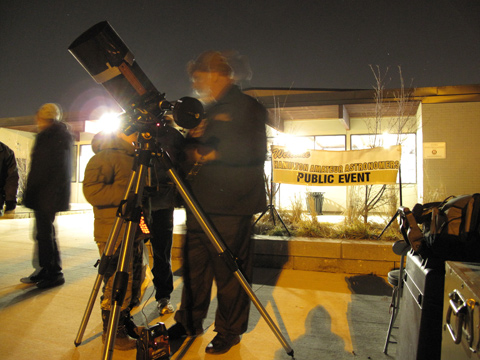
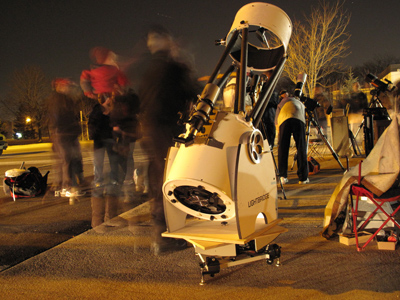
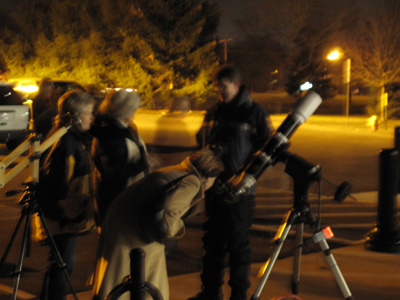
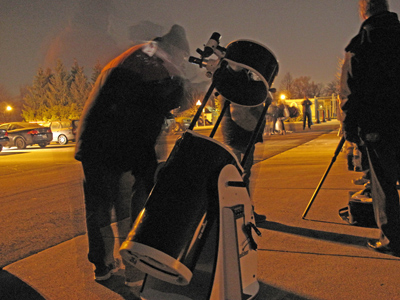
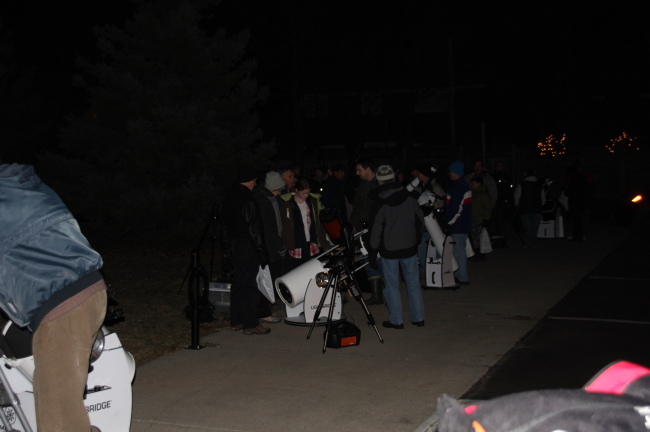
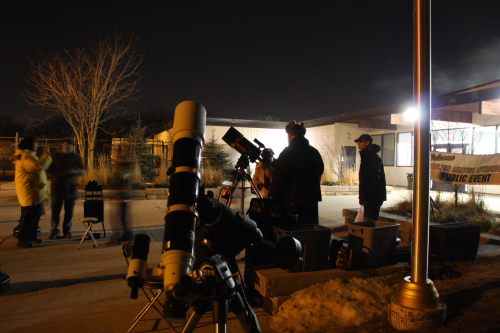
Our public star party at the Nelson Rec Centre in Burlington was very well attended by both members of the HAA and the public. The skies stayed crystal clear for the entire evening and there were many telescopes and binoculars on hand for everyone to get their fill of photons.

Here are a few photos of the event. I hope others add to/edit this report with their comments.

Burlington Public Star Party – Jan. 22, 2010 – Jim W.

Burlington Public Star Party – GWS

Burlington Public Star Party- Don P.

Update and photos from Don Pullen

As mentioned by Ann and commented by Jim, this was definitely one of our best attended public night. We had about 200 people come by, either because of the ringette and hockey at the arena, or had seen our promotion in some of the local papers. But whatever it was that brought them out, they left with a new sense of awe and appreciation for the HAA and astronomy.

As expected, the afternoon skies cleared and we had good seeing (a little unsteady, but not bad considering we were in a parking lot).

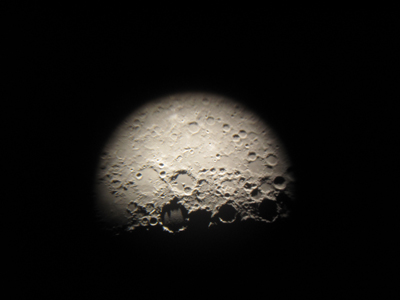
About a dozen scopes were set up with a mix of refractors, reflectors and SCT’s. People were amazed with views of the Moon, Mars and some nebulas and clusters.

True to forecast, the clouds started to roll in a little after 10pm and things were starting to wind down, so we packed up and we crowded out the staff at a nearby Tim’s for comaraderie and reminiscing on the event.

A great night and thanks to all of our members for coming out on a chilly, but pleasant night and providing a wonderful show for the people of Burlington and area.

SID on SpaceWeather

For those who saw Michael Jefferson’s talk on his Sudden Ionospheric Disturbance detector at the last meeting (and for those who didn’t) the same apparatus is currently featured on the SpaceWeather web site. There were recently a couple of strong solar flares that showed well on the SID graphs. Nice to see that Mike’s network is getting some publicity. Follow the link below to see the article and graphs. And yes, Mike’s apparatus recorded the same information very well too!
http://www.spaceweather.com/

UPDATE:

The SpaceWeather page has updated to new stories, but here is the text and image from th site:

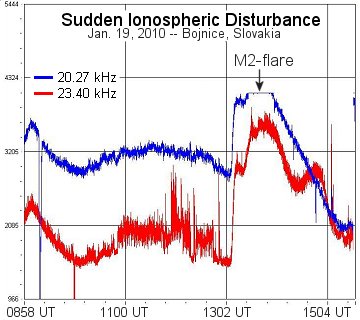
“IONOSPHERIC DISTURBANCE: An M2-class solar flare on Jan. 19th bathed Earth’s upper atmosphere in X-rays and caused a wave of ionization to sweep over Europe. This improved the propagation of low-frequency radio signals, which use the ionosphere as a reflector to skip over the horizon. A SID monitor operated by Rudolf Slosiar in Bojnice, Slovakia, recorded a surge in signal strength:
“SID” stands for Sudden Ionospheric Disturbance, and a “SID monitor” is a radio receiver that monitors ~20 kHz signals from distant transmitters. “My system clearly detected the effects of the solar flare,” says Slosiar. “The decay of the signal shows that it took about 72 minutes for the ionosphere to recombine [and relax to its pre-flare state].”
With solar activity on the rise, sudden ionospheric disturbances will become more common. Interested? Stanford University tells you how to build your own SID monitor.”

Astro talk at London, Ontario

Target Earth: Impacts Large and Small – Feb. 9

This one is for the week of our February meeting. If you are in the area
you might consider taking it in.

Peter Brown is an excellent speaker. I hope he will address our club in the future.
Here’s the annoucement for your pleasure.

February’s ?Classes without Quizzes” lecture is called Target Earth: Impacts Large and Small. The Earth is constantly bombarded by asteroids and comets. Peter Brown, physics & astronomy associate professor at Western, will discuss the threat these extraterrestrial impacts pose, and how they also offer researchers unparalleled opportunities to better understand our solar system and how it formed. The lecture takes place on Tuesday, February 9 at the Medway Community Centre, Sherwood Forest Square, Wonderland Road North, London. Doors open at 6:30 p.m. and the lecture begins at 7 p.m.

“Classes without Quizzes” is a complimentary lecture series for the community offered by The University of Western Ontario. Join us for topical, entertaining and insightful monthly lectures by some of Western?s leading faculty, each taking place in different London locations through to Spring 2010. For more information or to RSVP for a lecture, please email programs@uwo.ca, call 519-661-2111 ext. 85739 or visit http://communications.uwo.ca/CWQ/

Observing at the Alternate Site

Jim, John and I arrived about 7 PM and set up what equipment we had brought.

I also started shifting my weight from foot to foot to keep them warm. Boy, it was cold out there. The sky was clear, but the transparency was not good. It was still a pretty bright background.

Camelopardalis was almost at the zenith. That’s the worst place to find something with an alt-az. I brought my Big Black Binoculars with me. They are not good at the zenith but would do a fine job elsewhere in the sky. Orion was my first target.

I decided to snap some sky photos to get ‘warmed up’ and noted that as usual, focus was going to be an issue. Without the moon in the sky, the auto focus on my camera does not work, and manual focus means trying over and over.

Jim was using a 9.25 inch SC.

John had his binoculars trained almost on the zenith, at Kemble’s Cascade. What a nice view it was. I could see how it would earn a name instantly if someone spotted that in binoculars.

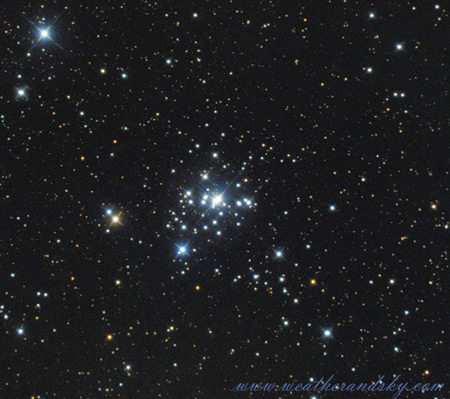
We eventually got Jim’s scope focused on NGC1502 at the end of the cascade. What a lovely set of matched pairs of stars it has. It’s like a special star-stamp was used to put pairs on the sky over and over.

After a while another member arrived and we shared views of Orion, and a few double stars.

At 9 PM or so, it was so cold, we decided to retire to Tim Horton’s at Nebo Road, and discuss all manner of interesting topics, while our feet warmed up.

It was our first outing of the year, and high time too. I don’t think i was out in November or December.

It can only get better now. Those long-johns are starting to sound like a good idea. John and Jim were cosy as teddy bears in them.

Our next outing is no later than January 22nd or 23rd, at Burlington. By then the half moon will make a great target, and mars will rise in the east.

Steve

————————-
Update By KerryLH

While the crew was out at Tyneside I was able to capture that pretty cluster NGC1502 from home. The entire Kemble’s Cascade was too large to fit in the field of view of the 8in and QHY-8 but it was nice to get some resolution on this small cluster at the end of it. Next time I’ll give the entire cascade a try with a different setup.

Large version: http://www.weatherandsky.com/main.php?g2_view=core.ShowItem&g2_itemId=7568&g2_imageViewsIndex=3

Observing tonight

Hi Everyone

Some HAA members will be setting up telescopes and binoculars at the Alternate Site on Tyneside
tonight from about 7 PM until about 9 PM. It’s cold so dress warm. Please
bring some of your equipment or you can share mine.

Cheers,
Steve Germann

ASX?s ?Expanding Canada?s Frontiers? Symposium

Sent to me via Facebook. I thought some club members might be interested in this. Sounds interesting.

ASX?s 7th Annual ?Expanding Canada?s Frontiers? Symposium

The Astronomy & Space Exploration Society (ASX) at the University of Toronto invites you to this exciting event!

Featuring:
* Prof. Peter Schultz (NASA LCROSS mission): Water on the Moon – a new oasis for life in space
* Prof. Sara Seager (MIT): seeking the stuff of life beyond our solar system
* Dr. Firouz Naderi (NASA JPL): engineering the future of robotic space exploration
* Dr. Narendra Bhandari (Indian Space Res. Org.): India’s Space Program finds water in the lunar desert

DATE & TIME: Friday, January 29, 2010, 6:30 PM
(Doors open at 5:30 PM, reception at 10 PM)

LOCATION: Convocation Hall, University of Toronto (31 King?s College Circle, Toronto)

ADMISSION:
General Public: $20 ($15 until Jan 7, 5pm) from UofT TIX:
http://uofttix.ca/view.php?id=579
Phone #: (416) 978-8849

** This event has attracted over 1,000 attendees in the past, so do book your ticket early!

ABSTRACT: The search for habitable worlds other than our own, from nearby in our solar system to far away exoplanets, is one of the greatest scientific endeavors of human history. The discovery of many exoplanets in recent years as well as the astonishing discovery of water on the moon has propelled this quest to the forefront of today?s scientific research. With these discoveries in mind, ASX is pleased to present a truly inspiring cast of speakers who are at the forefront of this field. Please come out on January 29th to hear these speakers talk about their latest work and accomplishments as well as their perspectives on the search for other worlds and space exploration.

More info: http://asx.sa.utoronto.ca/symposium/
Facebook: http://www.facebook.com/event.php?eid=233912979487

About ASX:
The ASX is a student group at the University of Toronto that is committed to bringing about awareness of astronomy and space exploration news, research, initiatives and opportunities in Canada and around the world, to the students and the greater public.

Anniversary

Today marks the 400th anniversary of the discovery of Jupiter’s moons, and the start of a whole new chapter in the history of science.

Despite the fact that last year was the International Year of Astronomy in celebration of the 400th anniversary of the first astronomical use of the telescope, it was actually in early 1610 that Galileo made many of his most important discoveries and announced them in his book, the Sidereus Nuncius.

From the Sidereus Nuncius, By Galileo Galilei:

“On the seventh day of January in this present year 1610, at the first hour of the night, when I was viewing the heveanly bodies with a telescope, Jupiter presented itself to me. And because I had prepaped a very excellent instrument for myself, I perceived (as I had not done before on account of weakness of my previos instrument) that there were three starlets beside the planet, small indeed, but very bright.”

And with those words began the era of modern observational astronomy…

Page showing Jupiter observations from ‘Sidereus Nuncius’