Brantford Night

I arrived there about 6:50 PM and proceeded to set up the GWS for the inspection of the attendees. It was very cloudy and i was assured that they would not clear.

Ann set up a Dob as an additional scope. I also set up the Big Binoculars, and pointed them at a nearby Cell Tower.

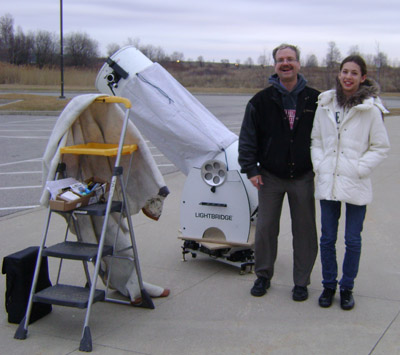
Megan Fox (travelling incognito) arrived and posed with me for a photo-op, as my car transformed into a telescope:

Reporters from Rogers Cable and some local newspapers also conducted interviews with me and with our presenters. As usual, Don was also a great spokesman for the club.

The talks went well and I sniped some photos of the proceedings, while keeping one eye on the GWS and the other on the clouds.

At about 9:20 PM, the clouds started to clear. Alas, many of our number had already headed home.

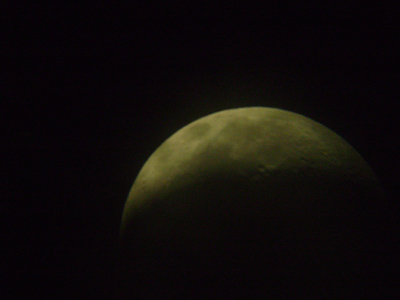
I got this photo of the Moon afocally through the eyepiece:

ADDITION from John Gauvreau:

Well, I think it is also important to mention that besides Steve, there were at least 17 other members of the HAA that turned out to this event. Tim did a great presentation and represented the club well to his hometown, and many others brought scopes in case it cleared up. The efforts of so many members willing to travel out of town on a cloudy night demonstrates clearly that this is an active and dynamic club that works so well because everyone is willing to contribute towards a team effort. The club was so well represented, in fact, that we (sadly) outnumbered the public.

The club owes a big thank you to everyone who travelled all the way to Brantford to help out with this public event. Please forgive me if I don’t remember everyone, but here goes:
Alex, Ann, Bill, Bob, Don, Ed, Kevin, Ed, Jim, Joe, Les, Linda, Wayne, Mario, Marcel and Tim. I enjoyed seeing all of you there!
Brantford tonight!

Hi Everyone,

I will bring the GWS (Great White Scope) and set it up at about 7 PM.

The skies might just be clear enough for some good views, so here’s hoping.

John Gauvreau and Tim Philp will be making presentations indoors,
regardless of the clouds, and there will be a sky tour after the presentations.

I hope to see you all there!

Steve

SpaceWeather

There’s a really nice picture of the sun by Alan Friedman on the SpaceWeather web site. Alan will be the main speaker at the April HAA meeting. Be sure to see his picture, and his talk!

http://www.spaceweather.com/swpod2010/18mar10/Alan-Friedman1.jpg?PHPSESSID=3h32ntrl26p11ot33mhukhnt04

http://www.spaceweather.com/

Observing Sat Mar 6 at Tyneside

The weather forecast is looking good again for another night of observing. (Hard to believe we’ve had several nice nights in a row!!)

Several HAA members will be heading out to our alternate observing site on Tyneside Rd for some stargazing. (directions can be found on our “About Us” page.) We welcome others to bring their scopes and join us or just come and look through the equipment that will be there.

We’ll be setting up between 7 and 8pm and will stay until we get too chilled or the fog rolls in around midnight.

A fine night observing with friends

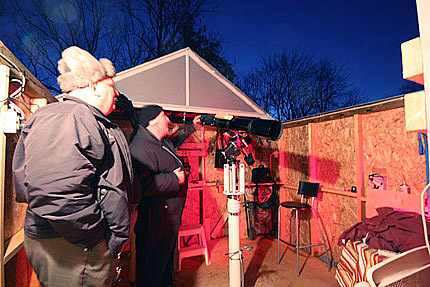
Tonight Jim and I were delighted to accept an invitation from Les to come visit his roll-off observatory. Overlooking the Grand River, the shed offers dark skies and a welcome shelter to observe from.

Setting up his very fine 4″ refractor, Les showed us the Orion Nebula through a variety of eyepieces, with some pleasing and surprising results. It’s amazing how well the inexpensive eyepieces compared to the premium oculars! We continued our tour of the sky with some winter highlights, like the Pleiades, the double cluster and M35, as well as views of Mars with its polar cap and Saturn and its moons Titan, Rhea, Dione and Tethys. Algieba in Leo and Polaris provided some fine double star targets. Algieba showed a bright yellow primary with a more rusty companion star. Through a no-name eyepiece the colours seemed more pronounced than through a Pentax. The ISS also went right overhead to make the evening complete.

Les and his wife fed us with a great assortment of meats and vegetables (and some deliscious strawberries) to keep our strength up. Both Jim and I were very impressed with the clever and ingenious way Les has put together and runs his backyard observatory, and we were delighted to take advantage of his hospitality and dark skies. Thanks, Les!

Jim and Les inside the observatory.

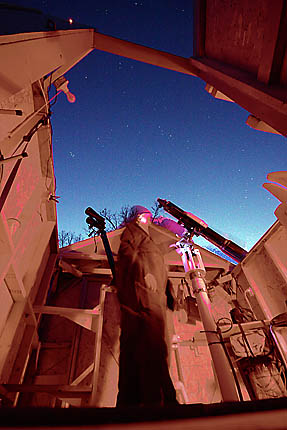
The stars rise over the observatory.

Clear Skies for a change

Got out last night while the going was good. Light pollution and moonlight made seeing a little challenging so I looked for a few new bright things. Cancer was completley invisible so I used binos to find it and look at M67 for the first time. Also looked at several other things for the first time. The Eskimo planetary (small but bright), The triple star B Monoceros (separation 7 and 5 arc seconds) and the double star Algieba in Leo. Back on Feb 7, I looked at a very beautiful double (Almach in Andromeda) that looks like the Albireo double but closer together (10″). The colours are orange and blue/green. Nothing exotic I know, but it’s still nice to find and see things for the first time. Also had a nice view of saturn even though it was low in the sky. the shadow of the ring across the face of the planet was easy to see and 3 moons.

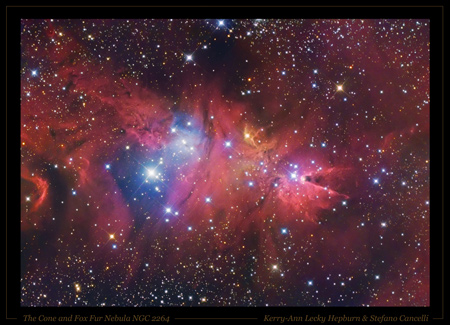
The Cone and Fox Fur Nebula collaboration.

Hey everyone, I just wanted to share with you my latest collaboration with Stef Cancelli. After a year of collecting frames in between spells of poor weather and getting over my slight fear of putting the pieces of this together. I’m finally able to share with you this HaRGB rendition of the nebula and cluster (aka Christmas tree cluster). With lots of help from Stef and a number of back and forths of the image file, checking on numerous monitors and making small tweaks here and there, I’m happy to say it’s finally complete 🙂

The details:

Stef contributed a 2 panel Hydrogen Alpha mosaic: 30 subs x 15 mins each with the ST10XME and Tak FS102 @ f6. I contributed a 2 panel RGB mosaic: 65 subs x 5min on the Cone and 57 subs x 5min on the Fox Fur with the QHY-8 and AT8RC @f6.4. A small RGB
contribution was made with frames taken from the c6 SCT last spring.
Total HaRGB exposure time was 17hrs 20min.

BTW All frames were acquired from the night lights of Toronto and Grimsby.

Hope you like it!

Take a peek at the large version to see the fox and cone:

http://www.weatherandsky.com/main.php?g2_view=core.ShowItem&g2_itemId=7578&g2_imageViewsIndex=3

KerryLH

SuperSID

From Michael Jefferson:

On January 19 and 20, LOFAR II SID detected 4 solar flares, respectively, in the C and M classes and a single M and C on February 06. The SID and GOES charts and event logs were on display on the back table of the February 12 general meeting. They were available for member inspection during the break and at the end of the meeting. If (as Bay Bloor Radio says in its sales ads) you missed it ? you missed it!

However, we are rapidly coming out of the deepest solar minimum in 100 years. Things should really start to get active from here on in. On the 13th , we had the biggest M-class flare since the new solar cyle began ~2 ½ years ago. WE MISSED IT %##$@!! because NAA (our 24 kHz transmitter) was down for a maintenance all day on Saturday. But, the best is yet to come. We will, of course, stay tuned!! There will be aurorae, radio blackouts, satellite ‘bakeouts’ and power failures, due to Sol, in the coming times. Be prepared!

Stanford Solar Physics says we have some of the cleanest data they have ever seen and have asked us to beta-test the new SuperSID receiver. In our possession, we have a ‘spare’ industrial IBM e-server to which the SuperSID will be connected. This apparatus will be BNC-T-connected to the LOFAR II radio antenna so that the antenna will feed both the SID and SuperSID receivers. This means we will run two radio-telescopes, the older doing narrow-band reception and the newer doing wideband. Chris Kubiak has agreed to help with the programming and setup, and The Computer Trade-In Post will help with hardware additions and installations.

The Society of Amateur Radio Astronomy (which has helped Stanford develop SuperSID) has asked us to become a member ($20.00/annum) of it, and Stanford is 100% behind this. I think HAA should do all of this. With or without HAA, I will go ahead with this project, myself, because it is very worthwhile and it gives us further international status. But, I would prefer to have the club in this as well as in the present apparatus setup. I trust that this will have full membership support ? it will not cost HAA one cent beyond the membership fee! I will be asking Council for full HAA-support for this endeavour at the council meeting on February 22.

The beauty of this equipment is that the results are so immediate, often not more than 8 minutes distant. On February 14, we apparently caught a coronal mass ejection as its progenitor sunspot (#1045) was disappearing over the solar horizon in a display of the Wilson Effect. The Stanford charts show us as the only station to capture this phenomenon.
-Mike Jefferson

Large Sunspot Group

Sunspot group 1045 has developed into one of the largest and most interesting sunspots in a long time (well, years!). It is currently centered in the sun’s northern hemisphere and is well worth looking at before it disappears. As always, be sure to use proper solar observing techniques and equipment, and always be safe when observing the sun. Check out today’s image from the SOHO satellite.

The sun on February 7th, with large sunspot group.

IMAX movie about Hubble mission

Here is a link to the trailer for the IMAX movie about the last mission to the Hubble Space Telescope, due out in May.

http://www.youtube.com/watch?v=SO4ZWJlROwE&feature=youtube_gdata&autoplay=1