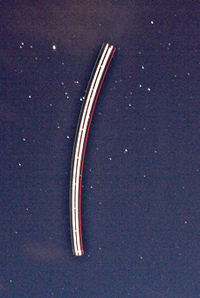
Astronomy Day Report

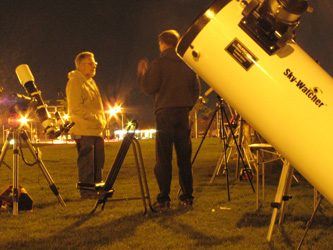
Many HAA members attended our Friday night event at McQueston Park. Although the skies were hazy, excellent views of the Moon, Saturn, Mars and Venus were shared with the public through over a dozen telescopes.

Astronomy Day (Friday evening) at McQueston

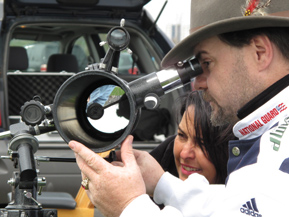
Our Saturday afternoon solar observing session was almost completely clouded out with just a few glimpses of a hazy solar disk through white light and h-alpha filters. That didn’t stop the public from coming out to ask questions and get help setting up their own telescopes.

Joe helps Gina set up her telescope properly.

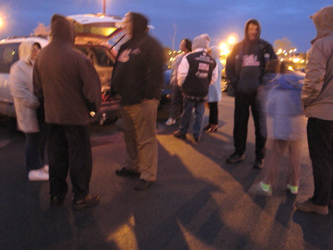
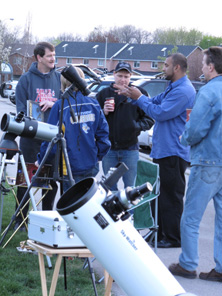
Nine HAA members attended the Saturday evening session at McQueston Park from 8:00 until about 9:00. True to the weather forecast, the skies were cloudy and a light rain was falling. In spite of that, about a dozen members of the public showed up. We couldn’t set up any telescopes because of the rain, but an impromptu tailgate party quickly ensued. John Gauvreau showed his meteorite and explained “falling stars” to an appreciative group while the rest of us answered astronomy and telescope questions.

Tailgate Astronomy in the rain at McQueston Park

About 9:00 the parking lot began to clear and the remaining HAA members headed to Tim Horton’s for well-deserved hot chocolates and coffees.

Lyrids Meteor Shower – Apr 21/22

As noted in the HAA calendar, overnight tonight (April 21 into the early morning of Apr 22) is the Lyrids Meteor Shower.

This is a medium intensity shower with an average of about 15-20 meteors per hour. However these travel at high speeds (over 100,000 km/h) when striking the Earth’s atmosphere. This can produce intense but very quick streaks. Some years have produced much higher strike rates. The average magnitude of these meteors are about +2 (similar to some stars in the Big Dipper), but occasionally can produce fireballs which are brighter than Venus and can leave a smokey trail which can last for a few minutes.

The Lyrids (also known as the Alpha Lyrids), which appear to emanate from the constellation Lyra, are remnant dust from comet Thatcher (C/1861 G1). We can see sporadics on any given night (1 or 2 per hour), but their point of origin if traced back along their path, will not be from Lyra. That’s how you can differentiate them.
(Speaking of comets, Phil Plait over at the blog “Bad Astronomy” has just recently added a “10 Things You Don’t Know About Comets” feature which might interest some of you.)

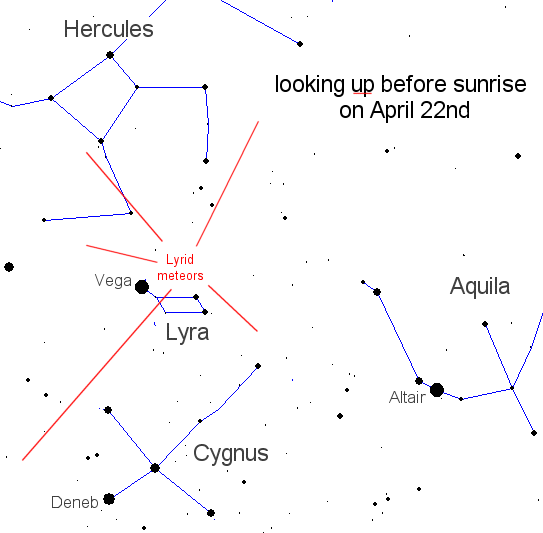
Lyrid meteor shower skymap

Click this link for a larger version of the map or this link for more info (courtesy of SpaceWeather.com).

If the skies remain clear overnight, the best viewing will be in the early morning several hours before sunrise. If you are a night owl or can get up really early, this meteor shower can be a rewarding show. Like all meteor showers, you will see more from a dark location than from within the city. So perhaps consider a trip out to Binbrook or some other rural area.

It’s also a fairly broad shower, which actually runs from about Apr 16 through to 26, but the peak is during this evening. So if you don’t see them tonight, you can try over the next couple of nights or early mornings, though the rate will drop off. Sadly we probably won’t see any of these on Astronomy Day from the location of McQueston Park due to bright lights and time of the event. But you can be sure we’ll be trying.

Good hunting!

Clear Skies Bring Many Out to Observe

Sunday night saw clear skies attract several observers out to the alternate site, where even a cold, stiff breeze couldn’t dampen our spirits. The air was not too transparent, but very steady and the wind kept the telescopes dry.

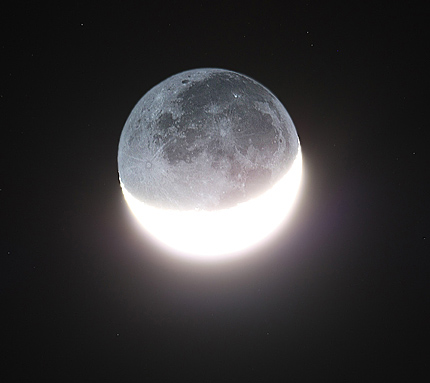
Jim’s 9.25″ pulled in a variety of objects, while Don showed spectacular views of Saturn through his 5″ refractor. Ann ran a marathon through a large part of the Messier list with her 6″ Dobsonian, and Jackie provided encouragement and coffee to all. I, naturally, brought my small but mighty 80mm refractor. Like Don, I took a few pictures of the moon. Here’s the Earthshine, also known as the ashen light, nestled in the overexposed arms of the sunlit crescent.

The Moon seen through my 80mm refractor.

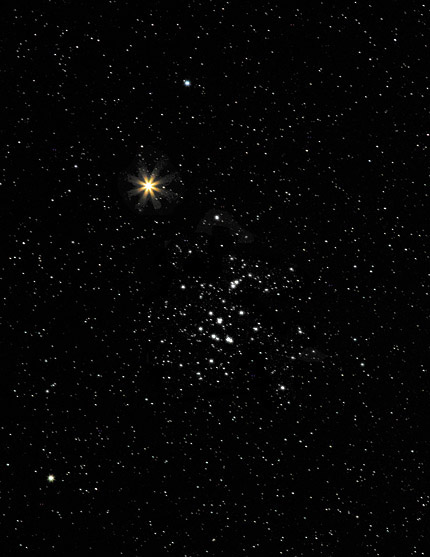
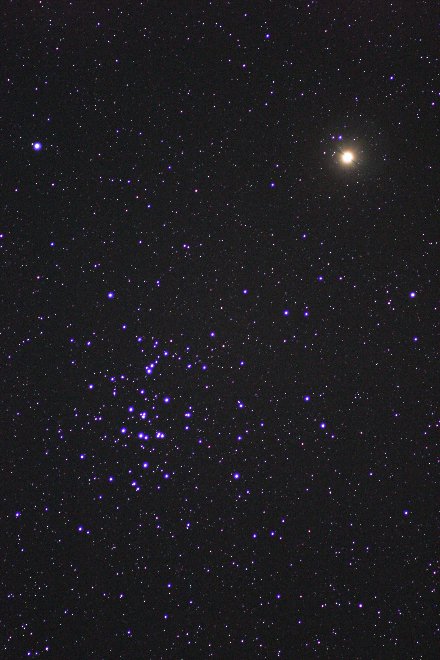
My main objective was to photograph Mars next to the M44, the Beehive Cluster. I tried to get this shot last week but I was clouded out. That same night last week, Bob Christmas got a beautiful shot from his observing site up north. Compare this shot that I took last night, to his shot seen in his blog entry below (“Bob Christmas’ Images from Spectacle Lake” April 12, 2010).

Mars and M44 imaged through a camera being piggybacked on my 80mm scope.

Notice how much Mars has moved relative to the cluster. Mars is moving away from the cluster now, but still looks beautiful in binoculars or a wide-field scope. Be sure to check it out yourself.

A good night of observing is almost always the result of good company, and last night sure was a good night.

__________________________________________________________

FUTURE OPPORTUNITIES

Later this year, as the M44 sinks into the west, there will be another planetary encounter. On June 20th, Venus will pass even closer to the Beehive than Mars did. Venus moves appears to move across the sky quicker than Mars, so there are only a few days centered on the 20th to catch this sight.

For a really close encounter, wait until July 6th, 2011. Mercury will pass directly through the heart of the cluster. Knowing how fast Mercury moves in its orbit, you only have one chance to see this sight! The night before and the night after, Mercury will appear near the cluster, but only on the 20th will it appear as an extra star in the cluster.

Enjoy!

John

M82 again, and M83 finally, amid the clouds.

My ever-ending quest to view all of the Messier Objects in numerical sequence was recounted in some detail in the April issue of the Event Horizon, our club newsletter.

In that report, M79 had been found.

M80 rises late, and M83 at 9:30 PM, so finding them before the big day of the full Messier Marathon would mean i could get ‘down to business’ with the Virgo Cluster right away instead of having to wait a few hours. Also, M93 sets before M80 rises, so it was necessary to do some advance preparation.

It is possible to sight M80 from the steps leading from my porch to the driveway, between the house and some large trees. There was some ‘mitigation’ necessary in order to block the glare from the neighbor’s porch lights due south of my porch. A leaf-bag hung strategically did the job.

The first night, i managed to spot M80, and the star field was sketched, but i could not recapture it when i tried again and the trees were coming in, and the star field did not match CDC enough for my liking. (When i sketch i look for triangles, stars in rows, angles, etc, and try my best to reproduce the stars near the galaxy location)

Trying again the next evening, it was confirmed definitively, and a more precise star field was made.

The Finderscope of the GWS is a 3.5 inch Nexstar and it’s comparable to the scope that Charles Messier used for some of his early comet hunting, so it was possible that it was all that would be required for the next few objects. The finderscope can either attach to the GWS or be tripod-mounted. This allows it to be used for astrophotography, as well as quick setup viewing.

On my front lawn in Burlington, positioning the scope such that street lights were shadowed by intervening tree trunks in 2 different directions, and having the porch light blocked for good measure, I tried to find M81. It took 4 trips downstairs to check the sky charts and devise a star hopping plan, because very few stars were visible due to background sky-glow. M81 was found, and a star hopping scheme devised which works with stars of magnitude 7. M82 was in the same field of view, but near the edge. Being on a tripod, it was not easy to adjust the view. I could barely make it out, even knowing where it was. I definitely saw something but only intermittently.

So last night, seeing the CSC indicating some clear skies near midnight, I packed my laptop, tripod, Big Binoculars and Finderscope into the VW and set out for Lynden. At least if it clouded over I could go indoors.

First, I checked with Ann who said that from her location on Hamilton Mountain, the western horizon was clear, and the sky above was clear, but it was very windy.

While travelling, I saw a bank of clouds arriving from the north. Although it was clear over Hamilton, it was going to be cloudy by the time I got to the farm.

No matter, I pressed onwards. When I arrived it was in time to watch some TV, lament the sudden return of the clouds, and do some light yard work for my buddy.

I then watched the Toronto Rock beat Rochester 14-6, and when it was 1 AM I realized it was time to give up and go home. I had brought the Binoculars and tripod indoors, and had been sizing up the clouds at intervals during the previous hours. Some sucker holes but nothing that would allow me time to set up the GWS or even to plan a star hopping path.

As I left for home, with the Big Binoculars and tripod in hand, I noticed a large clear area to the north and west, and the wind blowing the zenith clouds away. Eager to re-confirm my sighting of M82, I set up quickly, and star hopped my way to the right place, using the diagonally opposite stars in the Dipper to get me to the area, and then spotting an asterism of 5 brighter stars that point the rest of the way. I had needed to learn these in the soupy skies of Burlington.

Tonight, M81 and M82 practically jumped out of the sky and into my telescope! I could easily see their shapes, and they had significant sizes. They matched the sketch made 2 nights earlier, for location, but for sheer appreciation of their grandeur, this was grand indeed. It’s amazing how much more you can see in darker skies.

Having tried on Thursdsay night to see M83 from Burlington Waterfront Park (before 11 PM so as to not be in violation of the park rules), I had studied the charts and knew if I could find Arcturus, Spica, then I could extend the line to the next bright star, bearing a bit clockwise, and then there would be 2 more stars farther south. The diagonal between the leftmost of those two stars and my intermediate is neatly split in half by M83. On Thursday night there was so much cloud and haze that i could not make out any stars at all in the region i should be looking, although Arcturus and Spica could be seen, and my intermediate was just faintly discernible. I knew that i was not going to see any galaxies if I could only spot one star in the scope. But the practice paid off. I had a chance to apply what i had planned.

Pointing the Big Binoculars in the right direction, I was mildly surprised to see M83 looking back at me. Although I had been warned it was large and diffuse, (the RASC handbook lists descriptions for all of them) I could easily make out an area of nebulosity about a third the size of the full Moon.

I decided to sketch the star field, and confirm it later, rather than booting up the laptop and calling up the star charts to verify it on the spot, since the clouds were blowing in and i would not probably have enough time to try again anyways. Once the sketch was complete, i wanted to try with my finderscope on the tripod, in case the view might be more impressive. (the BB’s are the same diameter as my Finderscope, but the finderscope can use different eyepieces).

I reached for the finderscope. Having only one tripod, and not much time, I balanced it somewhat loosely on top of my BB’s and had a look. I could not point it accurately with glasses on, and switch to glasses-off viewing to see without moving it, so I refocused it for looking with glasses on. By then, the clouds were back, and that was a night.

On close examination of the star field using Cartes du Ciel at home, it corresponds perfectly with my sketch, and that M83 was in the right place too.

So my quest has chalked up another pair, and the next clear night will see me looking for a crowd of different galaxies starting with M84.

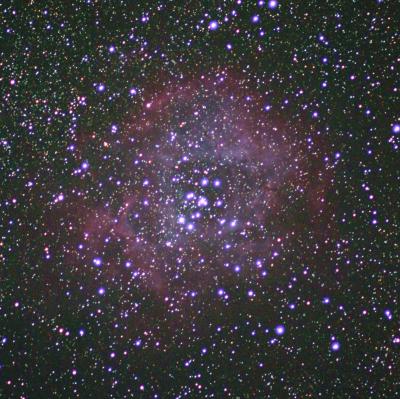
The Rosette Nebula by Bob Christmas

Here is the Rosette Nebula, in the constellation Monoceros, from Spectacle Lake, Sunday, April 11, 2010.

8 x 90 seconds = 12 minutes total exposure @ ISO 1600 @ f/2.8:

The Rosette Nebula, by Bob Christmas

Bob Christmas’ Images from Spectacle Lake

I’ve arrived safe and sound yesterday afternoon at Spectacle Lake near Barry’s Bay, ON, and Night 1 was spectacular (although there were a few bouts with cloud cover).

Here’s Mars and M44, the Beehive Cluster, side by side in Cancer Sunday night:

Mars and M44, April 11, 2010, by Bob Christmas

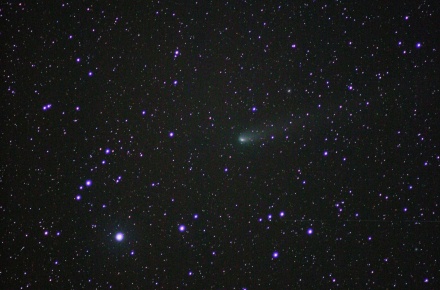
Also, just after midnight, I managed to find Comet 81P/Wild 2 in Virgo:

Comet 81P/Wild 2, April 12, 2010, by Bob Christmas

— Bob Christmas

Venus Pillar

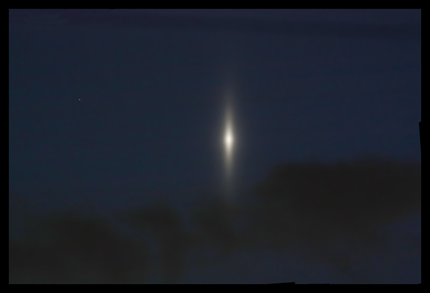
Just before the clouds came in (and Jim set to work on them with his cloud bustin’ laser finder!) we observed Venus and Mercury sinking in to the west. Ann first noticed the odd shape of Venus, and closer examination revealed that Venus was exhibiting pillars, just like solar pillars. Venus pillars are very rare, and we saw both upper and lower pillars. Although small to the unaided eye, they looked impressive though the telescope. It was a rare treat! This image was made with my small but mighty 80mm refractor.

Interesting Session at the Alternate Site

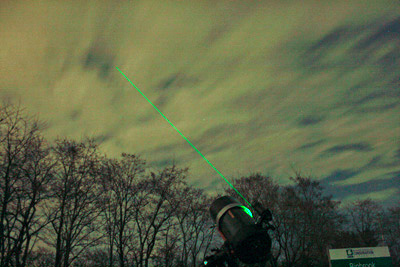
I travelled out to the alternate site tonight hoping to get a photo of Venus & Mercury. Clouds and hydro wires prevented me from getting a decent shot, but I did snap a couple of interesting photos. One of those photos is of Jim’s new laser/finder apparently burning a hole in the clouds:

Using a green laser to burn holes in the clouds.

Another interesting photo I took was a 20 second exposure of a plane passing through the Hyades.

Plane passing in front of the Hyades star cluster.

Unfortunately, the cloud cover was too thick for just one laser to cut through (LOL) and I didn’t get as many photos as I’d hoped. There’s always next time.

Links from Friday’s meeting

Alan Friedman’s excellent talk included several links
which are listed here for the convenience of those who attended
and did not want to transcribe them, and anyone else who’s interested.

Alan has graciously sent us the links. Thanks, Alan!

The current hydrogen alpha sun (updated every minute.)
http://www.spacew.com/sunnow/index.php

APOD I’m sure everyone knows this one with Kerry’s success here!
http://antwrp.gsfc.nasa.gov/apod/astropix.html

Spaceweather: http://www.spaceweather.com/

Cloudy Nights Forums (my particular favorite is the Solar forum – one of the best solar discussion groups around.)
http://www.cloudynights.com/ubbthreads/ubbthreads.php

Alan Friedman’s Site: http://www.avertedimagination.com/

Bob Christmas also mentioned a few interesting links, to follow soon.

Steve

UPDATE FROM BOB CHRISTMAS

A very useful resource for comet hunting is the Weekly Information about Bright Comets Site:

http://www.aerith.net/comet/weekly/current.html

APOD for an HAA member

Check out April 6th APOD! (Astronomy photo of the Day)

http://antwrp.gsfc.nasa.gov/apod/ap100406.html

It’s a spectacular rendition of the Fox Fur Nebula by
Kerry-Ann Lecky Hepburn (HAA) and Stefano Cancelli (RASC Toronto)

(Kerry incidently will be hosting our Imaging Clinic in April)

Thanks, Kerry, for the great AP you do! I like it!

Steve