Solar eruption misses Earth, auroras likely anyway

Space Weather News for Sept. 5, 2010
http://spaceweather.com

SOLAR ACTIVITY: On Sept. 4th around 1600 UT, a magnetic filament erupted, hurling a bright coronal mass ejection (CME) off the sun’s northwestern limb. Today’s edition of http://spaceweather.com features a close-up view of the blast from NASA’s Solar Dynamics Observatory. The CME is not expected to hit Earth. Nevertheless, auroras are possible in the nights ahead. A solar wind stream flowing from a coronal hole is heading our way, due to arrive on Sept. 5th or 6th. NOAA forecasters estimate a 50% chance of high-latitude geomagnetic activity when the solar wind hits. With the approach of northern autumn, Arctic nights are getting dark again–dark enough to see the Northern Lights. People in Alaska, Canada and Scandinavia should keep an eye on the night sky this weekend.

Mars Hoax – debunked (again)

Have you seen the recent emails claiming that on Aug 27, 2010, that Mars was going to be huge, larger than it’s ever been, as big as the Moon, and larger than anyone alive will ever see again? I hope you didn’t believe it. This is a recurring email that appears to be sent out every year about this time – and it’s a Hoax.
Mars Hoax
Being an active astronomy club and a site that many people come to look for info, it seemed appropriate that we post something about this hoax and hopefully put it to rest once and for all (perhaps I’m too optimistic).

First it may help to present some numbers to put things in perspective. Mars is about twice the size of the Moon and roughly half the size of the Earth, and orbits the Sun, like the Earth but at a greater distance. The Earth’s average orbit is about 92 million miles or 150 million kilometers from the Sun. Mars’ average distance from the Sun is 140 million miles or about 227 million km. So while the Earth take 365 days to orbit the Sun (1 Earth year), Mars takes 687 days (1 Mars year). On the other hand, the Moon orbits Earth at an average distance of 250,000 miles or 400,000 kilometres and doesn’t change much since it’s always orbiting the Earth.

Since the Earth takes less time to orbit the Sun than Mars (because it’s closer to the Sun), it means that every 26 months or so, we “catch up” to Mars and pass it. Think of watching a car race around an oval track. Cars on the inside lane more easily pass those on the outside lanes because they have less distance to travel. And cars that are on the same side of the track are closer to each other (so appear to be about the same size) than those on the opposite side of the track (they appear smaller in the distance). This race track analogy will come into play again later.

When we are on the same side of the Sun (same side of the track), we are at the closest point between the 2 planets, what astronomers call Opposition. Earth’s orbit is fairly circular (but not exactly) but Mars’ is much more eccentric (more elliptical or oval than Earth’s orbit). So sometimes at closest approach, we can be as close as about 55 million kilometers or more than 80 million km apart. (When Mars is on the opposite side of the “track” then obviously it’s even further away). Now keep this in mind. The closest Mars can get is about 55 MILLION kilometers, whereas the Moon is about 400,000 km away. That’s more than 130 times further. And even though Mars may be twice the size of the Moon, it can never look as big as the Moon. Consider a dime and a quarter. A quarter is about roughly twice the size of a dime. If you place a dime 5 feet from you and place the quarter 675 feet (130 times) away, the quarter isn’t going to look the same size. In fact you’re going to have a tough time seeing the quarter. For Mars to appear the same size as the Moon, it would have to get within about 750,000 km, and it can never get any where “close” to that distance from the Earth.

Now in these emails, which actually started back in 2003, and have now become an annual event, were very loosely based on some facts. On Aug 27, 2003, Mars did get closer to Earth than it has been in at least 5000 years, about 56 million km from Earth at its closest. The first emails came out then telling people that Mars would appear as large as the Moon. From the numbers above we know this can never happen. Mars was impressive through a telescope, but it didn’t get as big as the Moon.

We had a break in 2004 when it appears the emails didn’t circulate (or at least not widely). But then they appeared again in 2005 when Mars was going to be moderately close (astronomically speaking) in Oct of that year (remember we catch up every 26 months). The fact that they used the same Aug 27th date instead of Oct didn’t seem to bother the originators of the email. But in 2005 Earth didn’t get any closer than about 72 million km. Certainly a lot further than 56 million km we experienced in 2003.

For some reason, since then, these emails have re-appeared every year, regardless of whether we are getting to close approach of Mars (opposition) or not. In fact, right now, Mars is almost to the far side of the Sun from us, about 315 million km away – not even close. We had hit our closest approach back in Jan 2010 – quite a long time ago, and it won’t be until Mar 2012 when we get moderately close again. We won’t get as close as we did in 2003 for many years. I think in 2018 we’ll get almost as close as we did in 2003 – but “almost” in this case is about 60 million km.

In later years the emails have taken slightly different forms and some have had minor corrections or additions. For instance, some of them indicate in small print somewhere that using a telescope with 75 times magnification, then Mars will look as big as the Moon, since the apparent size of Mars in 2003 was about 75 times smaller than the Moon. Sadly they don’t make that obvious. I guess it takes away from some of the “WOW factor”.

Why do they keep sending these emails? I don’t know. No one is making money or “phishing” for your email address like some viruses do. So there doesn’t appear to be anything malicious. But when you consider that they are spreading misinformation and causing people to believe in things that aren’t true, then that’s a true disservice. Sadly there is a lot of bad info on the internet, many times made to look factual. In fact one could make that claim about this post. The best way to deal with this is to arm yourself with the facts. Check out many sources, especially the main-stream scientific sources for factual information. So I’m providing some links below to help you research this subject or to get more information.

This link is for Snopes which talks about modern folklore and various stories, identifying which are true and which are false. This particular link is for one of the entries over the years for this False claim.
Mars Hoax

This is a recent NASA article talking about the hoax.
NASA

Bad Astronomy, which I have referred to several times in the past, has a lot of articles and blogs postings about various hoaxes including this one. Many of the blog postings contain additional references and resources. Some of them can be found HERE and HERE.

And Universe Today has a good article from 2007, but still relevant, debunking this misinformation at Mars Hoax

You’ll notice that most of these references are old. That’s because this hoax keeps reappearing and scientists keep trying to correct it, and yet it keeps coming back each year.

I encourage you to read these articles and seek out others. And of course, when you see these emails in the future, and they inevitably will re-appear again next year, please don’t forward them on to your friends. Let’s put an end to this nonsense.

Observing Report from BCA

“Clear skies? Must be full moon.” A sarcastic statement but all too true this week! Many of our members found the lure of clear summer skies and warm temperatures too tempting to resist last night and again tonight (Friday and Saturday).

The ISS passed overhead both evenings. Tonight the seeing was excellent and I had a great view of Jupiter through John’s “small but mighty” 80mm refractor. Kevin’s 10″ Dob. pulled in B86 and the adjacent globular cluster, NGC6520 and gave breathtaking views of M11, M22 and M15.

I tried taking some untracked, unguided photos of the Milky Way through Sagittarius.

Now, if we can only save some of these clear skies for new moon….

Upcoming ISS Sightings

Just by chance, I stepped outside last night for some fresh air and as I often do, I looked up. And just as I was looking to see what was visible from the backyard, a bright light was moving through the sky. My experience told me it was a satellite and not an airplane. I momentarily thought it might have been an Iridium flare, but the size seemed too large. So my guess changed to the ISS (International Space Station).

Once it had faded and moved into Earth’s shadows, I went back in to visit the Heaven-Above.com website which has transit times for many satellites, and confirmed that it was indeed the ISS and I just happen to catch the 20-30 seconds that it was passing overhead. I also noticed that we’re going to have a number of additional passes for the next 4 or 5 nights. Ann suggested I make this info available to members and the general public. Always interesting to see the ISS pass overhead. And if you have time to prepare, you could try using binoculars to see some structure.

So as a public service, I’m posting some of the upcoming ISS passes for your observing pleasure. Remember that for basic observing of the space station, you don’t need any equipment. It’s bright enough that when the skies are clear, you can see it with just your eyes – it will look like a bright airplane, but without the flashing coloured lights. (Binos and telescopes may allow you to see detail which you can’t do with just your eyes, but it’s harder to track when it moves across the sky).

How to read this info:
Date and Time should be fairly straight forward. The time shown is local for the Hamilton area using the 24 hour clock. The times shown are in the evening.

Mag – (Magnitude) this indicates how bright the ISS will be with larger negative numbers being brighter. Venus (presently in the Western sky after sunset) is currently about -2. So a -3 pass will be brighter than Venus.

Track – this is a rough guide where to start looking for, and the direction that the ISS will take as it crosses the sky. At the designated time, look in the specified direction at about 30 degrees above the horizon which is roughly where you should first spot the ISS. Then follow it’s path when it crosses the sky. Usually the brighter passes will become visible earlier and last longer, but at most a pass will only last a couple of minutes. Usually they are more in the 15-30 sec time frame. Some won’t get very high above the horizon (trees and houses could be a problem). Others will pass nearly overhead. For the “NW to NW” appearances, this indicates that the ISS will only appear briefly in the general NW area of the sky and not very high above the horizon.

Most of the brighter passes will occur this weekend and fortunately the forecast is expected to generally be good.

I’ve tried to simplify the info from the Heavens-Above website, so what’s listed below won’t be exactly as you would find on their site. More details and info can be found at:
Heavens-Above for Hamilton
This info is current as of Thu Aug 26.

   Date     Time    Mag    Track      Notes
Thu Aug 26  20:23  -2.4   SW to E   won't get high in sky
Thu Aug 26  21:58  -2.3   W to NE     

Fri Aug 27  20:50  -3.7   SW to NE  will pass nearly overhead
Fri Aug 27  22:26  -1.1   NW to NW  appears just above horizon

Sat Aug 28  21:17  -2.0   W to NE
Sat Aug 28  22:54  -0.2   NW to NW  appears just above horizon

Sun Aug 29  20:09  -3.5   SW to NE  will pass nearly overhead
Sun Aug 29  21:46  -1.1   NW to NE  won't get high in sky

Mon Aug 30  20:37  -1.8   W to NE
Mon Aug 30  22:14  -0.8   NW to N   appears just above horizon

Tue Aug 31  21:05  -1.1   NW to NE
Tue Aug 31  22:41  -0.3   NW to NW  appears just above horizon

For the following dates, the ISS won't get very 
high above the horizon.
Wed Sep 1   21:33  -0.9   NW to NE

Thu Sep 2   20:24  -1.1   NW to NE
Thu Sep 2   22:00  -1.1   NW to N

Fri Sep 3   20:52  -1.0   NW to NW
Fri Sep 3   22:27  -0.5   NW to NW 

Hopefully there will be lots of clear evenings and you’ll have a chance to see the ISS. You don’t need a particularly dark location, just a clear view of the path. If you don’t have trees or home in your way, you can see the ISS from the city.

Happy hunting.

Persied night in Binbrook and a New Collaboration Image

Hey everyone,

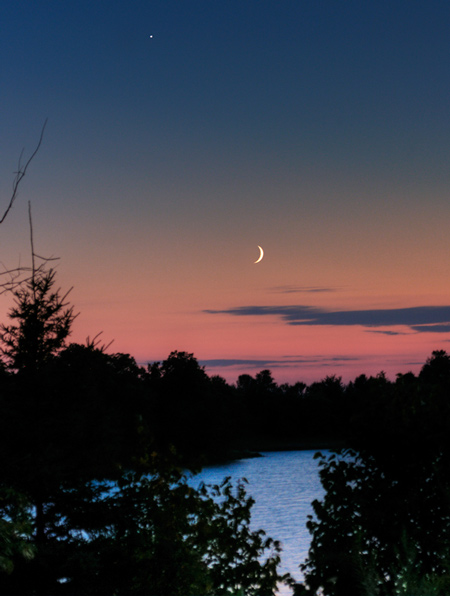
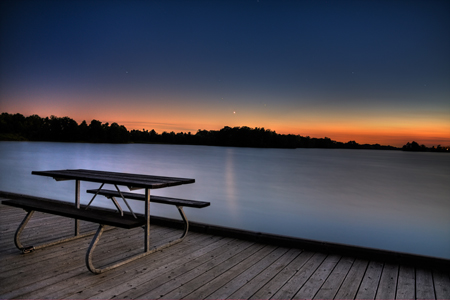
I had a great time out at Binbrook with the HAA gang on the ‘members persied meteor night’. This was my first time out there in a really long time so it was especially nice to see everyone and catch up. For the first hour or so a few of us took pictures of the scenery with the moon, venus, mars and saturn. Later in the night we joined the the rest of the group who were already watching the meteors. I saw a few really bright ones with smoke trails and many numerous smaller ones. Since I had my celestron 15x70s with me I did a quick tour of the summer constellations. A few of the objects that were easily visible were M71 globular cluster, the coathanger asterism, M27 Dumbell nebula, M11 wild duck cluster, m8, m20, M16 and M17, and M22. M22 a bright globular cluster in Saggitarius was most impressive.

Venus and the Moon

Venus reflecting on the water

Relaxing under the Milkyway

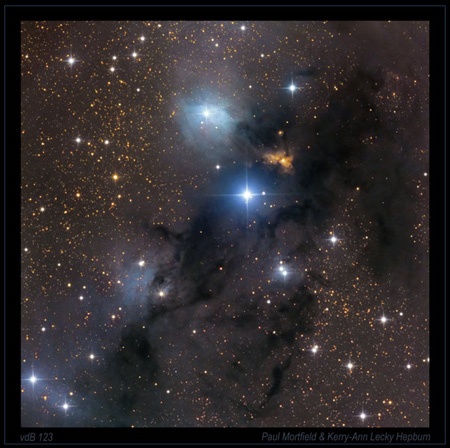
On and off over the past several months I have been working on a collaboration with Paul Mortfield. This part of the sky is very murky with lots of dust shrouding the golden stars in the Milkyway. Hope you like it!

Click for image details and higher resolution:
http://www.weatherandsky.com/main.php?g2_view=core.ShowItem&g2_itemId=8056&g2_imageViewsIndex=2

KerryLH

Side Walk Astronomy at McQueston park tonight Aug.16

The conditions look good for a night of side-walk astronomy. We will setup our scopes at the usual spot by the parking area about 8:00 pm tonight.
.

Report on the Aug. 11 Public Perseid Meteor Watch

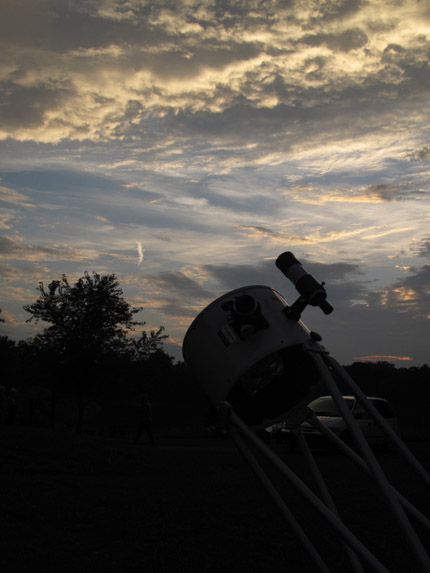
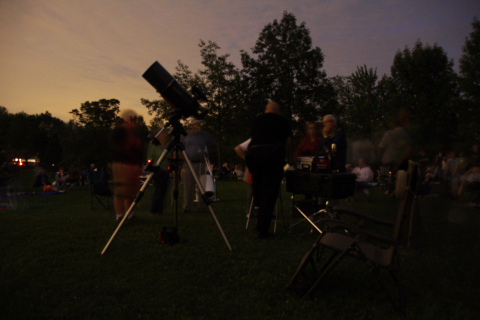
Andrew Bruce’s 12″ Meade Lightbridge telescope under less than co-operative skies

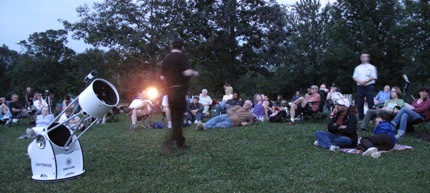
An estimated crowd of 200 showed up for our scheduled August 11 Perseid Meteor Watch at the Binbrook Conservation Area in spite of the overcast skies. Telescopes were set up in the hopes of glimpsing brighter stars through the cloud cover. (I was able to catch Vega and Altair long enough to offer views of these to the public and I’m sure other fellow HAA-ers did likewise with their telescopes.) Some families brought their own telescopes and we were able to offer them advice on setting these up. As the skies darkened, John Gauvreau entertained the crowd with an excellent presentation on the Perseids, meteors, meteorites and comets:

Public Perseids Night at Binbrook

A little late in posting, but I finally got some photos from the evening processed so now I can do a full report.

Wed Aug 11 was our annual Public Perseid Meteor Shower Night at Binbrook. Thanks to our Publicity Director Mario Carr, and various people for the interviews they provided, we had a great turn out. More than 250 people mad the journey to Binbrook despite a sky full of clouds, in hopes for clearings that would reveal the much anticipated meteor shower.

Perseids Meteor Night at Binbrook

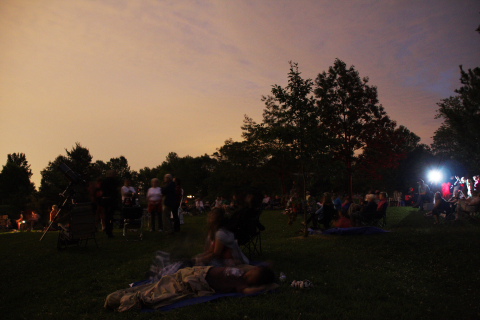
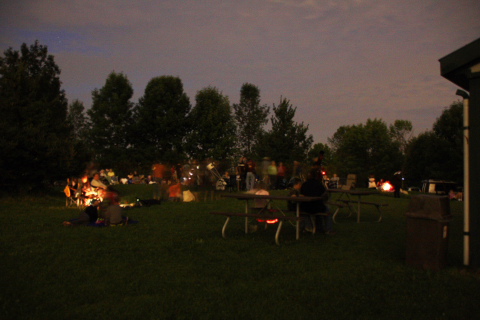
Some of the many people patiently waiting for the skies to clear. This and subsequent photos are long exposure (25sec) shots and then brightened.

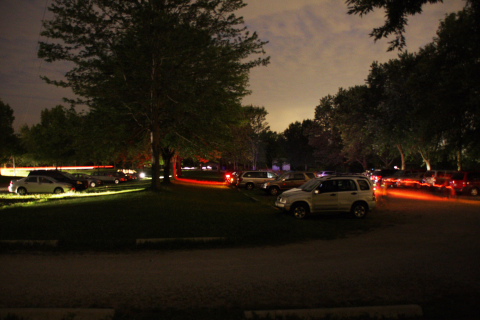
HAA members started arriving by 7:30pm and already found several people waiting inside the park. The gate saw a steady flow of cars coming in with at least 2 or 3 per vehicle. By 9pm, the main parking area was full and people were starting to fill the overflow section.

Full Parking Lot

The event was so popular that we more than filled the main parking area at Binbrook.

While waiting for darkness and clearing, John Gauvreau provided several interesting presentations for the crowds including a participatory demonstration with some of the many children in attendance. He also enhanced the anticipation by showing a piece of meteorite.

Jim and others holding court

Never giving up, Jim and others continue to provide interesting info to everyone who came out.

We did get a small break in the clouds to provide a brief viewing of Venus, Arcturus, and the Summer Triangle. But sadly it didn’t last nor spread enough to permit the sighting of any meteors. The crowds were excitedly patient, but eventually young children became antsy and bored, and when the realization that the skies weren’t going to clear, people started to leave.

Binbrook Perseids Night

Binbrook Perseids Night

This ended up being one of our very best attended public events. We can only imagine what the turnout might have been if the skies were clear. Due to the location, every person who attended made the deliberate effort to be there – no “walk-by” traffic as we often get when holding events in town.

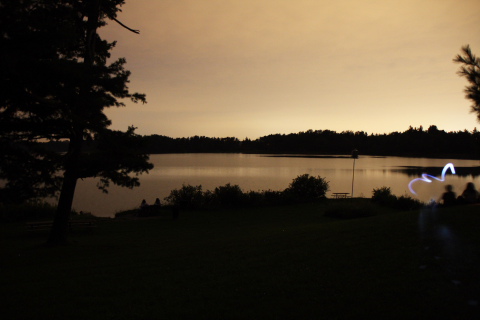
Lake Niapenco

A 15 sec exposure overlooking Lake Niapenco with special effects (someone waving their flashlight while I was trying to take the shot).

I’d like to thank the many HAA’rs who came out to help with traffic control, setting up scopes, and entertaining the interested public. While some of the public were disappointed by the lack of meteors, I didn’t hear anyone complain which is a testament to how much they enjoyed the night, and the effort HAA members made to make people feel welcome and hold their interest. I’d also like to thank Binbrook Conservation Area and NPCA for allowing us to make the park available for this evening. And lastly I want to say thank you to everyone who came out to Binbrook. We hope you enjoyed yourselves and learned something while there. We’re sorry the weather didn’t cooperate, but next year the skies will be better (always the optimist). Remember that there are still a few nights remaining – just find a dark location and look up.

Starfest 2010

Happy campers at Starfest 2010

Two clear nights at Starfest at the peak of the Perseid meteor shower. Life for a Canadian amateur astronomer doesn’t get any better than that. Well, except for Kevin Salwach. He won a telescope at his very first Starfest!! I’m thinking he may be back next year…

Last year’s near miss by a tornado was almost repeated at this year’s Starfest. The organizers had a trained Canwarn volunteer on hand and just as the Saturday night door prizes were to be given away, Malcolm Park (president of Starfest’s host astronomy club, the NYAA, and the resident trained Canwarn volunteer) announced that a tornado warning had just been issued for the area. He asked the crowd for a decision on whether to go ahead with the evening’s planned events or not. With a thunderous roar from the crowd and nearly unanimous show of hands, the night’s activities carried on. (Nothing stands between amateur astronomers and a table full of amazing door prizes – not even Mother Nature!)

Door prizes at this year’s Starfest ranged from gift certificates to a Meade 6″ Lightswitch telescope. The only prize won by an HAA-er was a beautiful Maksutov-Newtonian telescope and that was the prize that Kevin won.

We met many of our old friends and made many new ones at this year’s Starfest. There were a lot of new faces at Starfest this year. It’s great to see such a big influx of newcomers to astronomy! The campground has put in a new, larger pool. (Much appreciated!) This summer’s constant heat and humidity accompanied us to Starfest and made it uncomfortable (for me,anyway) to stay in the big tents for many of the talks. One of the campground’s seasonal tenants made the mistake of putting their sprinkler out on their front garden and a few of us spent more than a few minutes standing under it with the pretense of admiring that garden. One of the park’s more entrepreneurial residents operated a tractor ride/tour of the park that many of the younger kids were enjoying.

This year’s list of speakers was as impressive as always with the highlight being David Levy. “Crazy” Bob Summerfield’s ‘Physics of Rainbows’ talk was amazing, too.

Although my mount was giving me grief, I managed to get a couple of astrophotos:

Lagoon Nebula (M8) taken through 80 mm refractor.

Trifid Nebula (M20) taken with 80 mm refractor.

All in all, it was a memorable and fun Starfest and I’m already looking forward to next year!!

Aurora

There has been much talk about the most recent coronal mass ejection from the sun, and the possibility that it might spark some aurora borealis, even this far south.

Encouraged by even this slim possibility of northern lights, Jackie and I set off heading north, leaving the lights of the city to the south of us. Sadly, (although not unexpectedly) we encountered light cloud and heavy haze that spoiled our chances.

Being intrepid members of the HAA though, means never returning home empty handed, or without a great tale to tell and a smile on your face. So, although we didn’t see the aurora borealis, we did, at least, see half…

Not the aurora borealis, but close, photographed just south of Guelph.