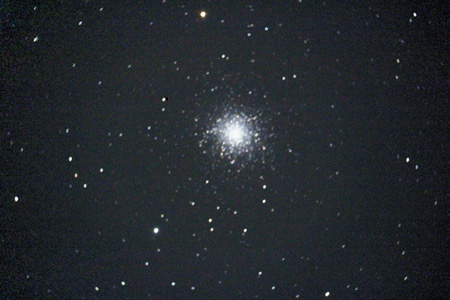
Here is the finished product of my M13 photo. Not bad for a first try even if I do say so my self.
Many thanks to Kerry for all her help in processing. A special thanks to all those who came by last night for my impromptu photo get together.

Here is the finished product of my M13 photo. Not bad for a first try even if I do say so my self.
Many thanks to Kerry for all her help in processing. A special thanks to all those who came by last night for my impromptu photo get together.
Two different Waterdown Cub troops joined together for a fun night of astronomy with members of the HAA. After a creating a human solar system and enjoying the opportunity to look at some meteorites up close, we all adjourned to the parking lot of Guy Brown School for some viewing under clear skies. Jim brought his big Schmidt-Cassegrain, Ann had her fine dob, Andrew also had his large dob, Joe had his 5″ Mak, Wayne his large binoculars and I had my small but mighty refractor. Michael ushered the troops to the various instruments, where they enjoyed views of Jupiter, M13 and Alberio. Most of the cubs correctly identified the yellow and blue colours of this lovely binary, and Jupiter showed fine detail on this particularly steady night, with some of the cubs even noting detail within the north equatorial belt.
All of the boys and girls were very keen to look through the scopes, and cub Jonathon was an enthusiastic assistant and helped set up and tear down the instuments.
Well over 30 cubs and many more leaders and parents enjoyed the evening, and so did the seven members of the HAA in attendance. Thanks to all for the great night!
Last night 11 HAA members heeded the call and went out to McQueston Park for a cool evening of sidewalk astronomy. The array of telescopes looked impressive, as visitors had the opportunity to look through any of 2 Schmidt-Cassegrains, 1 Maksutov, 4 Newtonians and 2 refractors.
A slightly gibbous moon offered that “wow” factor with tremendous detail along the terminator and Jupiter received lots of attention due to a Europa shadow transit that was visible in even the smallest scope there (90mm). A meteorite was available for children to hold and examine, and of course there was lots of exchanges of information and sharing of eyepieces between the members. Jackie brought along a new 8″ Dobsonian that was carefully assembled and examined by many members, and deemed to give very fine views! Attempts to set up the Maksutov with a binoviewer and a pair of 13mm Naglers met with success, as there was just enough room to fit in these very large eyepieces. The effort was very worthwhile, as the view of the moon through this set-up was spectacular!
As the night progressed and the visitors dwindled, attention was turned to how well we could see some deep-sky objects from this very light polluted area of the city. Not surprisingly, filters helped tremendously, and merely blocking the light of the closest lamps improved the view a lot. Although I could see only 5 of the Pleiades with the unaided eye (and only that with effort) the younger eyes of Kevin were able to pick out many more, showing once again that your eyes are the best observing tool that you have.
A big thank you to all the members who turned out to share the night sky with the public and were rewarded with a fun evening that included some great views of the sky and some even better company.
There will be several H.A.A. members out at McQuesten Park tonight from about 7:00 pm untill 10:00 pm or so.We will be seting up our scopes to share veiws of the first 1/4 Moon. and jupiter.Please join us. See you there.
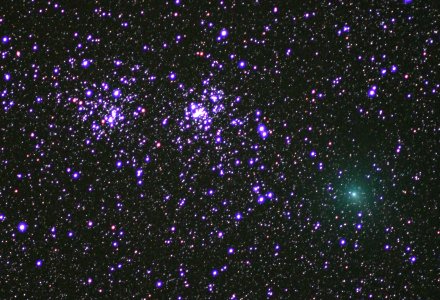
Here is the Perseus Double-Cluster and Comet 103P/Hartley 2, side by side, from Spectacle Lake, Barry’s Bay, ON, single 2-minute image taken through Tamron 300 mm f/2.8 lens with Canon Digital Rebel 300D, on Thursday, October 7, 2010, at approx. 9:25 pm.

— Bob Christmas
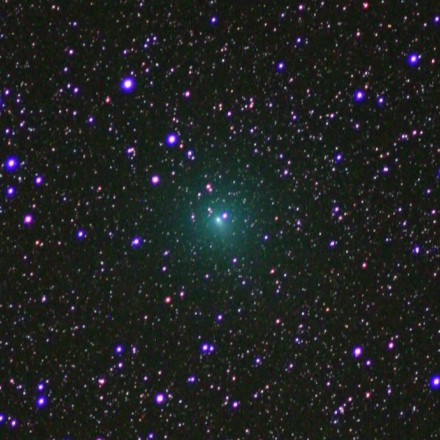
Here is a small excerpt of one of my images of Comet 103P/Hartley 2 that I took from Spectacle Lake Lodge, near Barry’s Bay, ON, Sunday Night, October 3, 2010, 10-pm-ish.

This is a single 2-minute exposure, Canon Digital Rebel 300D through a Tamron 300mm lens at f/2.8 & ISO 1600. Gamma-corrected and contrasted slightly.
— Bob Christmas
This month, Comet Hartley will be visible high in the sky just south of Cassiopeia. Sky and Telescope magazine has an excellent finder chart available on its website: http://media.skyandtelescope.com/images/CometHartley2-bw.jpg
Conditions will be excellent this week to view the comet because we are approaching new moon. If the skies clear (current weather forecasts are looking favourable for later this week), the comet should be visible in binoculars or small telescopes even from the city.
From Oct. 7 until about October 9 – a grand photo opportunity presents itself when the comet passes near the Perseus Double Cluster. You can get the jump on NASA – their EPOXI spacecraft will be imaging the comet from 1000 kms. away next month. So charge up your camera batteries!
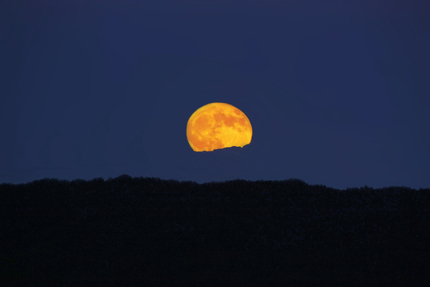
Shine on, harvest moon. That’s what the old song says, and that’s what will happen tonight. The full moon rises at 6:38pm, followed by Jupiter only a half hour later. But even better, this is the famed Harvest Moon, everybody’s favourite full moon of the year. This year it falls on the day of the autumnal equinox, meaning that this is the first day of fall. The equinox occurs a few hours after moonrise, at 11:09pm. By then the moon will be high in the sky, shining on for all the folks below who are out to enjoy this lovely autumn evening.

Our club’s principal founder, Doug Welch, has been awarded the Royal Society’s McNeil Medal for science promotion. The Hamilton Spectator has a report on it here: Astrophysicist Is Now A Star.
Since arriving at McMaster about 20 years ago, Doug has been a major player and driving force behind public astronomy education in this area.
I am thrilled to hear that he has been given this recognition. Congratulations, Doug!
Ann Tekatch
Last night I took advantage of good seeing conditions to watch Jupiter. The GRS was easily visible against the whitish cloud bands around where the Southern eq band should be. Saw another black dot on the surface which I identified as Ganymede transiting. This is the first time I’ve ever seen a moon transiting so I stayed up to watch egress at the western limb around 12:05 this morning. I also saw several white circles within the northern eq band for the 1st time. As Ganymede egressed, I noticed that it looked like a sphere instead of a point of light. It’s the first time I’ve seen any of the moons as anything but a point of light. I’m assuming (feel free to comment on this) that the combination of 2 light sources and their relative angles to each other (Jupiter and the Sun) gave the moon a 3D look. While I was at it, I spent some time looking at Uranus (looks blue to me). Its about 1degree North and slightly west of Jupiter and at 230 mag I could definately see it as a sphere. Neptune is about 1degree East of Mu Capricorn and I used 9×63 binos to ID it. I hope those at the various star parties are having a good time this weekend!