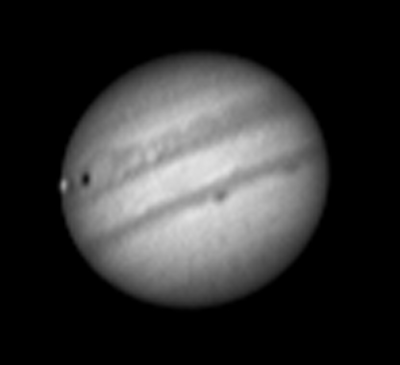
Matthew was right – Io and its shadow were crossing in front of Jupiter’s Great Red Spot tonight. I took some video of the event with a webcam, stacked the best frames using Registax v6 and this image is the result.

Matthew was right – Io and its shadow were crossing in front of Jupiter’s Great Red Spot tonight. I took some video of the event with a webcam, stacked the best frames using Registax v6 and this image is the result.

I was out tonight watching Io and its shadow transit of Jupiter. The shadow was very sharp and the moon was an indistinct blob beside it against the southern equatorial band (135x mag). With about 15% of the transit left to go, Io all of a sudden became a sharp tiny disk right beside the shadow. I followed it until Io separated from Jupiter. At the moment Jupiter is showing 3 dark brown spots on the northern eq. band. I’ve found out that they are called ‘barges’. Had a good look at the moon also, concentrating on the regions around Clavius and Copernicus. A few nights ago I was watching Jupiter and saw for the first time many more cloud bands in both of the mid-lattitudes clearly withouot filtering. I also saw Ganymede as a distinct disk for the first time. All in all, it’s been great observing Jupiter while its at conjunction. PS… While observing the transit tonight, I felt quite sure that Io was also transiting the Great no-so-red spot. A programme I use to check the grs position didn’t seem to agree, however i’ve been on cloudy nights and some one has announced that this was going to occur. So I watched a transit on top of another transit. Cool!!!
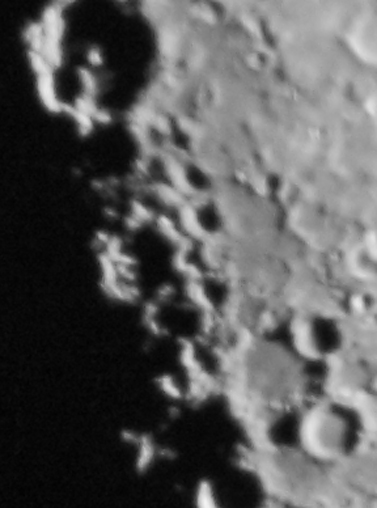
According to my RASC calendar, the “Lunar X” will be visible on the moon tonight around 11:00 pm. Hope the clouds hold off long enough so I can take a picture!!! The “Lunar X” appears for a brief time around first quarter moon when the sun illuminates the edges of some craters, making an “x” shape. This appears along the moon’s terminator (the line that separates the illuminated part of the moon from the uniluminated side), about 1/3 of the way up from the bottom edge of the moon. It “may” be visible in binoculars, although I’ve never tried to see it with them.
Here is a link to some great photos of this lunar feature: http://www.astropix.com/HTML/SHOW_DIG/Lunar_X.HTM
Update: Clouds moved in about 10:00pm, but I managed to catch the beginning of the Lunar X’s appearance. You can see it in the cropped photo below. The X is near the bottom of the photo and is just visible against the dark background.

A rather late decision (due to uncertainty about the weather) to head out to Binbrook proved to be worthwhile. A notice to all members was quickly sent out (and promptly duplicated) since we were eager to go. The forecast and skies had cleared up and as a result, we had a very respectable November evening observing.
There was nothing special planned. We knew it wasn’t going to be a great night for imaging, but any night to get out for a few hours is worth the effort. Jim, Vince, Keith, John, Tony and myself enjoyed some very nice views of the moon, Jupiter, a number of Messier objects and plenty of double stars. There was a wide variety of scopes, giving each of us a wide choice to try. Schmidts, Maks, Schmidt-Newts, DOB’s and refractors – everyone had something different. So it was an ideal night to compare similar objects with unique equipment.
Wind was absent which helped to keep the temperatures feeling tolerable, though it did eventually get a bit wet from dew. We packed up around 11:30 and headed off to Tim Horton’s to warm up and swap some observing stories – which is always a fun part of the evening.
Sadly we haven’t had many good observing nights this fall and when an opportunity comes up, we don’t often have a lot of advance notice. But hopefully next time we can give more warning and get more members out. It’s a lot of fun, and definitely a case of “more” is better. We’d love to have you join us.
CME IMPACT: A coronal mass ejection (CME) hit Earth’s magnetic field on Oct. 24th around 1800 UT (2 pm EDT). The impact strongly compressed our planet’s magnetosphere and may have exposed geosynchronous satellites to solar wind plasma. Mild to moderate geomagnetic storms are possible in the hours ahead as Earth’s magnetic field continues to reverberate from the hit. Sky watchers in Scandinavia, Canada, and northern-tier US States should be alert for auroras, especially during the hours around local midnight. Check http://spaceweather.com for updates.
UPDATE: 11:30PM, Monday Oct 24 – I haven’t been able to see any sign of the aurora from Hamilton mountain (including from Sam Lawrence Park), but Charles Baetsen saw a lot of auroral activity from his home near Orono. He reports seeing streamers up to the horizon at times. By the time he was able to get his camera, the aurora had faded to a glowing green arc at the bottom of the Big Dipper.

This is Comet Garradd (C/2009 P1), in southeastern Hercules at the time, as I imaged it from Spectacle Lake Lodge, near Barry’s Bay, ON, on the evening of September 25, 2011.

Canon Digital Rebel 300D through Tamron 300mm f/2.8 lens on SP EQ mount; 8×2:05 = 16 minutes 41 seconds total, at ISO 800; crop of original.
North is to the right.
Bob Christmas
From: Space Weather News for Sept. 9. 2011
http://spaceweather.com
GEOMAGNETIC STORM: A strong geomagnetic storm (Kp=7) is in progress following the impact of a CME during the middle hours of the day on Sept. 9th. This could be the first of several hits from a series of CMEs expected to reach Earth during the weekend. High-latitude sky watchers should be alert for auroras after nightfall. (Observing tip: The hours around midnight are often best for aurora sightings.) Check http://spaceweather.com for more information and updates.
UPDATE Saturday, Sept. 10 – There are reports (and photos) on Spaceweather.com from people in northern Michigan, North Dakota and Montana who were able to see the northern lights low on their northern horizons last night, just after dusk. Let’s hope that the auroral oval pushes farther south so that we will be able to see the northern lights, too.
Comet Garradd passed the globular star cluster, M71, while we were at Starfest. The two objects were easily viewed in the same field and made a spectacular sight. The comet will be passing very close to the Coathanger asterism (also known as Brocchi’s cluster) from September 1 to September 3. It will be interesting to watch the comet as it moves against the background stars of this well known asterism.
We’re just back from Starfest. There were two gloriously clear nights during the star party. Kerry’s presentation about astrophotography collaborations was excellent and well received. Her images were as breathtaking as usual. We enjoyed views of Comet Garradd through telescopes ranging in size from an 80mm refractor to a 16″ Dob. The comet was close to M71 and both objects were visible in the same field. Mike J. was sharing views through his new solar telescope. It was a jaw-dropping experience. In Kevin’s words, the view was “ridiculous!’.
Margaret won a book during the door prizes and Mike J. took home a new spotting scope. It seems that HAAers are always winners at Starfest.

A reminder to all members that this is the new moon weekend coming up and a great opportunity to observe. This is also the busiest weekend of the year for star parties, and many of our members will be away. At times like this, when a keyholder is unavalable to open the park, there is an alternative observing location for you to use.
The alternative site is located at the west end of the park on Tyneside Road. Directions can be found here:
http://amateurastronomy.org/sites/binbrookCA/BinbrookTyneside1.jpg
There is parking just off the road and a small field to set up scopes. The sky is as dark as at the main site in the park, and no key is needed to access this site. This location is open to the public, so remember to be safe, take care of yourself out there and take care of the park.
Enjoy the dark sky and feel free to post any observing you do on this blog to share your experiences with your fellow members!