Hubble’s “Hidden Treasures” contest

From our Facebook page, the Hubble team with NASA and ESA are sponsoring a contest to find some of the hidden treasures in the vast stored archive of the Hubble images collected over the past 22 years. It actually consists of 2 parts. First is to find things that hasn’t been found by conventional processing or the original science team (they may have been looking for other things). The second part is to use some free tools that have been made available to process images and submit them. You can work on one or the other task.


What I found interesting is that a professional tool (FITS Liberator) produced by PhotoShop for the Hubble team has been made into open source (free) for participants to use. It’s already a powerful and useful package, but making it open-source, many programmers can contribute to make it even better. And the beauty is that you can use it without having to purchase PS. Now you can have a powerful tool designed specifically for astro-photography for processing your own images.

Prior to the contest, there were amateurs who scoured the archives looking for interesting things and making significant discoveries (like comets, supernova, galaxy collisions, etc) that hadn’t been seen or recognized by the original science team. But there are huge quantities of images which haven’t been looked at. This contest gives regular amateurs like you and me a better starting point for us to get into the “game” (more tools, info and help). Amateurs from all over the world are getting into this project – and you can too!

The main link with more info, images, software downloads and more can be found here.
Moon Venus Jupiter Conjunction – Night #2

Once again a number of the HAA members headed out to Binbrook to take advantage of the clear nights and collect more images of the Moon-Venus-Jupiter conjunction. On Monday night, the Moon had moved enough in its orbit that it was now near Venus rather than Jupiter as it had been the night before. Hopefully some of them will share their photos on this blog. I’m sure some will be appearing in the April edition of the EH newsletter.

My photo of the Moon and Jupiter setting below the Skyway was shown on CHCH news during the day on Monday so this inspired me to try again that night. I went to various locations around town trying to find interesting backdrops to go along with the wondrous view that the conjunction offered.

Below are links to some of the images I collected. It was fun running from location to location with nothing more than a camera. No telescopes, big tripods or other associated gear to haul around. Just the eyes and camera were all that was needed to enjoy this site (as is often the case for many night sky apparitions. All these images were taken under skies with lots of city lights, yet it was still something easy to see and enjoy.

Click on images to enlarge them.

Moon-Venus-Jupiter conjunction at Discovery Centre

Conjunction from behind the old Discovery Centre on the waterfront. Too bad it isn’t used any more.

Moon-Venus-Jupiter conjunction at Harbour West

From Harbour West near Pier 4 and the Hamilton Yacht Club

Moon-Venus-Jupiter conjunction at Bayfront Park

Overlooking Bayfront Park with the conjunction behind.

Moon-Venus-Jupiter conjunction at Sam Lawrence Park

Sam Lawrence Park. Jupiter is just to the left of the prominent tree near the center of the image and some of the city lights are off to the right.

Moon Venus Jupiter conjunction – Night #1

Some of the HAA members ventured out to Binbrook Sunday night to enjoy the conjunction of the crescent Moon along with Jupiter and Venus. I wasn’t able to join them, needing to run out to Burlington and then get home quickly. But that didn’t stop me from taking my camera along and capturing some shots on my trip. It was very windy and quite cool, but with a camera tripod, I was able to set up quickly and take these images. You don’t need fancy gear to enjoy this beautiful viewing opportunity. Just your eyes are enough. But you can also use just about any camera to record this view so you can enjoy it over and over.

Moon and Jupiter conjunction setting below Burlington Skyway Bridge

Moon-Jupiter conjunction as it set below the Burlington Skyway bridge.
(Venus is hidden behind the bridge. Click to enlarge.)

Moon Jupiter and Venus Conjunction over Hamilton Harbour

Moon-Jupiter-Venus conjunction overlooking Hamilton Harbour.
(Click to enlarge.)

Tonight (Monday 26 March) is another opportunity to see this conjunction. The forecast is calling for clear skies. Tonight the Moon will be closer to Venus with Jupiter just below. Head out just after sunset and look West – you can miss these bright objects.

Upcoming ISS Transit of the Sun viewable from Burlington

Upcoming transit of the Space Station across the disk of the Sun
About 1:20 PM on Monday afternoon.

If you have a PST or a solar filter, or even some welder’s glass, you
can use the same precautions as for an eclipse to see the silhouette of he Space Station against the disk of the sun.


Click for a map

The map shows the ground track of the event, for the center of the shadow path.
At a distance of 350 km, and about a quarter degree, you will see some of it
even if you are as much as 3 km off track.

The other thing to keep in mind is that the orbital predictions for the ISS are
not very accurate. Wish we could do more.
Crossing the disk of the moon, of course, is a naked-eye event you don’t need any
precautions for.

Messier Marathon Online

In honour of this month’s speaker’s topic (March Madness) and being related to the Messier Marathon which is attempted by many amateur astronomers, here’s an interesting link. March/April is considered to be the most favourable time to attempt to view all 110 Messier objects in a single evening. Considering the cool weather for our latitude and the poor viewing conditions we’ve had over these past many months, the odds appear to be against us to having a good night to attempt this.

However, you can “do” the marathon from the comfort of your own home on Sun April 1, 2012. The Virtual Telescope in conjunction with GAM(Global Astronomy Month) and Astronomers Without Borders, is holding a Messier Marathon Night. They will use various remote, robotic telescopes to attempt to view all 110 Messier objects in a single night.
Messier Marathon Online

Astronomy badges for Oakville Cubs

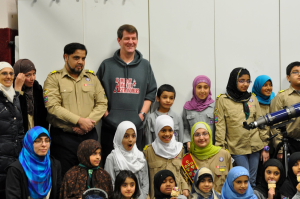
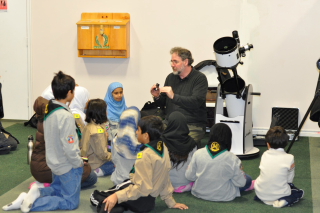
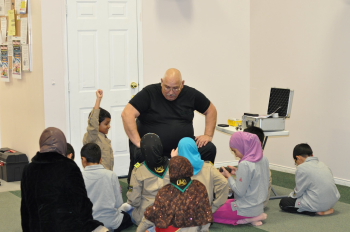
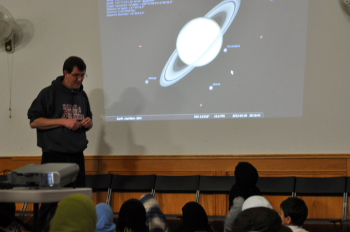
A small team of HAA’rs visited a Cub pack near the north end of Oakville on Leap Day (Feb 29) to teach astronomy to about 25 enthusiastic kids. This is the second time in recent history that the HAA brought astronomy to a group of cubs (also did a camp in Jan) in the Oakville area.

A partial group shot of the cubs we taught astronomy to.

John, Jim, Joe and Don covered all aspects of the cub badge requirements including:
– Locating the North Star (for navigation).
– Learn about some of the constellations and some folklore.
– Planets (including the usual talk about why Pluto isn’t anymore).
– Meteors and comets.
– Moon phases and how the Moon affects the Earth.
– Basics of how telescopes work.
– And how to use a planisphere/starfinder.

John has the kids enraptured.

Jim passing around meteorites.

The kids were really good and we all enjoyed ourselves. They had lots of questions and it was clear they learned a lot. A bright and fun bunch.

Don covering the basics of constellations and planets.

Our thanks go to their leaders Latif and Jasmine for contacting us and asking for our participation.
Larger/higher resolution photos available on our Facebook page:
www.facebook.com/hamiltonamateurastronomers

Transit of Venus Symposium

The Dunlap Institute for Astronomy and Astrophysics and the Institute for History and Philosophy of Science and Technology are holding a full day symposium about the Transit of Venus which may be of interest to HAA members and those with some astronomy background. It appears to be a fairly comprehensive program, it doesn’t seem particularly well suited to someone completely new to astronomy. (However review the program at the link below and see if this will be a good fit for you.) This is a FREE event running on Saturday April 28, 2012 from 10am to 5pm (with breaks).

Doctors Mike Reid, Ralph Chou, James Graham and others will be discussing various aspects associated with the transit. It includes how to view safely, historical events, science learned from transits, how it affects current exo-planet searches and more. It will also include a tour of astronomical instruments on display at the Institute for the History and Philosophy of Science and Technology.

More information, including location and a full schedule of seminars and events can be found:
Transit of Venus Symposium

The Cosmic Gift of Pulsars

The University of Toronto and the Dunlap Institute are sponsoring a FREE public talk on Thursday March 15, 2012 from 7pm to about 9pm.

Prof Victoria Kaspi from McGill will introduce pulsars, and show how astronomers are using them to study topics which range from the origins of the Universe to the very nature of matter.

University of Toronto – Earth Sciences Centre – Room 1050 (auditorium)
5 Bancroft Ave (near Spadina and College)
More info can be found at:
http://universe.utoronto.ca/special/hsh2012

Asteroid Eros close approach

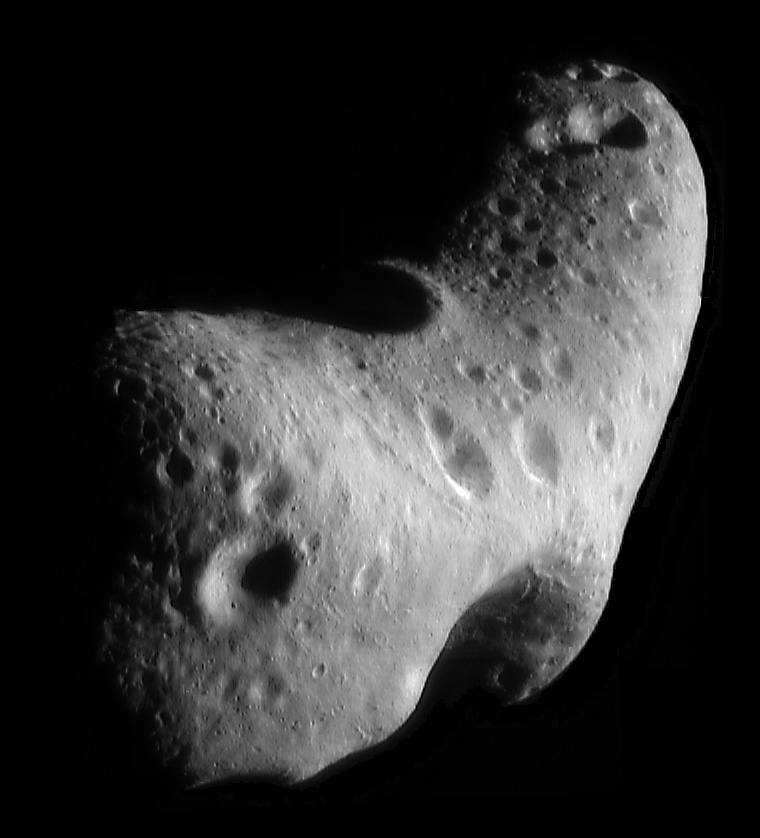
Asteroid Eros will be making closest approach to Earth on Jan 31. Might get to magnitude 8 or even 7 – visible in backyard telescopes and perhaps even binoculars. It will be closest it’s been to our planet in 37 years. Will be passing through Leo, Sextans and Hydra so will be visible after midnight over next few nights (assuming we get some clear skies). Info can be found here: http://tinyurl.com/845yx8z and charts from Sky&Tel found in this PDF file: http://tinyurl.com/79cbdxo . It should be moving fast enough to notice motion over a short period of time making it easier to identify.

Asteroid Eros

Possible Northern Lights (Aurora) Jan. 24/12

Here is the latest news from SpaceWeather.com:

Space Weather News for Jan. 24, 2012
http://spaceweather.com

CME IMPACT: As predicted by analysts at the Goddard Space Weather Lab, a CME hit Earth’s magnetic field on Jan. 24 at ~1500 UT (10 am EST). A geomagnetic storm is brewing in the aftermath of the impact, but as this alert is being written it is too soon to say how weak or strong the storm might be. High-latitude sky watchers should be alert for auroras after local nightfall; the hours around local midnight are often best for seeing the Northern Lights. Chances for a good display favor observers in northern Europe, Greenland, Iceland, Canada, Alaska, and possibly northern tier US states such as Maine, Wisconsin and Minnesota. Check http://spaceweather.com for updates.