Binocular Variable star is back

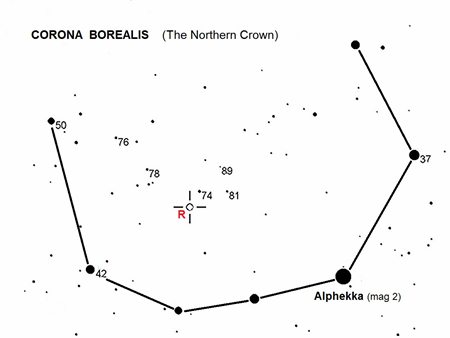
I am sure every sky-watcher can recognize CORONA BOREALIS, the beautiful constellation of the Northern Crown found in the spring sky, rising high in the East after dark.

After many years at minimum brightness (and I mean as faint as magnitude 15), the variable star R Coronae Borealis is slowly brightening again. If you have binoculars, you can watch it brighten slowly this spring until it reaches magnitude 6 again.

R CrB variables are normally bright, but can accumulate a cloud-like covering of carbon. Until that carbon shell is burned off, these stars can be dimmed up to 10 magnitudes. This star has a habit of dimming and then regaining its brightness within a few months.

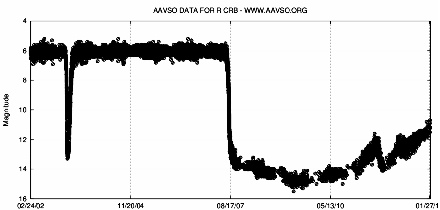
Strangely, since 2007 R CrB has been only 1/10,000 its normal brightness. Moreover, whereas R CrB usually springs back to magnitude 6 quickly, this latest recovery is taking a long time. The AAVSO chart below graphs R CrB’s visual brightness for the last 10 years. You can see the star’s swift dip and recovery in 2003, contrasted with the several years at minimum and the most recent – very slow – recovery.

This is a star worth watching again!

First meteor shower of 2013 – Quadrantids

The first meteor shower of the new year is coming up fast. The Quadrantids is an annual meteor shower which occurs on or about Jan 3 of each year. This can be a very productive shower, producing upwards of 50 to 100 meteors (often bright) per hour. But it can also be a very narrow shower, lasting only a few hours at peak (unlike the better known showers Perseids and Geminids which can last several days).

Like all meteor showers, the Quadrantids are named after a constellation from which the meteor “appear” to radiate from. Meteors don’t actually come from the constellation – the stars composing the constellation are far beyond our solar system. All meteors are remnants of comets or asteroids that reside within the solar system. But if you traced the path the meteors followed, they would appear to come from the same point in the sky in the area where the constellation is located. This particular shower is believed to be particles from the asteroid 2003 EH1 (2003 was when it was re-discovered and officially given a name). It may be the core of an extinct comet, possibly C/1490 Y1, discovered by Asian astronomers more than 500 years ago.

But where is the constellation Quadrantids you may ask? Actually, this is Quadrans Muralis (Mural Quadrant) which was defined in the late 1700’s, but was removed by the International Astronomical Union (IAU) in the early 1900’s when they defined the 88 constellations we use today. But this shower continues to use the constellation name that was given when they were discovered in the mid-1800’s. Quadrans Muralis was located between Bootes (the Shepard or Herdsman) and Draco (the Dragon).
Quadrantid Meteor Shower

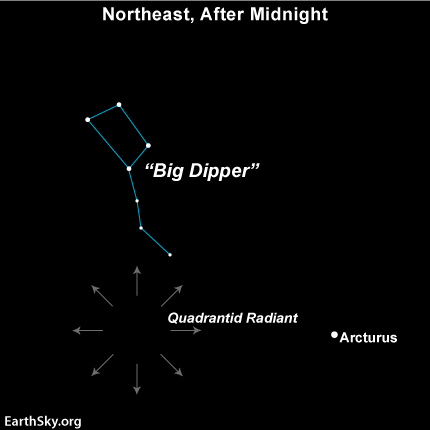
The best “guess”timate of when the shower will peak is before dawn on Thur Jan 3. Look below the Big Dipper and to the left of the bright star Arcturus (in Bootes). This is where the meteors will appear to come from. The meteors may not appear directly in this area, but in a wider circumference around this point and radiating away. As with all meteor showers, special equipment is not required to enjoy this show. The best is to lay out on the ground facing up to view as much of the sky as possible. Of course being winter in Ontario, you’ll want to dress warmly, place a groundsheet/plastic sheet on the ground and perhaps bring a sleeping bag to keep warm. You can also use a lounge-chair to raise yourself off the ground. If you want to image this shower, then a wide-angle lens is best to cover as much of the sky as possible. And of course, the darker the sky, the more meteors you will see, so try to get away from city lights if you can.

The current forecast for Thur morning in our area is calling for a mix of clouds and clearing. The waning gibbous moon will also be still present which can wash out some of the fainter meteors. But it looks like there is a pretty good chance to see some of these. This will be the last good meteor shower until April’s Lyrids so get out there and have fun.

Free e-books from NASA

Did you know that NASA has a series of FREE e-books available for you to download?

Some of the subject matter is rather technical (after all, it IS rocket science). But there are also some more suited for us mere mortals. They are available in various formats so you can put to good use that new Kobo, Kindle or iPad you got as a present.

30 Years of Shuttle History

Topics cover a range including History and Aeronautics.
http://www.nasa.gov/connect/ebooks/index.html

There’s also a couple over at HubbleSite.org from NASA on the Hubble Space Telescope and the upcoming James Webb Space Telescope.
HubbleSite iBooks

You might find some (or all) of them worth while to check out.

This Looks Interesting!

This Saturday night there is a free public lecture (much like the ones that we hold) hosted by the hamilton Association for the Advancement of Literature, Science and Art. The topic is “Searching for Signatures of Life in Astrobiology”. Could be interesting! Here is a link to their web page with more info. http://www.haalsa.org/lectures.htm

Of course, this Saturday is also the HAA’s Cosmology Discussion Group, and everyone in the club is welcome. It’s a very casual atmosphere and always lots of fun. If you want to come to that, contact me observing@amateurastronomy.org or Jim chair@amateurastronomy.org

Either way, Saturday night is looking awfully good!

Observing with the New Loaner Telescope

This evening Jim, Mario and I had the opportunity to test out the new loaner scope that has been donated to the club. It’s a 90mm achromat refractor from Skywatcher on an alt-azimuth mount with slow motion controls and a couple of eyepieces.

There was a light cloud but Jupiter proved bright enough to shine through. Often this can enhance planetary views, as the clouds cut down on glare. The seeing was quite steady and the scope proved worthy.

Using eyepieces of 25mm, 12.4mm, 9.7mm and 6.4mm we were able to obtain a variety of magnifications. The scope held up well even with the highest magnification of about 150x. Jupiter showed all four moons on one side of the planet, with one quite close to the planet’s limb. Jupiter itself showed both equatorial belts, the temperate belts, darkening at the poles and the red spot. Detail was visible in the main belts, and the views were very pleasing. One aspect that could use improvement is the diagonal. The scope came with a correct image Amici prism, which is great for terrestrial viewing, but doesn’t give as good a view as a good quality right-angle diagonal. Maybe somebody out there has a spare that can be used with this scope.

All three of us were very satisfied with the new scope. This is a truly fine beginners scope. The clouds prevented us from any other observations, but I’m sure that those who are lucky enough to use this scope under the loaner program will have many enjoyable views.

Total Solar Eclipse – Nov 13, 2012

Today, there will be a Total Solar Eclipse. Sadly for those of us in North America, we won’t be able to see it since the angle between Earth, Moon and Sun doesn’t align for the Moon’s shadow to fall on this part of the Earth.
However, it is visible from the South Pacific area, including Australia. The event begins there just after sunrise.
There are going to be many teams in the area watching and recording this event.
The 2 links below will be providing Live Streams of the Solar Eclipse. (A Google search will likely turn up others.) You can watch all of this celestial rare event from either of these links. The Live Feeds will begin around 2:30 (Slooh) or 3pm (Ustream) Eastern (EST) time. The Slooh page has some interesting tools to allow you to take snapshots of the feed for saving or posting to your page.
I hope you’ll find the time to watch this. It’s bound to be very interesting.
I’m sure both of these sites, plus others will provide playback later if you can’t watch this afternoon.

Solar Eclipse

Slooh: http://events.slooh.com/
Ustream: http://www.ustream.tv/cairnseclipse2012.

Stellarium

The software that I use for making my illustrations in the EH and at the meetings, and the software that I demonstrated at the most recent meeting is called Stellarium. It is a free, open source piece of software. Try it out yourself, and enjoy!
http://www.stellarium.org/

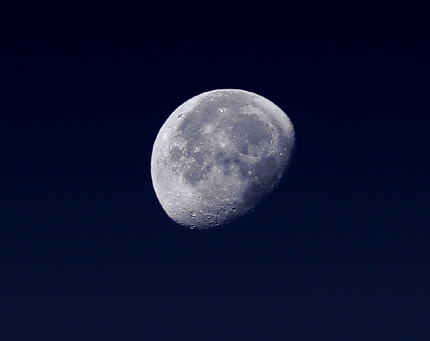
Daylight Moon

I stepped out this morning before the sun came up (seriously, what was I thinking?) and there was the moon. I took a few shots, just handheld with my 70-200mm zoom lens, and cropped the best one.

Morning Moon

Time for the Taurids

The Taurids Meteor Shower is nearly here, and although it is a fairly weak shower, the meteors that you see are likely to be good ones. With two streams of meteoroids to pass through, we should see a peak on the night of November 4th and then again on the night of the 11th. Since they are faily broad streams that we are passsing through, you may see the shower as a very long but weak one lasting most of this week.

The Taurids are rather slow moving but large meteors, so they tend to look slow and bright in the sky. This shower produces a fairly high proportion of fireballs. You never know when you might see a meteor that will be the talk of the next meeting, so get out and observe the Taurids!

Orionid Meteors are Coming!

Later this week will see the peak of the Orionid meteor shower. Although you can see a meteor any night, meteor showers are caused when the Earth passes through the debris left behind after a comet passes. In the case of the Orionids, the source comet is Comet Halley. In a way, this is your chance to see Halley’s Comet!

This year a fairly weak showing is anticipated because we are expected to pass though a particularly thin part of the debris trail left by the comet, but take heart! Not only is there a fairly small moon for this year’s shower, meaning a fairly dark sky, but the Orionids are known for producing bright meteors, so the few that we get could be good ones! (and let’s face it; meteor showers are somewhat unpredictable, so even though we expect a weak show this year, that is not a guarantee. Anything could happen!)

Although the shower doesn’t hit its peak until Saturday night (October 20th) the Orionid shower is rather spread out, so you could see meteors any time this week or next. Enjoy!