
Tuesday 17th of March 2015 | Bob Christmas
Fantastic auroral display tonight. These images were taken northwest of Hamilton, near Westover. The aurora was visible naked eye, but I couldn’t see colour.
Fantastic auroral display tonight. These images were taken northwest of Hamilton, near Westover. The aurora was visible naked eye, but I couldn’t see colour.
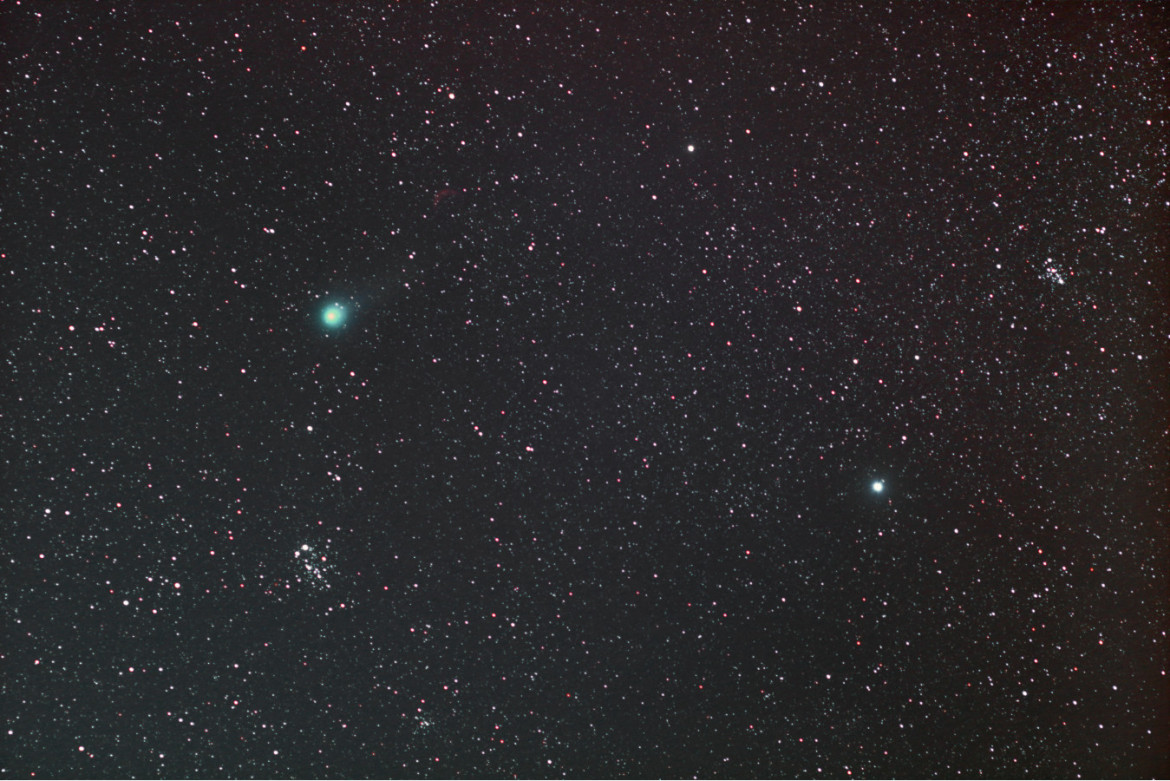
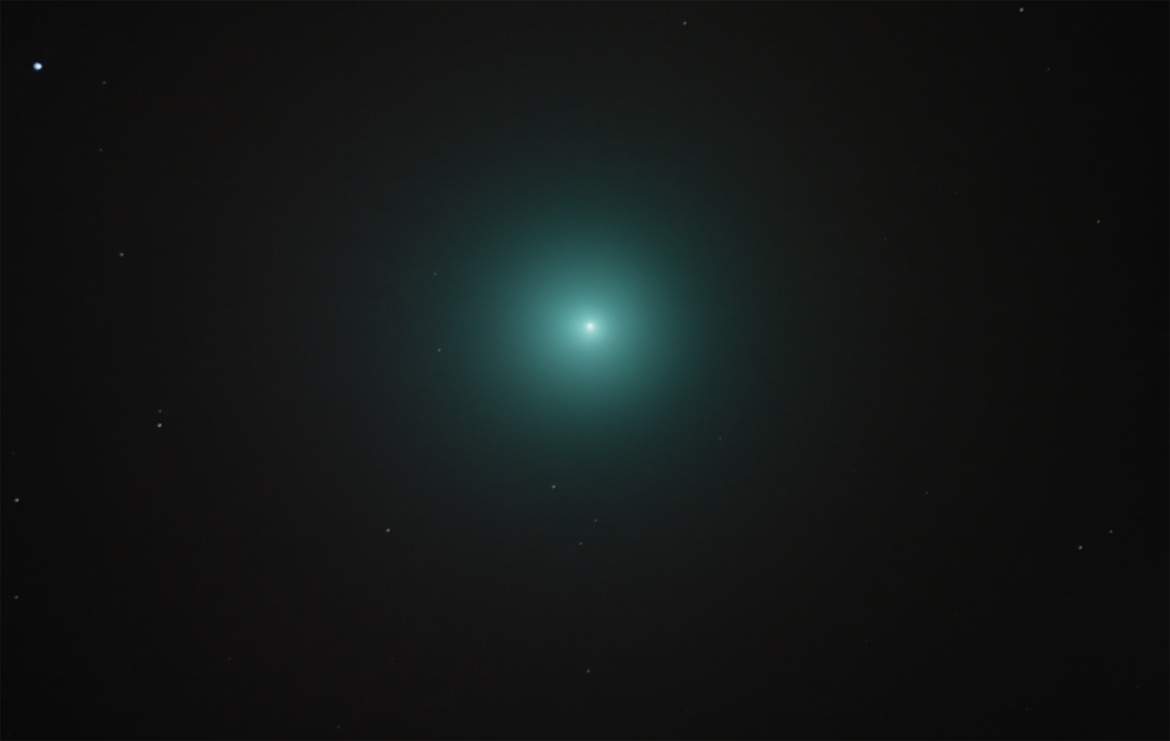
Comet C/2014 Q2 (Lovejoy) passed within about a degree of open cluster NGC 457, the E.T. Cluster, the week of March 9, 2015. This image is from Monday March 9, 2015, approx. 9:00 pm to 9:55 pm from Caledonia ON.
M103, another open cluster, is visible at far right. The bright star Delta Cassiopeiae is near lower right. The red emission nebula, Sh2-188, is faintly visible near the comet. North is towards the lower right.
This is a stack of 33 1-minute exposures at ISO 1600 and f/2.8.
I used my Canon 40D DSLR with an Astronomik CLS light pollution clip-filter and my Tamron 300mm f/2.8 telephoto lens on my SP EQ mount.
This was a lot of hard work processing this image; about a dozen iterations of layering and masking….. not including the gradient blending I had to do to flatten the field from side to side a bit better.
New Horizons; Space Exploration Today
There was a time when young men and women stood on a shore and looked out to the horizon, imaging what new lives a ship might transport them to. They imagined new sights, new wonders and in their minds they imagined new worlds.
This summer, after travelling a decade through the dark and quiet of space, a small craft that bears a name that recalls these brave people, will truly see a new world. The New Horizons spacecraft will give us our first look at Pluto as just one of the many amazing sights that are in store for us in this golden age of space exploration.
This richly illustrated talk is suitable for all ages and takes us from Earth to Mars, the asteroids, Pluto and beyond as we look through the mechanical eyes of these far flung probes and are witness to these new sights, new wonders and new worlds.
Continue Reading
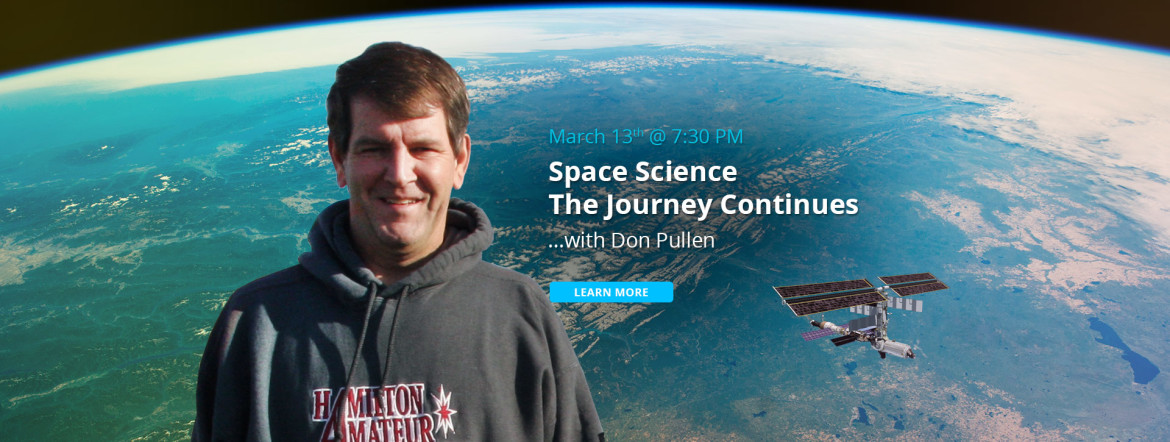
Please note that John Gauvreau’s talk originally scheduled for March 13th has been postponed until April 10th. Don Pullen will instead be talking about unmanned space missions.
Space Science – The Journey Continues
Manned space missions have been confined to low-Earth orbit (LEO) for more than 40 years, a big disappointment to many. However, our exploration of space beyond LEO continues to grow with many exciting robotic missions. From the Great Observatories (Hubble, Compton, Chandra, Spitzer) to contributions by Europe, India and other countries, we continue to find new ways to explore the unknown and find answers to some of the most important questions to mankind. In this talk, Don will review a few of the amazing current and upcoming missions and explore some of the science that has been revealed (and several of the questions that remain).
Continue Reading
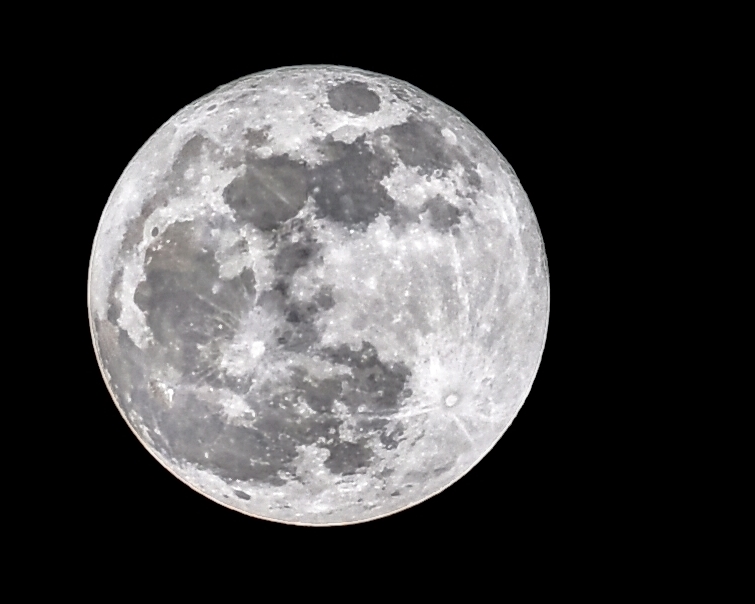
Last night’s full moon was the smallest full moon of the year. We’ve heard it called the micro-moon ormini-moon. This March 5, 2015 full moon lies about 50,000 kilometers (30,000 miles) farther away from Earth than will the year’s closest full moon – the full supermoon and Northern Hemisphere’s Harvest Moon – on September 28. The March 5 moon is the year’s farthest full moon because full moon and lunar apogee – the moon’s farthest point in its monthly orbit – both fall on the same date.
Continue Reading
The March issue of the Hamilton Amateur Astronomers Event Horizon newsletter is now available.
In this issue you’ll find…
Download your copy from the newsletters section.
Photo credit: Triple-play Conjunction by Lise Bennett
A 22° halo is a halo, one type of optical phenomenon, forming a circle with a radius of approximately 22° around the Sun, or occasionally the Moon (also called a moon ring or winter halo). It forms as sunlight is refracted in millions of randomly oriented hexagonal ice crystals suspended in the atmosphere. The halo is large; the radius is roughly the size of an outstretched hand at arms length. As light passes through the 60° apex angle of the hexagonal ice prisms it is deflected twice resulting in deviation angles ranging from 22° to 50°. The angle of minimum deviation is almost 22° (or more specifically 21.84° on average; 21.54° for red light and 22.37° for blue light). This wavelength-dependent variation in refraction causes the inner edge of the circle to be reddish while the outer edge is bluish. As no light is refracted at angles smaller than 22° the sky is darker inside the halo. A 22° halo may be visible on as many as 100 days per year—much more frequently than rainbows.
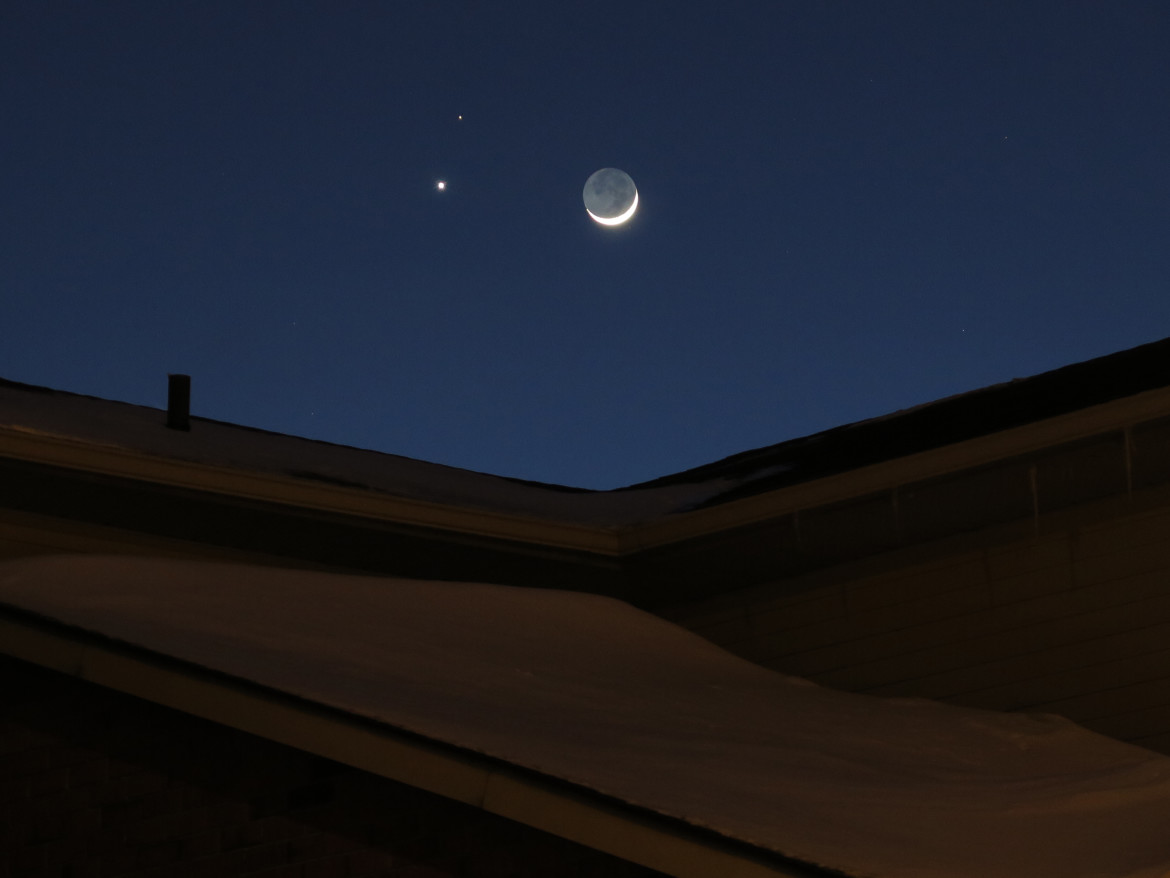
My entire neighbourhood is surrounded by 80+ foot trees, so Tonight’s Spectacular Triple-play Conjunction is partially hidden by trees, however, I love the effect that I was able to achieve!
The Moon, Venus and Mars formed a beautiful grouping in the western sky above Hamilton tonight. It was well worth the risk of frostbite to view. I snapped this photo with a point & shoot camera from our driveway.
I turned to face north just before 7:00 pm to catch a very bright pass overhead by the International Space Station. I snapped a photo of the ISS (it’s the streak in the image below) as it passed Jupiter in the ESE.
The latest issue of our club’s Event Horizon newsletter is now available.
In this issue you’ll find…
Download your copy from the newsletters section.
Photo credit: C/2014 Q2 (Lovejoy) by David T.